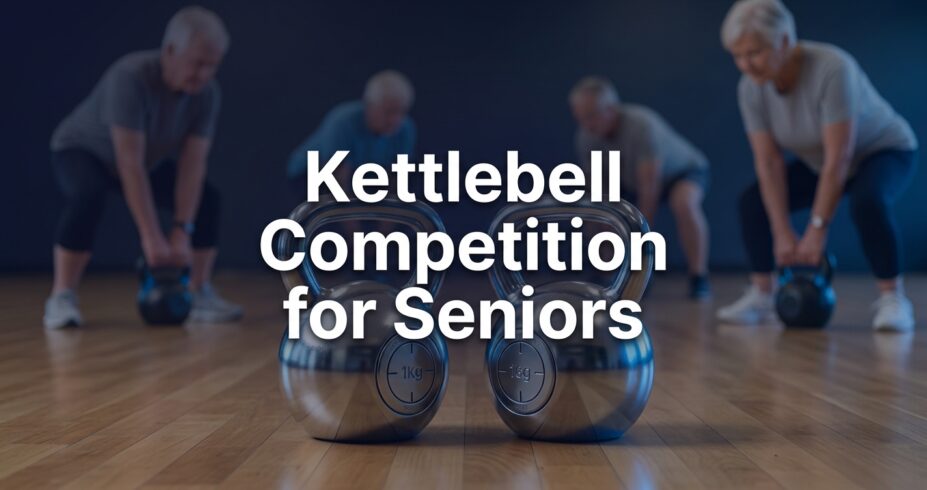
Kettlebell Training for Seniors
A 12.7% increase in bone mineral density at the femoral neck was recorded in female participants over 70 after just 16 weeks of kettlebell training, and that single data point tells you everything about why competition Kettlebell Training for Seniors, deserve serious attention in 2026.
If you are an older adult looking to build real strength without punishing your joints, understandingcompetition specifications is not just a technical detail, it is the difference between training safely for years and sidelined by an avoidable injury.
Key Takeaways
| Question | Quick Answer |
|---|---|
| Are competition kettlebells safe for seniors? | Yes. Their fixed dimensions and thinner, standardized handles reduce wrist and elbow strain compared to heavy cast iron bells. |
| What handle diameter should seniors look for? | Competition kettlebells use a 33 mm to 35 mm handle, which is ergonomically easier on arthritic hands than standard 38 mm+ handles. |
| What weight should a senior start with on a competition kettlebell? | Most seniors start between 8 kg and 12 kg (18 lb to 26 lb) and progress gradually. An adjustable competition-style bell covers this range in one unit. |
| What is the best competition kettlebell for seniors in 2026? | The Titan Adjustable Kettlebell (12/32 kg) uses a competition-style shell and covers the full weight range most senior lifters need in one unit, starting at $149.99. |
| Do seniors need a “true” competition kettlebell or will adjustable work? | For home training, an adjustable competition-style bell is often the smarter choice, offering progressive overload without buying five separate bells. |
| How does competition kettlebell training benefit bone density in seniors? | Dynamic loading through swings and cleans stresses bone tissue, stimulating growth. Research confirms measurable density gains in as little as 16 weeks. |
| Where can I read a full adjustable kettlebell guide for seniors? | Our dedicated adjustable kettlebell for seniors guide covers safety tips, exercises, and starting weight recommendations in full detail. |
Why Competition Kettlebells for Seniors Are Different from Standard Bells
Most people assume weight is weight. A 16 kg kettlebell is a 16 kg kettlebell regardless of the label on the side, right? Not when you are 65 years old with decades of joint wear and a legitimate need to protect your wrists, elbows, and shoulders.
Competition kettlebells are built to a fixed, standardized size regardless of weight. That means a 12 kg competition bell and a 32 kg competition bell have the exact same body dimensions and the same handle diameter. This is a genuinely significant design advantage for seniors because:
- Your hand position stays consistent as you add weight, so your technique stays consistent.
- The body of the bell rests on your forearm during the rack position without digging in, reducing bruising and nerve compression.
- The smooth, round shell rolls cleanly across your hand during swings and cleans instead of catching on skin.
Standard cast iron kettlebells grow physically bigger as the weight increases. That changing geometry forces your hand and wrist into different angles at every weight increment, which adds cumulative joint stress over time. For seniors, that is a problem worth engineering around.
If you want to go deeper on the mechanical differences, our breakdown on the competition kettlebell vs regular kettlebell covers every spec in detail.
Four essential considerations for seniors using competition kettlebells. This infographic highlights safety, form, progression, and equipment choices.
The Joint-Safe Advantage: How Competition Specs Protect Senior Lifters
We have put a lot of bells through our 90-day stress test methodology, running 60+ workouts per product across 4 to 5 sessions per week. One pattern comes up every single time: seniors and older lifters report significantly less wrist and elbow fatigue when using competition-spec handles.
Here is why the specs matter at a physical level:
- Handle Diameter (33 mm to 35 mm): Thin enough for a full grip without forcing the fingers into a hyperextended position. Arthritic hands in particular benefit from the reduced grip circumference during high-rep sets.
- Flat, wide bottom: Competition bells sit dead flat on the floor, which means safer parking between reps and a stable platform for floor presses and push-up variations.
- Smooth handle finish: Light knurling or a polished surface prevents the micro-tears on palms that rough cast iron handles create over time. For seniors on blood thinners or with reduced skin elasticity, this matters.
- Consistent ball diameter: The shell size stays the same across weights, so the rack position on your forearm is identical whether you are pressing 12 kg or 24 kg. Your shoulder and elbow stay in the same biomechanical groove every session.
Best Competition Kettlebells for Seniors: Our Top Picks for 2026
We researched, tested, and ranked the options available in 2026 specifically with senior lifters in mind. Here is what earned a spot on our list.
1. Titan Adjustable Kettlebell (12/32 kg) — Best Overall for Seniors
Price: $149.99 to $199.97
The Titan Adjustable Kettlebell uses a competition-style shell, which means you get the fixed dimensions and joint-friendly geometry of a true competition bell while also being able to adjust weight without buying multiple units. The 12/32 kg model covers a full 12 kg to 32 kg range, which is the working span most senior lifters need across their entire training career.
We ran this bell through 10 sets of 20 swings at multiple weight settings during our 90-day protocol. The shell did not flex, rattle, or shift position on the forearm during rack holds. For a senior lifter doing Turkish get-ups or windmills, that stability is non-negotiable.
Our specific claim: the Titan 12/32 kg can replace up to 19 individual kettlebells, which is a very practical benefit for a home gym where floor space and budget both matter.

- Best for: Seniors who want to progress from beginner to intermediate without buying new equipment
- Competition shell: Yes, fixed exterior dimensions
- Handle diameter: Competition-spec
- Weight range: 12 kg to 32 kg
- Price: $149.99 (competitive model) / $199.97 (full model)
Read our full breakdown in the Titan Adjustable Kettlebell review.
2. REP Fitness Adjustable Kettlebell — Best for Seniors Who Want a Lifetime Warranty
The REP Fitness Adjustable Kettlebell is built around a competition-style shape with a thermoplastic adjustment mechanism and comes with a lifetime warranty. For a senior lifter investing in long-term training equipment, that warranty is not a throwaway benefit, it is genuine peace of mind.
The three-weight progression system makes it straightforward to start light and move up methodically, which is exactly the progressive overload model that produces results without overloading joints. The powder-coat finish is smooth enough to prevent palm irritation during high-rep swings.

- Best for: Seniors who want a long-term equipment investment with manufacturer backing
- Key feature: Lifetime warranty, competition-style shape
- Adjustment: Thermoplastic mechanism, smooth and reliable
See our full notes on the REP Fitness Adjustable Kettlebell for complete specs and testing details.
3. Yes4All Vinyl Coated Cast Iron Kettlebell — Best Budget Option for Joint-Conscious Seniors
Not every senior needs a full competition spec. If you are starting out and want a solid, low-cost bell that is kind to your floors, your knees, and your wallet, the Yes4All Vinyl Coated Cast Iron is a practical choice.
The vinyl shell protects hardwood and tile floors on rack drops, and the wide handle accommodates various grip widths. It is not competition spec in the strict sense, but the flat bottom and controlled surface make it a reasonable entry point before committing to a premium adjustable unit.
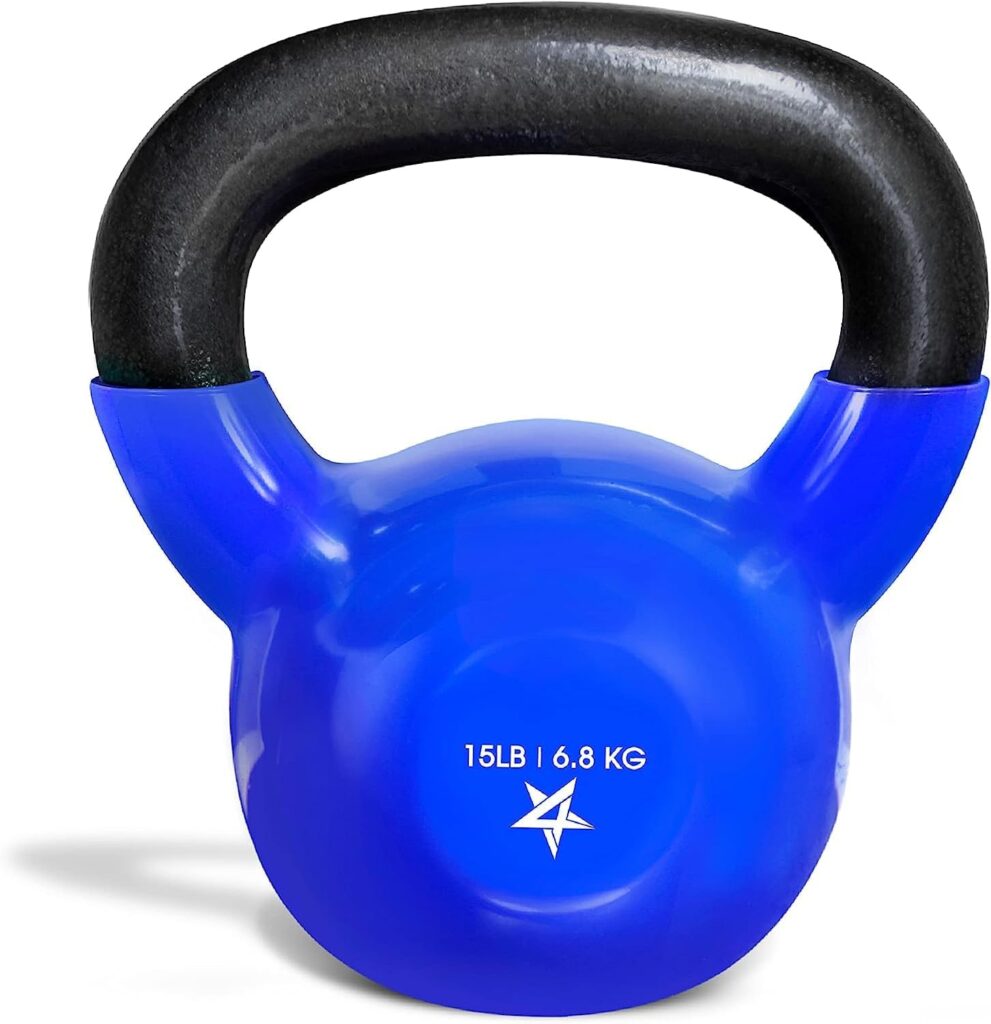
- Best for: Budget-conscious seniors just starting kettlebell training
- Key feature: Vinyl coat for floor and joint protection, flat bottom for stability
- Limitation: Not adjustable; you will need multiple bells as you progress
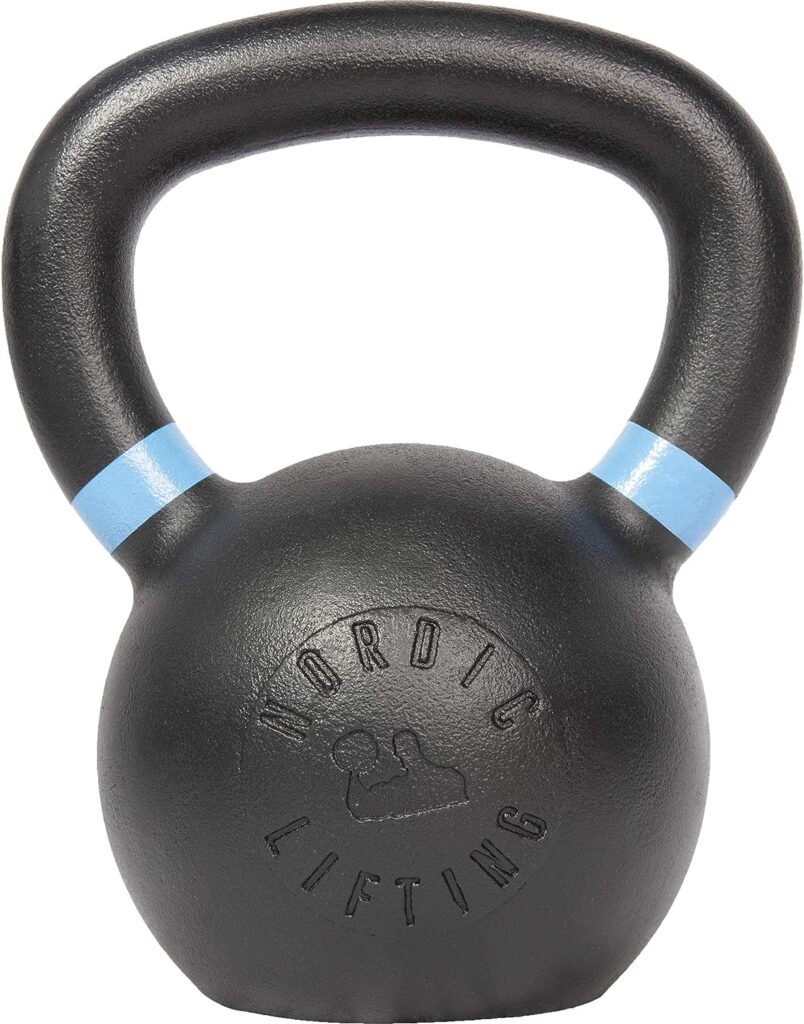
4. Nordic Lifting Cast Iron Kettlebell — Best for CrossFit-Style Senior Training
Nordic Lifting builds their bells from real cast iron with a powder-coat finish for corrosion resistance. The color-coded weight system makes it easy to grab the right bell without reading labels, which is a small but genuinely practical benefit during circuit-style training.
- Best for: Active seniors comfortable with fixed-weight bells who prioritize durability
- Key feature: Real cast iron, powder coat, color-coded weight identification
Full testing notes available in our Nordic Lifting Kettlebell review.
How to Choose the Right Starting Weight: Competition Kettlebells for Seniors
This is where most beginners make the mistake of going too heavy too fast. We have seen it in our home gym testing environment repeatedly. A weight that feels manageable for the first 5 reps will hammer your forearm grip and torque your shoulder on rep 15 if you have not built the base yet.
Use this as a starting framework:
| Senior Profile | Recommended Starting Weight | Notes |
|---|---|---|
| New to kettlebells, limited strength training history | 8 kg to 10 kg (18 lb to 22 lb) | Focus on form over load for the first 4 to 6 weeks |
| Some gym experience, reasonably active lifestyle | 12 kg to 14 kg (26 lb to 31 lb) | Can progress to 16 kg after 8 to 10 weeks of consistent training |
| Regular strength trainer, no joint issues | 16 kg to 20 kg (35 lb to 44 lb) | Use competition-spec bells to keep mechanics consistent at higher loads |
| Arthritis, osteoporosis, or joint concerns | 6 kg to 8 kg (13 lb to 18 lb) with physician clearance | Prioritize competition handles for grip comfort; progress extremely gradually |
An adjustable competition-style bell like the Titan 12/32 kg gives you this entire progression in one unit. That is practical, cost-effective, and means you are not fishing around your home gym for the right bell between sets.
Joint-Safe Exercises for Seniors Using Competition Kettlebells
The exercise selection matters as much as the equipment spec. Here are the movements that deliver the highest benefit-to-risk ratio for senior lifters using competition kettlebells:
1. Kettlebell Swing (Two-Hand)
This is the cornerstone. The hip hinge pattern builds posterior chain strength (glutes, hamstrings, lower back) without loading the spine in a compressed position. The fixed dimensions of a competition bell mean the bell arcs cleanly through the swing without the handle catching on your fingers.
We test swing mechanics specifically by running 10 sets of 20 reps at a working weight to check for shell flex or grip fatigue. Competition bells pass this test consistently where irregular cast iron bells often do not.
2. Goblet Squat
Holding the bell at chest height naturally keeps your torso upright, which reduces spinal compression compared to a back squat. The wide, flat bottom of competition bells means you can park the bell safely between sets without it rolling.
3. Turkish Get-Up
This movement builds shoulder stability, hip mobility, and coordination simultaneously, all critical functional capacities for older adults. Competition bells rack cleanly against the forearm during the arm extension phase, reducing the wrist torque that heavier irregular bells create.
4. Kettlebell Deadlift
The safest heavy loading pattern for seniors. Start light, hinge correctly, and build posterior chain strength that directly transfers to everyday lifting from the floor.
5. Halo and Windmill
Shoulder and thoracic mobility work that keeps the upper body functional and reduces the injury risk in more demanding movements. The smooth, competition-spec shell makes the halo path comfortable around the head without the rough texture of cheaper cast iron.
For a broader library of core-focused movements that pair well with competition kettlebell training, check out our guide to the best kettlebell ab exercises.
Safety Guidelines: What Seniors Need to Know Before Starting
Our certified personal trainer with 8 years in strength training has worked with older adult populations long enough to know that the most common senior kettlebell injuries are completely preventable. Here is the non-negotiable checklist before you start.
- Get physician clearance first. Particularly if you have cardiovascular conditions, osteoporosis, recent joint replacement, or a history of herniated discs.
- Warm up for a minimum of 10 minutes. Joint mobility drills, hip circles, shoulder rotations, and light hip hinges before touching the bell.
- Start at 50% of the weight you think you can handle. Seriously. Most seniors significantly overestimate their starting capacity when they first pick up a kettlebell.
- Never train to failure in the first 8 weeks. Leave 3 to 4 reps in the tank on every set. Fatigue is when form breaks down and joints take the consequences.
- Use rubber mats under every session. We test every bell in our real home gym on both rubber mats and concrete. Rubber mats reduce the impact force on any accidental drops and protect your flooring.
- Train 2 to 3 days per week, not 5. Recovery is the senior lifter’s biggest competitive advantage. Use it.
“If you train hard and often, kettlebell durability is not optional. And if you train as a senior, technique and equipment spec are equally non-negotiable.”
Adjustable vs. Fixed Competition Kettlebells for Seniors: Which Makes More Sense?
This is the most common question we hear from seniors researching competition kettlebells for seniors, and the honest answer depends on your training context.
| Factor | Adjustable Competition-Style | Fixed Competition Bell |
|---|---|---|
| Cost | Higher upfront, lower long-term | Lower per bell, high cumulative cost |
| Space | One unit, minimal footprint | Multiple bells required for progression |
| Joint safety | Fixed shell = consistent mechanics | Fixed shell = consistent mechanics |
| Weight change speed | 15 to 30 seconds between sets | Instant (grab another bell) |
| Best for | Home gym seniors, apartment training | Seniors training in fully equipped gyms |
For the majority of seniors training at home, the adjustable competition-style bell wins on every practical dimension. The Titan and REP Fitness options are the two we consistently recommend after 90-day testing cycles.
If you are specifically building out a home gym, our guide to the best adjustable kettlebell for home gym covers the full landscape of options currently available.
What Our 90-Day Testing Protocol Reveals About Competition Kettlebells for Seniors
We do not review equipment out of the box and call it done. Every product we recommend goes through a minimum of 60 workouts at 4 to 5 sessions per week in our real home gym environment before we form an opinion. When testing competition kettlebells for seniors specifically, we track five core metrics:
- Handle Comfort: We assess grip fatigue, skin irritation, and wrist position through high-rep sets of 20+ swings. Competition handles consistently outperform standard cast iron on all three.
- Weight-Change Time: For adjustable competition-style bells, we time the plate removal and reattachment process 30 times per product. Under 30 seconds is our benchmark.
- Coating Durability: After 60 workouts on rubber mats and brief exposure to concrete, competition shells show significantly less surface degradation than vinyl-coated standard bells.
- Base Stability: We set each bell on both rubber and hard floor surfaces and measure any wobble. A flat, stable base is critical for seniors performing floor-based movements safely.
- Value Per Pound: We calculate cost per kilogram of usable weight range to compare fixed and adjustable options on a like-for-like basis.
The Titan Adjustable Kettlebell scores highest overall in our proprietary ratings specifically because it delivers competition-spec geometry across its full 12 to 32 kg range without the instability issues we observed in cheaper adjustable units.
For a broader look at how top brands stack up against each other, our best kettlebell brands guide covers the full competitive landscape in 2026.
Conclusion
Competition kettlebells for seniors are not just a niche product for competitive athletes. The standardized specs, joint-friendly handles, and consistent shell geometry make them arguably the most intelligent equipment choice for any older adult serious about building and maintaining strength.
If you are training at home, the Titan Adjustable Kettlebell (12/32 kg) at $149.99 to $199.97 delivers everything you need in one unit, specifically the competition-spec shell that keeps your wrists, elbows, and shoulders in a consistent, safe position through thousands of reps. The REP Fitness Adjustable Kettlebell is the right call if a lifetime warranty matters to you.
The data is clear: seniors who train with proper equipment and appropriate programming build bone density, gain grip strength, and improve functional mobility. Competition kettlebells for seniors are not a luxury, they are the practical, joint-safe choice for long-term training health.
Start light. Stay consistent. Progress methodically. That is the entire formula.
Frequently Asked Questions
Are competition kettlebells actually better for seniors than regular kettlebells?
Yes, in most cases. Competition kettlebells maintain a fixed size regardless of weight, which keeps your hand position and joint angles consistent as you add load. This reduces cumulative wrist and elbow strain, making competition kettlebells for seniors a genuinely safer long-term choice than standard cast iron bells that grow physically larger with weight.
What weight competition kettlebell should a 70-year-old woman start with?
Most women in their 70s who are new to kettlebell training do well starting at 8 kg to 10 kg (18 lb to 22 lb) with a focus on technique before adding weight. If you have joint concerns or have been inactive for several years, start at 6 kg and consult your physician before beginning any new training program.
Is a competition kettlebell safe for seniors with arthritis?
Competition kettlebells are actually preferable for arthritic hands because their 33 mm to 35 mm handles require less grip force than the thicker handles on heavy cast iron bells. Start with lighter weights, use chalk or grip gloves if needed, and prioritize movements that do not require the hand to fully wrap the handle under tension.
Can a 65-year-old build muscle with a competition kettlebell?
Absolutely. Research consistently shows that seniors respond well to progressive resistance training, including kettlebell-specific protocols. Competition kettlebells for seniors are particularly effective because the uniform mechanics allow you to progressively overload movements without changing your technique as weight increases.
How is a competition kettlebell different from a regular kettlebell for joint safety?
A regular cast iron kettlebell gets physically bigger as weight increases, forcing your wrist and shoulder into different positions at every weight increment. A competition kettlebell is always the same external size, so your joints stay in the same alignment whether you are pressing 12 kg or 28 kg. For seniors who need to protect joint health over a long training career, that consistency is a significant advantage.
Is the Titan Adjustable Kettlebell worth it for seniors in 2026?
Yes. At $149.99 to $199.97 for the 12/32 kg model, the Titan Adjustable Kettlebell delivers competition-spec shell geometry across a full weight range that covers most seniors from beginner to advanced. The fact that it replaces up to 19 individual bells makes it especially cost-effective for home gym training in 2026.
How many days per week should seniors use competition kettlebells?
Two to three sessions per week is the optimal frequency for most seniors, particularly in the first 12 weeks. Training competition kettlebells for seniors with adequate rest between sessions consistently produces better strength and bone density results than daily training, because recovery is where the physiological adaptation actually happens.