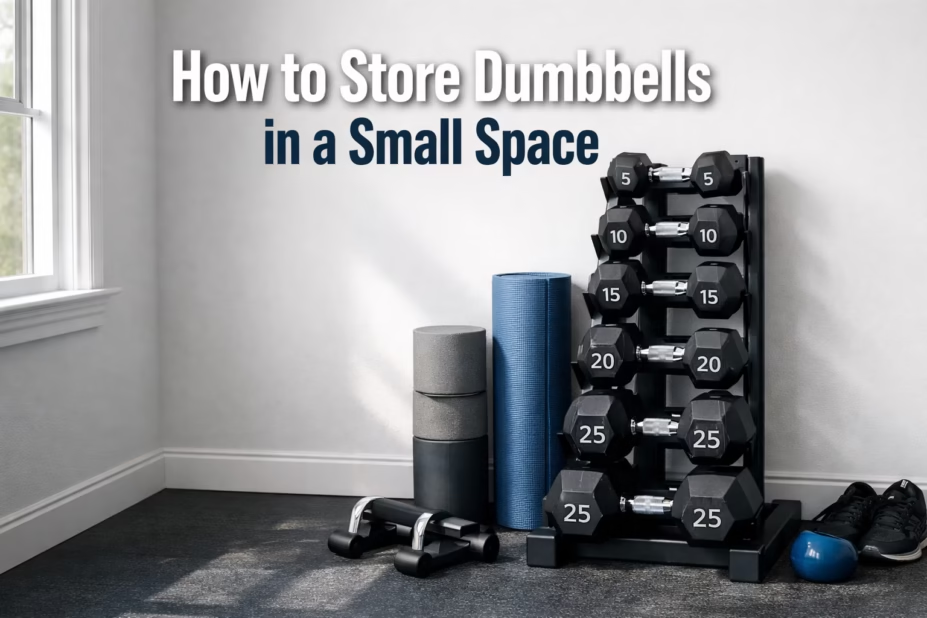
How to Store Dumbbells in a Small Space
Last updated: March 8, 2026
When I moved into my 600-square-foot apartment in 2024, I faced a common dilemma: How to Store Dumbbells in a Small Space without turning my living room into an obstacle course.
My collection of weights was taking over my bedroom floor, and I knew something had to change.
After testing various storage solutions and nearly tripping over a 25-pound dumbbell in the dark, I discovered that smart storage isn’t just about organization, it’s about reclaiming your living space while maintaining an effective workout routine.
Key Takeaways
- Vertical storage solutions occupy less than 2 square feet of floor space compared to 15+ square feet for horizontal racks
- Wall-mounted systems completely free up floor space and can support up to 1,000 pounds when properly installed
- A-frame racks hold up to five pairs of dumbbells while taking up less than one square foot
- Adjustable dumbbells eliminate the need for multiple pairs, reducing storage requirements by up to 80%
- Multi-purpose furniture and repurposed shelving offer budget-friendly alternatives under $50
- Proper weight distribution on storage units prevents tipping and extends equipment lifespan
- Climate considerations matter for equipment longevity, especially in garage or basement setups
Quick Answer
How to store dumbbells in a small space requires maximizing vertical space through wall-mounted racks, vertical towers, or compact A-frame stands that minimize floor footprint.
The most efficient approach combines vertical storage (using less than 2 square feet) with adjustable dumbbells that replace multiple fixed-weight pairs, reducing your storage needs by 80% while maintaining workout versatility.
What Are the Best Storage Solutions for Small Space Home Gyms?
The best storage solutions for small spaces prioritize vertical organization and multi-functional designs that minimize floor footprint. Wall-mounted systems, vertical towers, and compact A-frame racks consistently outperform traditional horizontal storage in space efficiency.
Top storage options include:
- Wall-mounted shelving systems – Free up floor space entirely, supporting 1,000+ pounds when properly anchored to wall studs
- Vertical dumbbell towers – Occupy less than 2 square feet while holding complete 5-50 pound sets
- A-frame compact racks – Hold five pairs in under one square foot of floor space, typically under $40
- Adjustable dumbbell systems – Replace 10-15 pairs with a single set, like Bowflex SelectTech 552 or PowerBlock adjustable sets
- Industrial shelving units – Support up to 2,500 pounds across multiple shelves for mixed equipment
Choose wall-mounted storage if you have concrete or wood-stud walls and want to maximize floor space for movement. Opt for vertical towers if you rent and can’t drill into walls. Select A-frame racks when budget is a primary concern and you have five or fewer dumbbell pairs.
How Do Vertical Storage Racks Save Space Compared to Horizontal Options?
Vertical storage racks save space by stacking dumbbells upward rather than spreading them horizontally across your floor.
A typical horizontal rack requires 15-20 square feet of floor space, while vertical alternatives need less than 2 square feet for the same weight capacity.
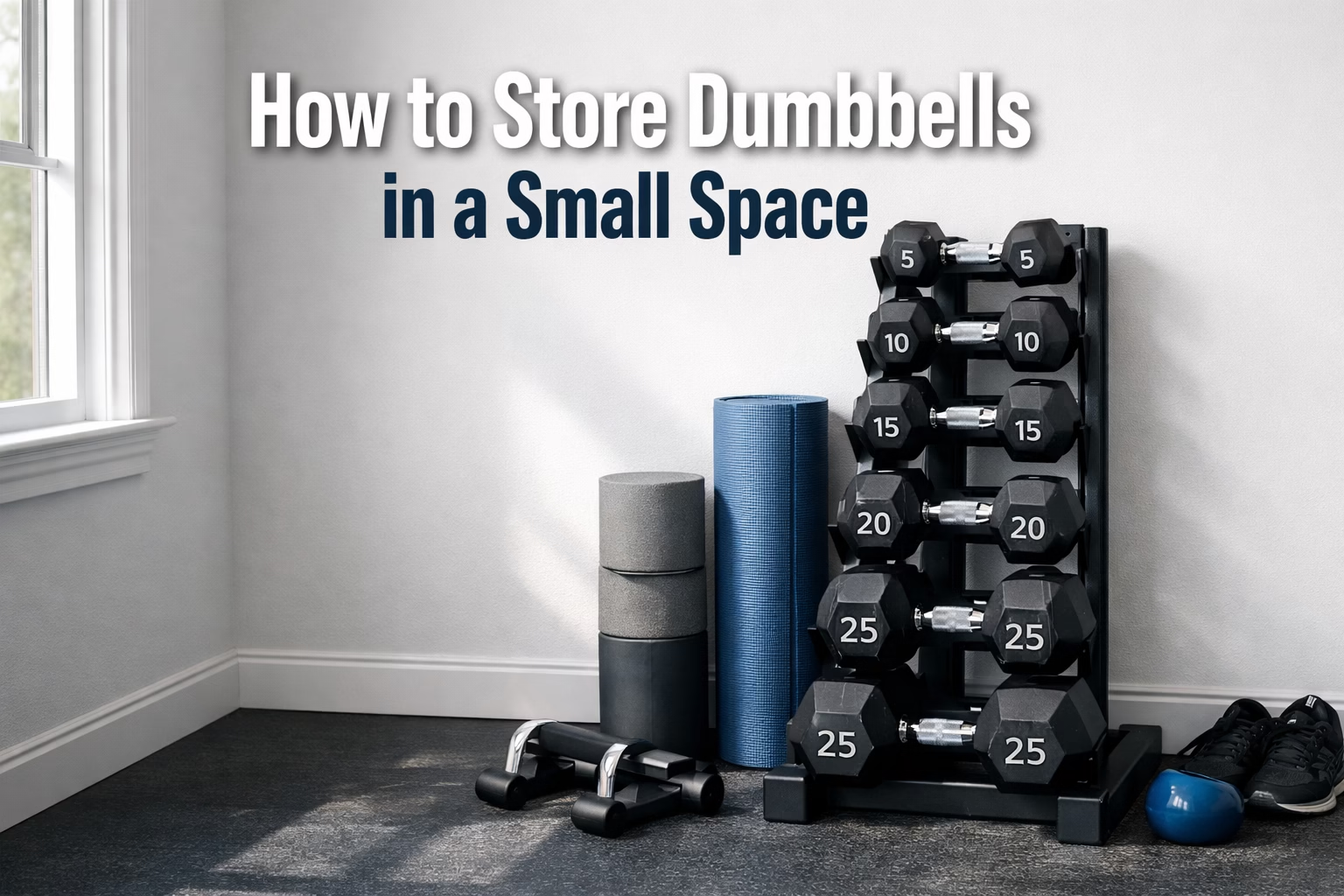
The Delta 10-Tier Vertical Dumbbell Rack, for example, holds a full 5-50 pound set in a footprint measuring approximately 18 inches by 12 inches.
This vertical approach creates more room for actual workout space, critical when you’re working with limited square footage.
Vertical storage advantages:
- Floor space reduction – 85-90% less floor footprint than horizontal racks
- Easier weight selection – Weights displayed at eye level for quick identification
- Corner placement – Fits into unused corners without blocking pathways
- Scalability – Add tiers as your collection grows
- Professional appearance – Creates organized, gym-quality aesthetic
Common mistake: Placing vertical racks on unstable surfaces. Always position them on level, solid flooring and load heavier weights on lower tiers to prevent tipping.
Are Wall-Mounted Dumbbell Storage Systems Worth the Investment?
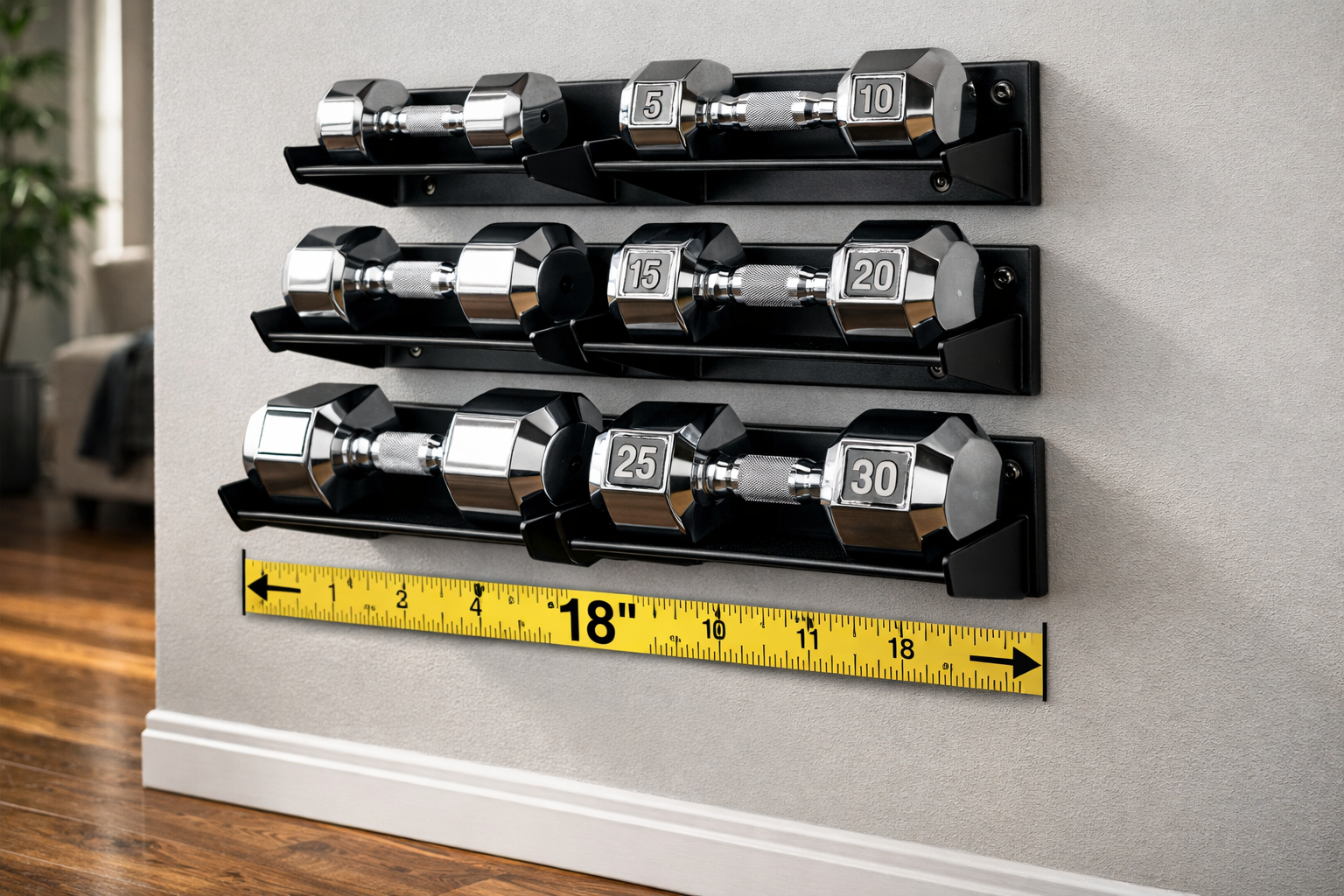
Wall-mounted storage systems are worth the investment for permanent living spaces where you can securely anchor into wall studs.
They completely eliminate floor footprint, freeing up space for cardio equipment, stretching areas, or simply more room to move during workouts.
The PRx Profile Dumbbell Storage system can hold a full 5-60 pound dumbbell set across four shelves while supporting up to 1,000 pounds when properly mounted to studs.
I installed a similar system in my garage gym in 2025, and it transformed my workout flow, I could finally fit my rowing machine without constantly rearranging equipment.
Installation considerations:
- Wall type matters – Concrete, brick, or wood studs required; drywall alone won’t support weight
- Stud spacing – Standard 16-inch spacing works for most systems; verify with stud finder
- Shelf angle – Angled shelves (15-20 degrees) prevent dumbbells from rolling
- Height placement – Install between 24-48 inches from floor for optimal access
- Professional installation – Consider hiring help for systems holding 500+ pounds
Choose wall-mounted storage if you own your home or have landlord permission to drill. Skip this option if you’re in a short-term rental or have plaster walls that can’t support heavy loads.
What Makes A-Frame Racks Ideal for Apartment Gyms?
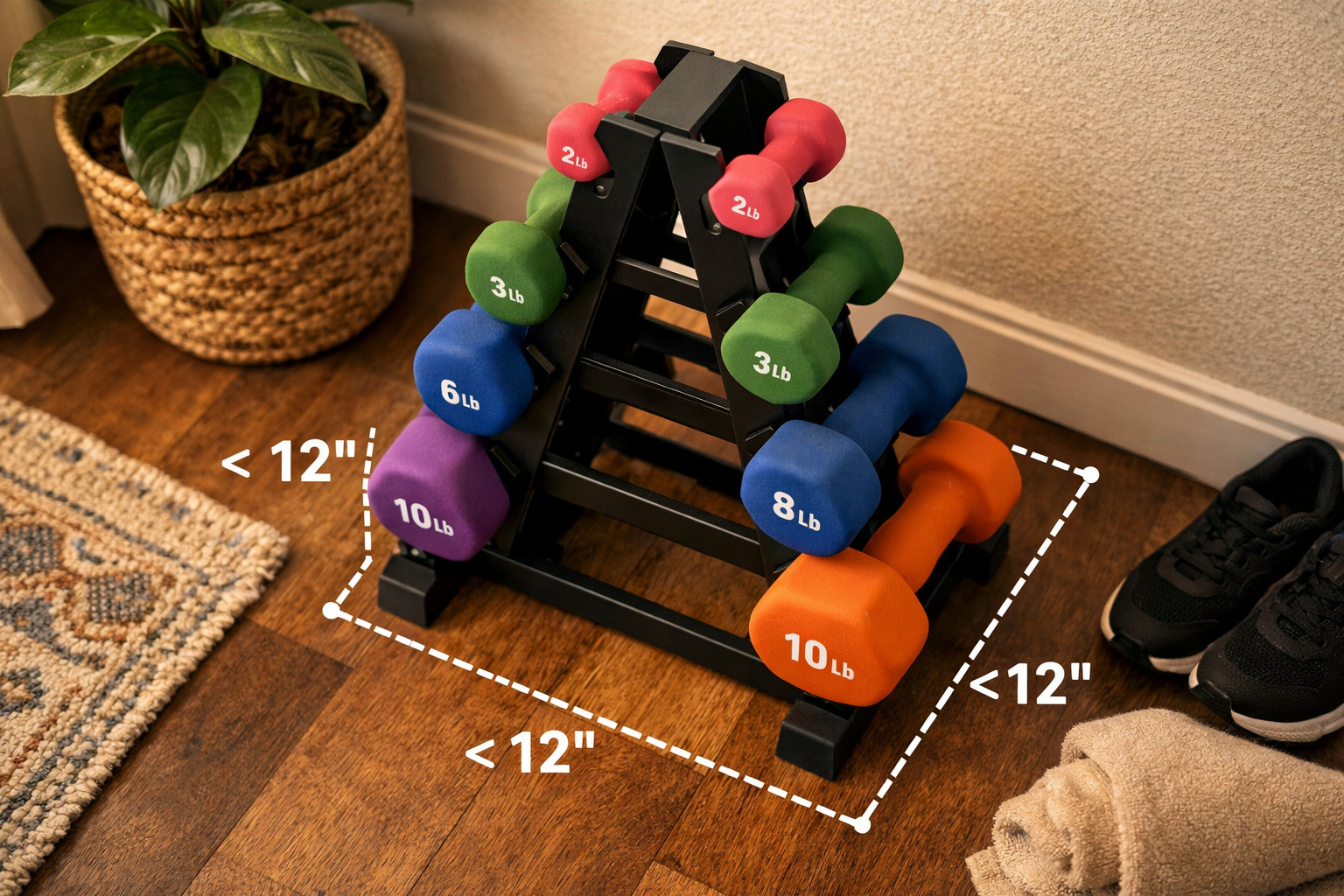
A-frame racks are ideal for apartment gyms because they deliver maximum storage density in minimal floor space while remaining completely portable and requiring no wall installation.
The CAP A-Frame Dumbbell Rack holds five pairs of dumbbells in a triangular footprint measuring less than 12 inches per side.
For renters who can’t drill into walls or frequently relocate, A-frame racks offer the perfect balance of functionality and flexibility.
They’re also budget-friendly, typically costing under $40, making them accessible for fitness beginners building their first home gym.
A-frame advantages for small spaces:
- Ultra-compact footprint – Less than one square foot of floor space
- No installation required – Place anywhere and move as needed
- Rental-friendly – Zero wall damage or permanent modifications
- Low cost – Entry-level models under $40
- Stable design – Wide base prevents tipping when loaded correctly
Limitation to consider: Most A-frame racks accommodate only 5-6 pairs of dumbbells. If you need storage for larger collections, combine multiple A-frames or upgrade to vertical towers.
How Can Adjustable Dumbbells Reduce Storage Requirements?
Adjustable dumbbells reduce storage requirements by replacing 10-15 pairs of fixed-weight dumbbells with a single compact set that changes weight through dial or pin mechanisms.
A Bowflex SelectTech 552 set replaces fifteen pairs of traditional dumbbells (5-52.5 pounds) while occupying just 16 inches of shelf space.
This space reduction is transformative for small apartments. Instead of dedicating an entire wall to a dumbbell rack, you can store your complete weight collection on a small stand or even under your bed.
I switched to PowerBlock adjustable dumbbells in my apartment, and the difference was immediate, I reclaimed an entire corner of my bedroom.
Space-saving benefits:
- 80-90% storage reduction compared to fixed-weight sets
- Dedicated stands available – Bowflex SelectTech stands and PowerBlock stands occupy less than 2 square feet
- Under-bed storage – Many sets fit in standard 8-inch clearance
- Closet-friendly – Store in bedroom closets between workouts
- Travel-ready – Some compact models fit in luggage
Decision rule: Choose adjustable dumbbells if you need weights ranging from 5-50+ pounds and have less than 4 square feet available for storage.
Stick with fixed weights if you prefer the traditional feel or need to drop weights during exercises (adjustable sets shouldn’t be dropped).
Learn more about whether adjustable dumbbells are worth the investment for your specific workout needs.
What DIY Storage Solutions Work Best for Budget-Conscious Fitness Enthusiasts?
DIY storage solutions work best when repurposing existing furniture or building simple wooden racks from hardware store materials.
Old bookshelves, industrial shelving units, and even sturdy side tables can be converted into functional dumbbell storage for under $50.
I repurposed a $30 IKEA bookshelf into dumbbell storage by reinforcing the shelves with additional brackets and arranging weights by size.
The total cost was under $45, and it held my complete collection while doubling as storage for resistance bands and workout accessories.
Budget-friendly DIY options:
- Repurposed bookshelves – Reinforce shelves with L-brackets, arrange weights on lower shelves for stability
- Cinder block and wood plank racks – Stack cinder blocks vertically, insert wooden planks for shelving (under $30)
- PVC pipe organizers – Create custom-sized holders for specific dumbbell dimensions (under $25)
- Wooden crate storage – Stack vintage crates horizontally for rustic aesthetic (under $40)
- Husky Industrial Shelving – Four-shelf units support 2,500 pounds for around $200
Construction tips: Always place heavier weights on lower shelves to prevent tipping. For wooden DIY racks, use 2×4 or 2×6 lumber rated for the total weight load. Sand all edges to prevent dumbbell coating damage.
Common mistake: Underestimating total weight. A complete 5-50 pound dumbbell set weighs 550+ pounds. Verify your shelving can handle the cumulative load, not just individual dumbbell weight.
How Should You Organize Dumbbells by Weight for Maximum Efficiency?
Organize dumbbells by ascending weight from lightest to heaviest, positioned at heights that match your most frequent exercises.
Place your most-used weights (typically 10-25 pounds for general fitness) at waist to shoulder height for easiest access during workouts.
This organization strategy reduces workout interruptions and prevents the frustration of searching through your collection mid-set.
I arrange mine with 5-15 pound weights on upper shelves for warm-ups, 20-35 pounds at waist height for main lifts, and 40+ pounds on lower shelves for heavy compound movements.
Optimal organization strategies:
- Ascending order – Lightest weights on top or left, heaviest on bottom or right
- Frequency-based placement – Most-used weights at easiest-to-reach heights
- Color coding – Use colored tape or labels for quick weight identification
- Pairs together – Always store matching weights side-by-side
- Angled shelves – 15-20 degree angle prevents rolling and improves visibility
Height recommendations:
- Upper shelves (48-60 inches): Light weights (5-15 lbs) for warm-ups and high-rep exercises
- Middle shelves (30-48 inches): Medium weights (20-35 lbs) for most exercises
- Lower shelves (12-30 inches): Heavy weights (40+ lbs) for compound lifts
Edge case: If you use specific weights for dedicated exercises (like 15-pound dumbbells exclusively for shoulder work), consider organizing by exercise type rather than strict weight progression.
What Space-Saving Features Should You Look for in Dumbbell Racks?
Space-saving features to prioritize include vertical orientation, tiered shelving, compact footprint dimensions, and multi-equipment compatibility.
The best small-space racks hold maximum weight in minimum square footage while accommodating future collection growth.
Essential space-saving features:
- Vertical design – 10+ tiers stacked upward rather than spread horizontally
- Compact base – Footprint under 2 square feet for freestanding models
- Tiered shelving – Multiple levels maximize vertical space utilization
- Angled cradles – Prevent rolling while reducing depth requirements
- Modular expansion – Add sections as collection grows
- Multi-equipment slots – Accommodate dumbbells, kettlebells, and weight plates
Measurement specifications to verify:
- Height: 48-72 inches for vertical towers
- Width: 12-24 inches for most vertical designs
- Depth: 10-18 inches from wall
- Weight capacity: 500-1,000+ pounds total load
- Individual cradle width: 6-8 inches per dumbbell pair
Decision rule: Choose vertical towers if you have 6+ pairs of dumbbells and at least 6 feet of vertical clearance.
Select A-frame racks if you have 5 or fewer pairs and limited vertical space. Opt for wall-mounted systems if you need to preserve all floor space for movement.
How Do Mobile Storage Carts Improve Small Space Flexibility?
Mobile storage carts improve flexibility by allowing you to reposition your entire dumbbell collection quickly, transforming any room into a temporary workout space.
These wheeled units let you store weights in a closet or corner, then roll them out for workouts and tuck them away afterward.
I use a three-tier rolling cart in my studio apartment, storing it in my bedroom closet between workouts and wheeling it into the living room for exercise sessions.
This approach keeps my living space clutter-free while maintaining easy access to my complete weight collection.
Mobile cart advantages:
- Room transformation – Convert any space into temporary gym
- Closet storage – Hide equipment when not in use
- Multi-room flexibility – Move between bedroom, living room, garage
- Dual-purpose design – Store towels, resistance bands, water bottles on additional shelves
- Locking wheels – Secure in place during workouts
Specifications for effective mobile carts:
- Weight capacity: 300-500 pounds minimum
- Wheel size: 3-4 inches for smooth rolling over thresholds
- Shelf depth: 12-18 inches to prevent dumbbells from sliding off
- Locking mechanism: All four wheels should lock independently
- Frame material: Steel construction for durability
Limitation: Mobile carts work best for collections under 50 pounds per dumbbell. Heavier weights require more robust stationary storage for safety.
What Maintenance Practices Extend the Life of Storage Equipment?
Regular maintenance practices that extend storage equipment life include weight distribution monitoring, periodic tightening of bolts and brackets, rust prevention treatments, and proper load balancing. Well-maintained storage systems can last 10+ years even with daily use.
Essential maintenance tasks:
Monthly checks:
- Inspect wall-mounted brackets for loosening
- Verify weight distribution remains balanced
- Wipe down metal surfaces to prevent rust
- Check for cracks in welds or joints
Quarterly maintenance:
- Tighten all bolts and fasteners
- Apply rust-preventive spray to metal components (especially in humid environments)
- Inspect wheels on mobile carts for wear
- Verify floor contact points remain level
Annual deep maintenance:
- Remove all weights and inspect structural integrity
- Replace worn rubber cradles or protective padding
- Re-anchor wall-mounted systems if any movement detected
- Apply fresh protective coating to exposed metal
Climate considerations: In garage or basement gyms with humidity, apply rust-preventive treatments every 2-3 months. In climate-controlled apartments, annual treatment suffices.
Common mistake: Overloading individual shelves beyond rated capacity. Distribute weight evenly across all available tiers, placing heaviest dumbbells on lower levels.
Conclusion
Learning How to Store Dumbbells in a Small Space doesn’t require sacrificing your fitness goals or living in constant clutter.
The key is choosing storage solutions that maximize vertical space, minimize floor footprint, and align with your specific living situation and budget.
Whether you invest in a wall-mounted system that frees up all floor space, opt for a compact A-frame rack under $40, or switch to adjustable dumbbells that reduce storage needs by 80%, the right approach transforms your cramped workout area into an organized, functional fitness space.
Your next steps:
- Measure your available space – Determine exact floor and wall dimensions for storage
- Inventory your current collection – Count dumbbell pairs and total weight capacity needed
- Evaluate your living situation – Determine if wall mounting is possible or if portable solutions are required
- Set your budget – Allocate $40-200 depending on storage type and quality
- Choose your storage solution – Select from vertical towers, wall mounts, A-frames, or adjustable systems
- Implement organization strategy – Arrange weights by frequency of use and ascending weight
- Establish maintenance routine – Schedule monthly checks and seasonal deep maintenance
Start by implementing just one storage solution this week.
Even a simple $35 A-frame rack can transform your workout experience and reclaim valuable living space.
Your organized home gym is just one smart storage decision away.
FAQ
What is the most space-efficient way to store dumbbells?
Wall-mounted storage systems are the most space-efficient option, eliminating floor footprint entirely while supporting up to 1,000 pounds. Vertical towers are the best freestanding alternative, occupying less than 2 square feet while holding complete dumbbell sets.
How much space do I need for a vertical dumbbell rack?
Most vertical dumbbell racks require 12-24 inches of width, 10-18 inches of depth, and 48-72 inches of height. The total floor footprint typically measures less than 2 square feet for racks holding 10-12 pairs of dumbbells.
Can I store dumbbells under my bed?
Yes, adjustable dumbbells like Bowflex SelectTech or PowerBlock sets fit under most beds with 8+ inches of clearance. Fixed-weight dumbbells can be stored in low-profile rolling storage bins designed for under-bed use.
Are adjustable dumbbells better than fixed weights for small spaces?
Adjustable dumbbells are significantly better for small spaces, replacing 10-15 pairs of fixed weights with a single compact set. They reduce storage requirements by 80-90% while providing the same weight range. Learn more about whether adjustable dumbbells are worth it.
How do I prevent my dumbbell rack from tipping over?
Prevent tipping by placing heavier weights on lower tiers, ensuring the rack sits on level flooring, and anchoring tall vertical racks to walls when possible. Never exceed the manufacturer’s weight capacity for individual shelves.
What’s the best budget storage solution for dumbbells?
A-frame racks offer the best budget solution at under $40, holding five pairs of dumbbells in less than one square foot. Repurposed bookshelves with reinforced brackets provide another option under $50 for larger collections.
How should I organize dumbbells by weight?
Organize dumbbells in ascending order from lightest to heaviest, with most-used weights at waist to shoulder height. Place light weights (5-15 lbs) on upper shelves, medium weights (20-35 lbs) at mid-height, and heavy weights (40+ lbs) on lower shelves.
Can I build my own dumbbell storage rack?
Yes, DIY dumbbell racks can be built using 2×4 lumber, cinder blocks with wooden planks, or PVC pipe for under $50. Ensure your design supports the cumulative weight of your entire collection and place heavier weights on lower levels.
What type of shelving works best for mixed gym equipment?
Industrial shelving units with 24-inch deep shelves work best for mixed equipment, supporting up to 2,500 pounds across four shelves. Flat shelves accommodate kettlebells and weight plates, while angled shelves work better for dumbbells.
Do wall-mounted dumbbell racks damage walls?
Wall-mounted racks require drilling into wall studs, creating permanent holes. When properly installed into studs (not just drywall), they’re secure and safe. Renters should verify landlord permission before installation or choose freestanding alternatives.
How much weight can a typical dumbbell rack hold?
A-frame racks typically hold 200-300 pounds, vertical towers support 500-800 pounds, wall-mounted systems handle 1,000+ pounds, and industrial shelving units support 2,000-2,500 pounds. Always verify manufacturer specifications before loading.
What’s the difference between angled and flat dumbbell shelves?
Angled shelves (15-20 degrees) prevent dumbbells from rolling and improve visibility, making weight selection easier. Flat shelves work better for kettlebells, weight plates, and other equipment that sits flat. Many racks offer both options.