Russian vs American Kettlebell Swing
Last updated: March 2, 2026
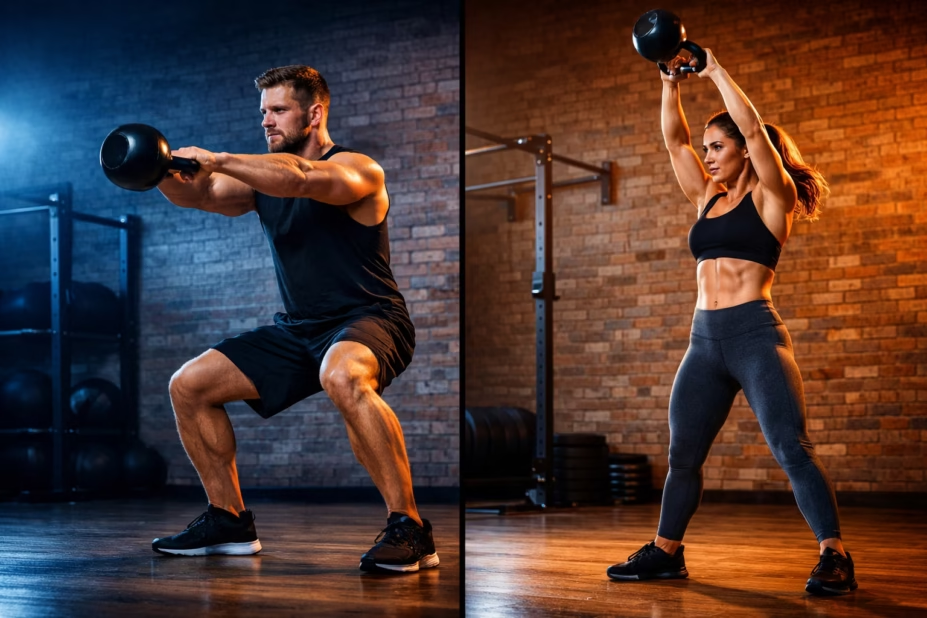
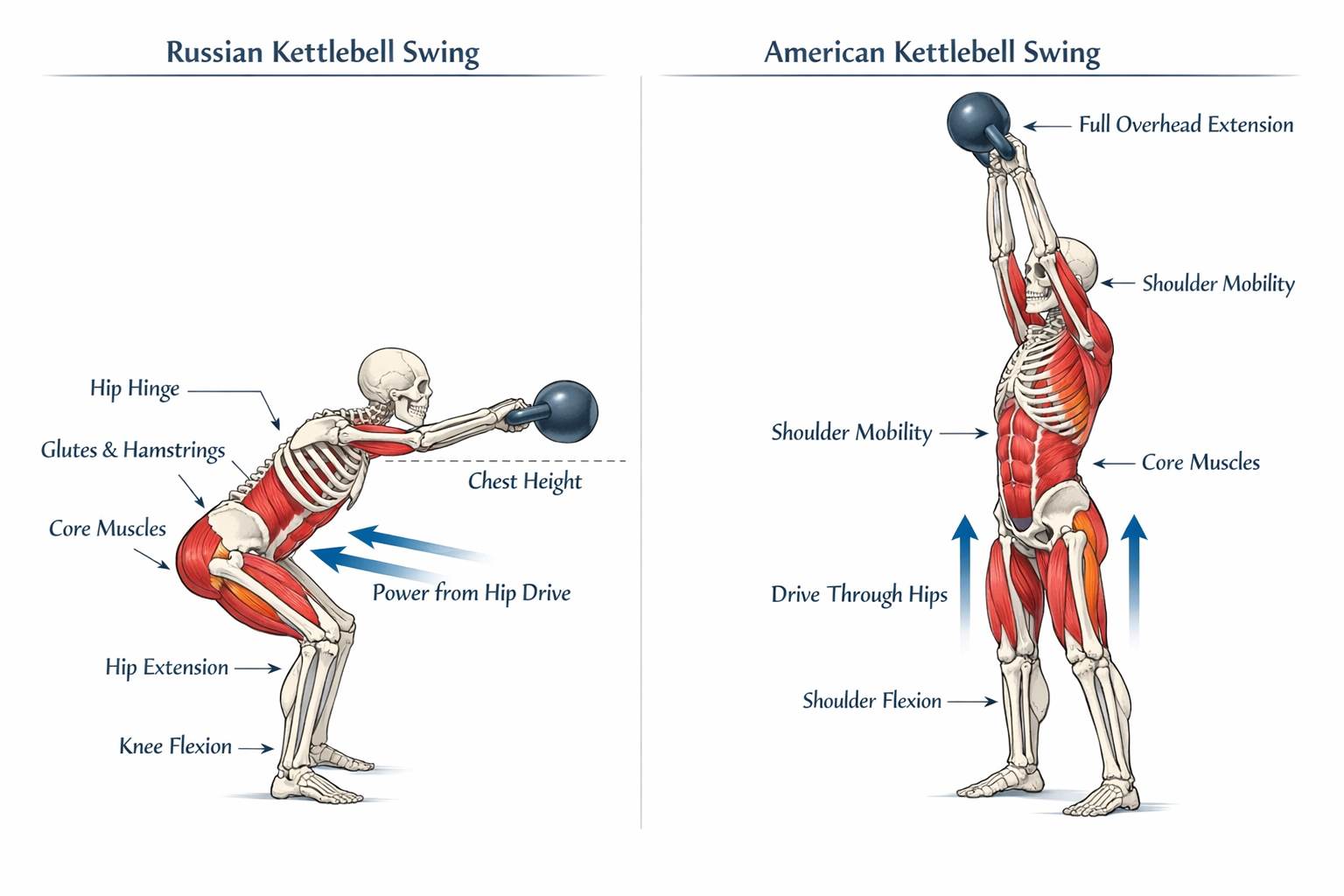
The Russian vs American kettlebell Swing debate centers on one key difference: the Russian swing stops at chest height while the American swing continues overhead.
Both variations build explosive power through hip drive, but they target different muscle groups and require distinct mobility levels, making your choice dependent on your training goals and physical capabilities.
Key Takeaways
- Russian swings stop at chest height and emphasize hip power generation with lower injury risk
- American swings require full overhead extension and demand greater shoulder mobility
- Both variations activate glutes, hamstrings, and core through the same hip hinge pattern
- Russian swings are better for pure power development and beginners learning proper form
- American swings increase shoulder engagement and range of motion but carry higher injury potential
- Proper hip drive, not arm strength, powers both swing variations
- Athletes and strength-focused individuals typically benefit more from Russian swings
- CrossFit and overhead sport athletes may prefer American swings for sport-specific training
- Mobility limitations in shoulders or thoracic spine make Russian swings the safer choice
- Programming should match swing variation to specific training goals and individual assessment
Quick Answer
The Russian kettlebell swing stops at chest or eye level and focuses on explosive hip power, making it ideal for building posterior chain strength with minimal shoulder stress.
The American kettlebell swing extends fully overhead, requiring greater shoulder mobility and adding upper body engagement but increasing injury risk.
Choose Russian swings for power development and general fitness; choose American swings only if you have excellent shoulder mobility and sport-specific overhead requirements.
What Is the Difference Between Russian and American Kettlebell Swings?
The fundamental difference between Russian and American kettlebell swings lies in the endpoint of the movement. Russian swings finish when the kettlebell reaches chest or eye level, creating a horizontal line with your arms parallel to the ground.
American swings continue the arc until the kettlebell reaches full overhead extension with arms locked out above your head.
Both variations start identically with a powerful hip hinge and explosive hip extension. The hip drive generates the force that propels the kettlebell upward in both cases.
However, the American swing requires an additional pulling motion with the shoulders and arms to guide the kettlebell overhead, fundamentally changing the exercise mechanics.
Key mechanical differences:
- Range of motion: Russian swings use approximately 90-120 degrees of movement; American swings require 180 degrees
- Shoulder involvement: Russian swings keep shoulders in a stable, packed position; American swings demand active shoulder flexion and overhead stability
- Power source: Russian swings rely almost entirely on hip drive; American swings blend hip power with shoulder and arm engagement
- Spinal position: Russian swings maintain neutral spine throughout; American swings require thoracic extension to achieve overhead position safely
The Russian swing represents the traditional kettlebell training approach developed in Russia and popularized by Pavel Tsatsouline in the late 1990s. The American swing emerged later, gaining popularity in CrossFit gyms where overhead movements are emphasized.
This historical context matters because the Russian swing was designed specifically for power development, while the American swing adapted the movement for sport-specific training needs.
Choose Russian swings if you’re focused on building explosive hip power, learning proper kettlebell technique, or have any shoulder mobility limitations. Choose American swings only if you have excellent overhead mobility and specific training requirements that justify the increased complexity and risk.
How Do You Perform Each Swing Variation Correctly?
Proper execution of both swing variations starts with mastering the fundamental hip hinge pattern. Stand with feet shoulder-width apart, kettlebell positioned about a foot in front of you. Hinge at your hips by pushing your butt back while keeping your spine neutral, grab the kettlebell handle with both hands, and prepare for the backswing.
Russian Kettlebell Swing Technique
Setup and execution:
- Starting position: Hike the kettlebell back between your legs like a football snap, keeping arms straight and shoulders packed down
- Hip drive: Explosively extend your hips forward by squeezing your glutes and driving your hips through, creating the power that propels the kettlebell
- Float phase: Let the kettlebell float to chest or eye level naturally from hip power alone, arms acting as ropes connecting you to the weight
- Plank position: At the top, your body forms a straight plank from head to heels with glutes contracted, core braced, and shoulders pulled back
- Descent: Allow gravity to pull the kettlebell down, absorbing the weight by hinging at the hips again as it passes below waist level
- Repeat: Immediately drive hips forward again for the next repetition
Common mistakes to avoid: Don’t squat the weight up (this is a hinge, not a squat), don’t use your arms to lift the kettlebell (power comes from hips), and don’t hyperextend your lower back at the top (maintain neutral spine with tight glutes).
American Kettlebell Swing Technique
The American swing follows the same initial pattern but continues past chest height:
- Setup through hip drive: Execute steps 1-2 exactly as the Russian swing with powerful hip extension
- Overhead transition: As the kettlebell reaches chest height, actively pull it overhead using your shoulders while maintaining straight arms
- Overhead lockout: Achieve full overhead extension with arms locked out, biceps by ears, and kettlebell directly over your center of mass
- Shoulder position: Keep shoulders actively engaged and pulled into their sockets, avoiding any shrugging or forward shoulder roll
- Controlled descent: Guide the kettlebell back down through the same path, transitioning back to the hip hinge as it drops below shoulder level
- Continuous flow: Maintain rhythm and timing through the complete range of motion
Critical safety points: Never attempt American swings without first mastering Russian swings and confirming adequate shoulder mobility.
Your thoracic spine must extend enough to allow overhead positioning without compensating through your lower back. If you feel any lower back strain at the overhead position, your mobility isn’t sufficient for this variation.
I learned this progression the hard way when I rushed into American swings during my first CrossFit experience. The shoulder fatigue hit fast, my form broke down, and I felt lower back discomfort for days. After dropping back to Russian swings and building proper mobility over several weeks, the overhead variation became manageable and safe.
For detailed guidance on mastering the fundamental movement pattern, check out our comprehensive kettlebell swing guide.
Which Muscles Do Russian vs American Kettlebell Swings Target?
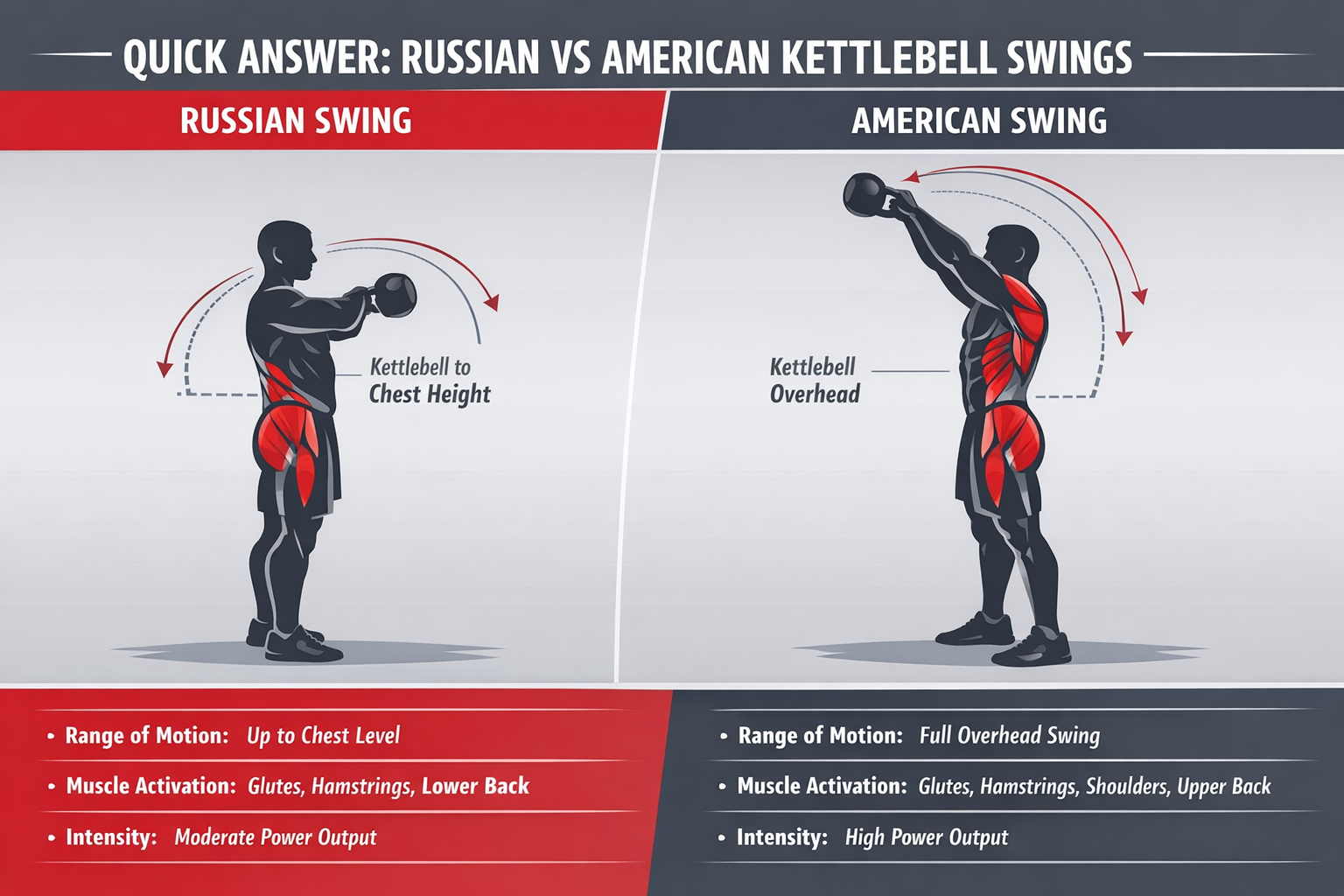
Both swing variations primarily target the posterior chain through the hip hinge movement, but they distribute muscular emphasis differently based on range of motion and overhead requirements.
Primary movers in both variations:
- Glutes: Maximum engagement during hip extension phase, responsible for generating explosive power
- Hamstrings: Work eccentrically during the hinge and concentrically during hip drive
- Core muscles: Stabilize spine throughout the movement, preventing rotation and maintaining neutral position
- Lower back (erectors): Maintain spinal position under load during the hinge pattern
- Lats: Keep shoulders packed and stable, connecting upper body to the movement
These muscles receive similar stimulation in both variations because the hip hinge mechanics remain identical through the power generation phase.
American Swing Additional Activation
The overhead component of American swings recruits additional muscle groups:
- Deltoids (shoulders): Actively engage to pull kettlebell overhead and maintain lockout position
- Trapezius: Stabilizes shoulder blades during overhead phase
- Rotator cuff: Works harder to maintain shoulder stability through extended range
- Triceps: Help maintain arm lockout at overhead position
- Upper back: Increases activation to support thoracic extension
Comparative activation levels: While both variations activate glutes and hamstrings similarly during the hip drive, American swings distribute total work across more muscle groups. This doesn’t necessarily make them better—it makes them different. Russian swings concentrate force production in the posterior chain, potentially creating greater power adaptation in those specific muscles.
Muscle Engagement for Different Goals
Choose Russian swings if your goal is maximum posterior chain development, explosive hip power, or athletic performance requiring sprint speed and jumping ability. The concentrated focus on glutes and hamstrings through hundreds of repetitions creates significant strength and power adaptations in these muscles.
Choose American swings if you need overhead stability for sports like volleyball, swimming, or Olympic lifting, or if your training program emphasizes total-body integration with shoulder endurance. The distributed muscle activation provides more comprehensive conditioning but less concentrated power development.
One consideration often missed: muscle activation doesn’t equal muscle building. Both swings are primarily ballistic power exercises, not hypertrophy movements.
They build explosive strength and conditioning rather than significant muscle size. If you’re looking for muscle growth, combine either swing variation with traditional strength training exercises.
What Are the Benefits of Each Kettlebell Swing Variation?
Each swing variation offers distinct advantages depending on your training context, experience level, and physical capabilities. Understanding these benefits helps you select the right tool for your specific situation.
Russian Kettlebell Swing Benefits
Power development: Russian swings maximize power output per repetition because all force goes into horizontal hip extension rather than being distributed across a longer range of motion. This concentrated power application translates better to athletic movements like sprinting, jumping, and changing direction.
Lower injury risk: Keeping the kettlebell at chest height eliminates overhead shoulder stress and reduces the chance of form breakdown under fatigue. Your shoulders stay in a strong, stable position throughout the movement, and there’s no risk of the kettlebell pulling you into hyperextension or compensatory movement patterns.
Easier to learn: The simpler movement pattern allows beginners to focus on mastering the critical hip hinge without simultaneously managing overhead positioning. I’ve taught hundreds of people kettlebell swings, and the Russian variation consistently produces better form acquisition in less time.
Higher volume potential: Because Russian swings create less total-body fatigue, you can perform more repetitions before form breaks down. This matters for conditioning workouts where you might perform 100+ swings in a session.
Better for heavy weights: When using heavier kettlebells for pure strength development, the Russian swing allows you to handle more load safely because you’re not fighting to control weight overhead.
Cardiovascular efficiency: Russian swings elevate heart rate effectively while maintaining safe form, making them excellent for cardiovascular conditioning and weight loss.
American Kettlebell Swing Benefits
Increased range of motion: The full overhead extension creates greater total-body movement, potentially improving mobility when performed correctly with adequate existing range.
Shoulder endurance: Repeated overhead positioning builds shoulder stamina and stability, beneficial for overhead sports and activities.
Sport-specific training: For CrossFit athletes and others who compete in events requiring overhead movements, American swings provide specific adaptation to overhead work under fatigue.
Total-body integration: The extended range requires coordination across more joints and muscle groups, creating a more comprehensive conditioning effect.
Grip endurance: The longer time under tension and higher position of the kettlebell increases grip demands compared to Russian swings.
Calorie expenditure: The greater range of motion and additional muscle recruitment may slightly increase energy expenditure per repetition, though the difference is modest.
When American swings make sense: If you’re a competitive CrossFit athlete, the American swing appears in workouts and competitions, making practice necessary. If you’re training for overhead sports and already possess excellent shoulder mobility, the variation can complement your specific needs. For general fitness, strength development, or power training, Russian swings typically provide better risk-to-reward ratio.
Common mistake: choosing American swings because they “look harder” or seem more advanced. Difficulty doesn’t equal effectiveness. The Russian swing’s simplicity is its strength, allowing you to focus on what matters—powerful hip extension—without unnecessary complexity.
For more information on the comprehensive benefits of kettlebell swings, explore our guide to 11 kettlebell swing benefits.
Who Should Use Russian vs American Kettlebell Swings?
Your choice between Russian and American swings should match your training goals, physical capabilities, and experience level rather than arbitrary preferences or trends.
Choose Russian Swings If You:
- Are learning kettlebell training: Beginners need to master hip hinge mechanics without the complication of overhead positioning
- Focus on power development: Athletes in sports requiring explosive hip power (sprinting, jumping, combat sports) benefit most from concentrated posterior chain work
- Have shoulder mobility limitations: Any restriction in overhead range of motion makes Russian swings the only safe option
- Train for general fitness: Most people training for health, conditioning, and strength get better results from Russian swings
- Use kettlebells for fat loss: Higher sustainable volume with Russian swings creates better conditioning stimulus for burning calories
- Have a history of shoulder issues: Previous injuries or chronic shoulder problems contraindicate overhead loading under fatigue
- Want to lift heavier weights: Russian swings allow progressively heavier loading for strength development
- Prioritize safety and longevity: The lower-risk movement pattern supports long-term training consistency
Choose American Swings If You:
- Compete in CrossFit: Sport-specific practice requires the variation that appears in competition
- Have excellent shoulder mobility: Confirmed through assessment showing pain-free overhead range with thoracic extension
- Need overhead sport preparation: Volleyball, swimming, tennis, or Olympic lifting may benefit from overhead conditioning
- Have mastered Russian swings: Competency with the fundamental pattern is a prerequisite
- Train under qualified coaching: Proper instruction and form monitoring reduce injury risk
- Perform lower volume: American swings work better in shorter sets with full recovery
- Want variety in advanced programming: Experienced lifters with no mobility limitations can rotate variations
Assessment criteria: Before attempting American swings, you should be able to: hold a PVC pipe or dowel overhead with arms locked and biceps by ears without arching your lower back, perform 50 consecutive Russian swings with perfect form, and pass a shoulder mobility screen showing adequate thoracic extension and shoulder flexion.
Special Population Considerations
Older adults: Russian swings provide the hip power benefits that combat age-related muscle loss and functional decline without unnecessary shoulder stress. American swings add risk without proportional benefit for this population.
Athletes in rotation sports (golf, baseball, tennis): Russian swings build rotational power through hip drive without the overhead component that doesn’t transfer to these movement patterns.
People with desk jobs and forward shoulder posture: Russian swings can be performed safely while working on mobility; American swings would reinforce poor positioning until mobility improves significantly.
Pregnant and postpartum women: Russian swings (with medical clearance) maintain hip strength and conditioning; overhead work typically isn’t recommended during these periods.
I’ve seen too many people attempt American swings because they assume it’s the “advanced” version, only to develop shoulder pain or lower back issues. Advancement in training means choosing the right tool for your goals, not necessarily the most complex variation. Russian swings built the foundation of kettlebell training for good reason—they work exceptionally well for most people’s needs.
What Are Common Mistakes to Avoid in Russian vs American Kettlebell Swings?
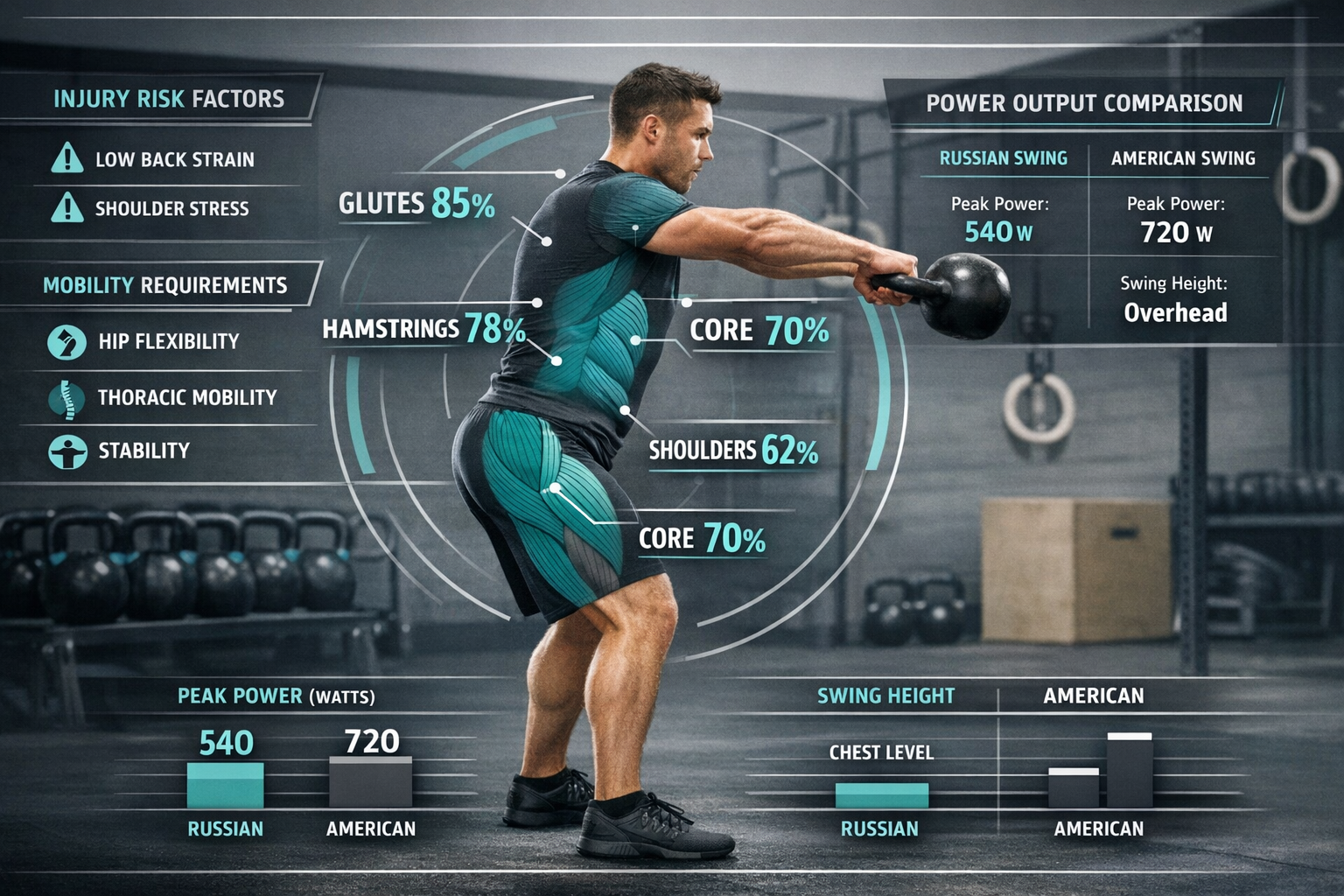
Both swing variations share fundamental errors while each has specific mistakes related to its unique mechanics. Recognizing and correcting these issues prevents injury and maximizes training effectiveness.
Universal Swing Mistakes (Both Variations)
Squatting instead of hinging: The swing is a hip hinge movement, not a squat. Your knees should bend slightly during the backswing, but the primary motion comes from pushing your hips back and driving them forward. Squatting the weight reduces power output and shifts stress to your knees rather than developing hip power.
Lifting with arms: Your arms are ropes connecting you to the kettlebell. All power comes from explosive hip extension, not from pulling with your shoulders or arms. If your shoulders feel fatigued before your glutes and hamstrings, you’re using too much upper body.
Hyperextending the lower back: At the top of the swing, your body should form a straight plank with glutes contracted hard. Leaning back and arching your lower back indicates weak glutes and poor core bracing, creating injury risk.
Looking up or down: Your neck should maintain neutral alignment with your spine. Looking up hyperextends your cervical spine; looking down rounds your upper back. Keep your gaze on the horizon throughout the movement.
Holding breath: Proper breathing involves forceful exhalation during the hip drive (the power phase) and inhalation during the backswing. Holding your breath creates unnecessary blood pressure spikes and reduces power output.
Starting too heavy: Master the movement pattern with a lighter kettlebell before progressing weight. Men typically start with 16-24kg (35-53lbs); women with 8-16kg (18-35lbs), depending on strength levels.
Russian Swing-Specific Mistakes
Pulling the kettlebell to chest height: The kettlebell should float to the finish position from hip power alone. Actively pulling it up with your arms defeats the purpose of the exercise and creates shoulder fatigue.
Inconsistent finish height: Every repetition should reach approximately the same height (chest to eye level). Varying heights indicate inconsistent hip drive and poor movement control.
Letting the kettlebell drop too low: The kettlebell should stay above knee level at the bottom of the backswing. Dropping it to the floor and resetting each rep eliminates the ballistic training effect.
American Swing-Specific Mistakes
Pressing the kettlebell overhead: The kettlebell should still be driven primarily by hip power, with shoulders guiding it overhead rather than pressing it. If you’re actively pressing, you’re performing a different exercise.
Forward shoulder roll: As the kettlebell goes overhead, shoulders often roll forward, creating dangerous positioning. Keep shoulders pulled back and down, maintaining active shoulder stability.
Arching the lower back at lockout: Compensating for insufficient thoracic mobility by hyperextending the lumbar spine is the most common and dangerous American swing error. If you can’t achieve overhead position with a neutral lower back, you lack the mobility for this variation.
Losing control on descent: The kettlebell should follow a controlled path back down, not drop freely. Losing control creates dangerous momentum and increases injury risk.
Attempting when fatigued: Form breakdown happens faster with American swings because of the complexity. Stop sets before fatigue compromises overhead positioning.
Ego lifting: Using weights too heavy for controlled overhead positioning is a recipe for shoulder injury. American swings require lighter loads than Russian swings for safe execution.
Form Check Protocol
Record yourself performing swings from the side angle. Watch for these checkpoints:
- Hip hinge depth and speed during backswing
- Explosive hip snap at the bottom
- Straight arms throughout (no bending elbows)
- Kettlebell path (should be smooth arc, not choppy)
- Finish position (plank for Russian, overhead alignment for American)
- Consistent rhythm and timing
If any checkpoint fails, reduce weight and focus on that specific element. Quality movement always trumps heavy weight or high repetitions.
How Should You Program Russian vs American Kettlebell Swings?
Effective programming matches swing variation to training goals, integrates appropriate volume and intensity, and progresses systematically over time. Both variations serve different roles in a comprehensive training plan.
Russian Swing Programming
For power development:
- Sets: 8-12 sets
- Reps: 10-15 reps per set
- Rest: 45-90 seconds between sets
- Frequency: 2-3 sessions per week
- Focus: Maximum explosiveness on each repetition
For conditioning and fat loss:
- Sets: 3-5 sets
- Reps: 20-50 reps per set
- Rest: 30-60 seconds between sets
- Frequency: 3-4 sessions per week
- Focus: Maintaining form while elevating heart rate
For strength endurance:
- Protocol: EMOM (Every Minute on the Minute) for 10-20 minutes
- Reps: 10-20 swings at the top of each minute
- Rest: Remainder of the minute
- Frequency: 2-3 sessions per week
- Focus: Consistent power output across all sets
Sample weekly structure for general fitness:
- Monday: 10 sets of 15 Russian swings, 60 seconds rest
- Wednesday: 5 sets of 30 Russian swings, 45 seconds rest
- Friday: 15-minute EMOM, 15 swings per minute
American Swing Programming
For CrossFit-specific training:
- Sets: 5-8 sets
- Reps: 10-15 reps per set
- Rest: 60-90 seconds between sets
- Frequency: 1-2 sessions per week
- Focus: Maintaining overhead position under fatigue
For shoulder conditioning:
- Sets: 4-6 sets
- Reps: 8-12 reps per set
- Rest: 90-120 seconds between sets
- Frequency: 1-2 sessions per week
- Focus: Controlled overhead lockout on each rep
Important volume considerations: American swings create more total-body fatigue and shoulder stress than Russian swings. Keep total weekly volume lower and ensure adequate recovery between sessions. If you’re performing other overhead work (pressing, Olympic lifts), reduce American swing frequency accordingly.
Progressive Overload Strategies
For Russian swings:
- Volume progression: Increase total reps per session by 10-20% every 2-3 weeks
- Density progression: Reduce rest periods while maintaining reps and weight
- Load progression: Increase kettlebell weight when you can complete all sets with perfect form
- Variation progression: Add single-arm swings or other variations after mastering two-hand swings
For American swings:
- Technical mastery first: Perfect form for 4-6 weeks before adding volume
- Conservative load increases: Increase weight only when overhead position remains perfect under fatigue
- Volume caps: Keep total reps lower than Russian swing volumes to manage shoulder stress
Integration with Other Training
Russian swings work well as:
- Warm-up for lower body training (2-3 sets of 10-15 reps)
- Finisher after strength work (3-5 sets of 20-30 reps)
- Standalone conditioning sessions
- Active recovery on off days (lighter weight, moderate volume)
American swings work better as:
- Primary exercise in shorter sessions
- Sport-specific practice for CrossFit athletes
- Occasional variation in advanced programs
Sample integration: If you’re running a strength program with squats, deadlifts, and presses, add Russian swings 2-3 times per week as finishers or conditioning work. Reserve American swings for specific overhead conditioning needs or skip them entirely if they don’t serve your goals.
For additional workout ideas and programming approaches, check out our collection of kettlebell exercises for total-body transformation.
FAQ
What is the main difference between Russian and American kettlebell swings?
Russian swings stop at chest or eye level with arms parallel to the ground, while American swings continue to full overhead extension with arms locked out above the head. Both use the same hip hinge and explosive hip drive, but American swings add an overhead component requiring greater shoulder mobility.
Which kettlebell swing is better for beginners?
Russian swings are better for beginners because they’re easier to learn, carry lower injury risk, and allow you to focus on mastering the fundamental hip hinge pattern without managing overhead positioning. Start with Russian swings and only progress to American swings if you have specific overhead training needs and confirmed shoulder mobility.
Do American swings burn more calories than Russian swings?
American swings may burn slightly more calories per repetition due to greater range of motion and additional muscle recruitment, but the difference is minimal. Russian swings often produce better total calorie burn because you can safely perform higher volumes without form breakdown or excessive fatigue.
Can I do kettlebell swings if I have shoulder problems?
Russian swings are generally safe with shoulder issues because they keep shoulders in a stable, packed position without overhead stress. American swings are contraindicated with any shoulder problems, pain, or mobility limitations. Always consult with a healthcare provider before starting any new exercise program with existing injuries.
How heavy should my kettlebell be for swings?
For Russian swings, men typically start with 16-24kg (35-53lbs) and women with 8-16kg (18-35lbs), adjusting based on strength levels. American swings require lighter weights—usually 25-35% less than your Russian swing weight—to maintain safe overhead control. Choose a weight that allows perfect form for all planned repetitions.
Should I do Russian or American swings for CrossFit?
CrossFit athletes should practice American swings because they appear in CrossFit workouts and competitions, making sport-specific preparation necessary. However, Russian swings should still form the foundation of your swing training, with American swings added as supplemental sport-specific work rather than your primary swing variation.
How many kettlebell swings should I do per workout?
For Russian swings focused on power development, perform 100-200 total reps across multiple sets (10-15 reps per set). For conditioning, 150-300 reps in longer sets works well. For American swings, keep total volume lower at 80-150 reps to manage shoulder stress and maintain form quality throughout the session.
What muscles do kettlebell swings work?
Both swing variations primarily target glutes, hamstrings, lower back, and core through the hip hinge pattern. Russian swings concentrate work in these posterior chain muscles. American swings add significant shoulder, upper back, and arm engagement during the overhead phase, distributing work across more muscle groups.
Can kettlebell swings replace deadlifts?
Kettlebell swings complement but don’t fully replace deadlifts. Swings develop explosive hip power and conditioning through ballistic movement, while deadlifts build maximum strength through heavy, controlled lifting. Both exercises use hip hinge patterns but serve different training purposes. An optimal program often includes both movements.
How do I know if I have enough shoulder mobility for American swings?
Test your shoulder mobility by holding a PVC pipe or broomstick overhead with straight arms and biceps by your ears. If you can maintain this position without arching your lower back or feeling shoulder discomfort, you have adequate mobility. If you compensate through lower back extension or can’t achieve the position, stick with Russian swings until mobility improves.
Are kettlebell swings cardio or strength training?
Kettlebell swings are primarily a power and conditioning exercise that bridges strength and cardio training. They build explosive strength in the posterior chain while elevating heart rate for cardiovascular benefits. Russian swings lean slightly more toward power development, while American swings add conditioning emphasis through increased range of motion. Learn more about kettlebell swings for cardio and weight loss.
Can I do kettlebell swings every day?
You can perform Russian swings daily if you manage volume appropriately and monitor recovery, though 3-4 sessions per week typically produces better results for most people. American swings shouldn’t be performed daily due to higher shoulder stress and total-body fatigue—limit them to 1-2 sessions per week with adequate recovery between sessions.
Conclusion
The Russian vs American kettlebell swing debate ultimately comes down to matching the right tool to your specific needs.
Russian swings offer superior power development, lower injury risk, and better sustainability for most training goals, making them the default choice for general fitness, athletic performance, and strength development.
American swings serve specific purposes for CrossFit athletes and those with overhead sport requirements, but only when adequate shoulder mobility and technical mastery exist.
Start with Russian swings regardless of your ultimate goals. Master the hip hinge pattern, build explosive power through hundreds of quality repetitions, and develop the posterior chain strength that transfers to virtually every athletic movement and daily activity.
Only consider American swings if you have confirmed shoulder mobility, sport-specific overhead requirements, and months of Russian swing experience establishing perfect form.
Your next steps:
- Assess your shoulder mobility using the overhead positioning test described above
- Start with Russian swings using appropriate weight for your strength level
- Film yourself from the side to verify proper hip hinge and finish position
- Build to 100-200 quality Russian swings per session over 4-6 weeks
- If American swings serve your specific goals, add them gradually while maintaining higher Russian swing volume
- Track your progress through consistent form, increased power output, and improved conditioning
The best kettlebell swing variation is the one you can perform safely with perfect form while progressing toward your training goals.
For most people, that’s the Russian swing. Don’t let trends or perceived difficulty levels dictate your choice, let your goals, mobility, and training context guide your decision.
Ready to start your kettlebell training journey? Check out our guide to choosing the right kettlebell and explore our comprehensive kettlebell workout programs to maximize your results.
Which Kettlebell Swing Is Right for You?
Answer these questions to find your ideal swing variation