Competition Kettlebell vs Regular
Latest Update: March 8, 2026
I’ll never forget the confusion on my face when I walked into my first kettlebell sport gym. There, lined up like soldiers, were dozens of colorful kettlebells, all exactly the same size despite displaying different weights.
Coming from a background of traditional strength training, where a 32kg kettlebell dwarfed an 8kg one, this seemed to defy physics.
That moment sparked my deep dive into understanding Competition Kettlebell vs Regular options, and it completely transformed my training approach.
Whether you’re a competitive athlete eyeing events like the Luva’ Bells Kettlebell Sport Open scheduled for February 14, 2026, in Las Vegas, or a home fitness enthusiast trying to maximize your investment, understanding the differences between Competition Kettlebell vs Regular is crucial for your success.
Key Takeaways
- Competition kettlebells maintain uniform dimensions across all weights (8-32kg), while regular kettlebells increase in size as weight increases
- Competition bells excel for technical movements like snatches and cleans due to consistent handle diameter and predictable balance
- Regular kettlebells offer better value for beginners and general fitness enthusiasts, with varied sizes building progressive grip strength
- Handle design differs significantly: competition bells feature smooth steel handles ideal for high-rep endurance, while regular bells often have textured, powder-coated grips
- Your training goals determine the best choice: sport-specific training demands competition bells, while varied strength workouts benefit from regular kettlebells
Understanding the Core Differences: Competition Kettlebell vs Regular Design
What Makes Competition Kettlebells Unique? 🏆
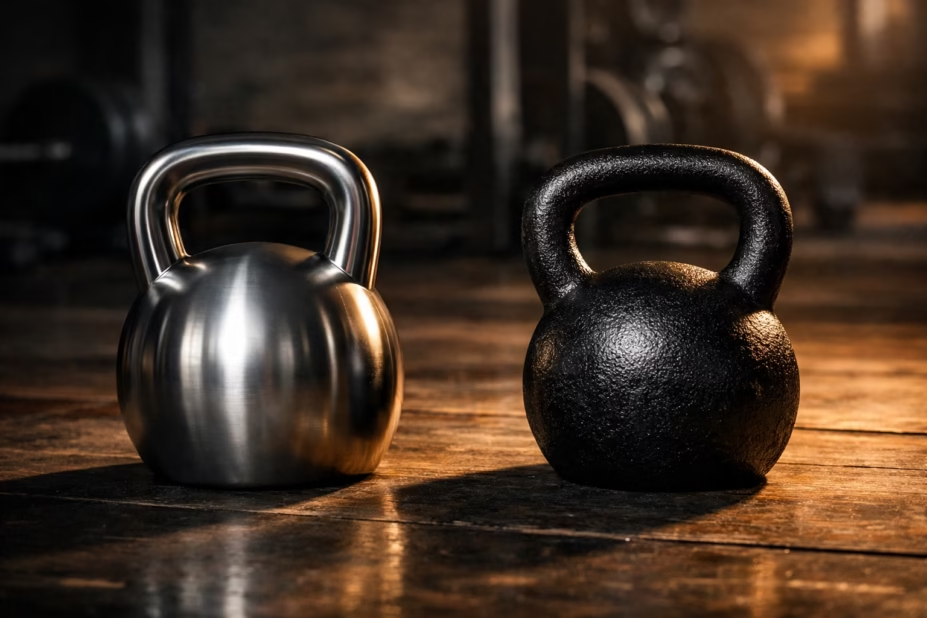
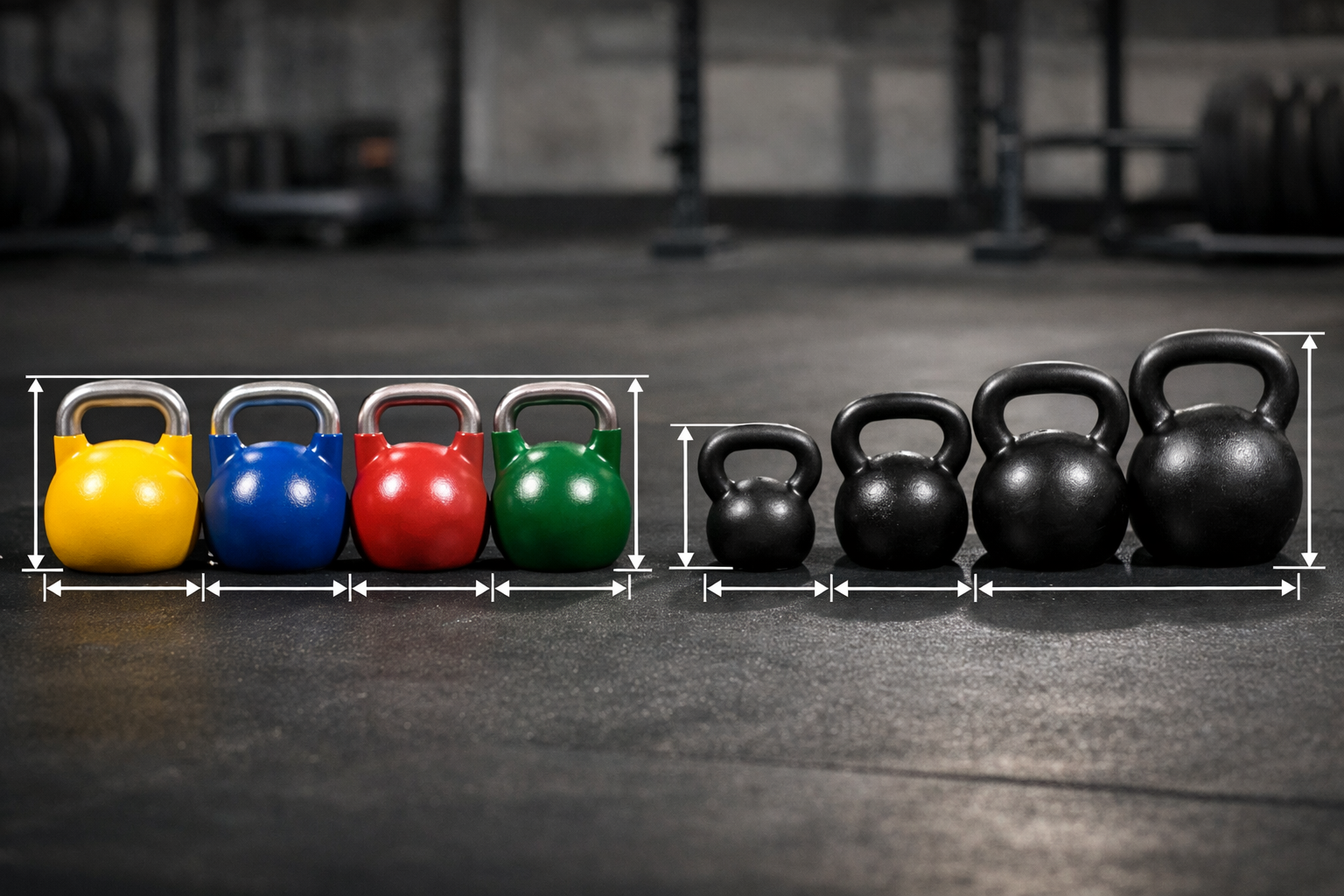
Competition kettlebells, also called sport kettlebells or pro-grade bells, follow strict standards set by organizations like the International Union of Kettlebell Lifting (IUKL) and World Kettlebell Club (WKC). The defining characteristic? Every competition kettlebell measures the same size regardless of weight.
This means an 8kg (18lb) competition bell has identical external dimensions to a 32kg (70lb) bell. The only differences are the internal density and the color-coded handles that help athletes quickly identify weights during competition.
Here’s what you’ll find in a standard competition kettlebell:
- Uniform dimensions: Typically 280mm tall with a 210mm diameter
- Steel construction: Solid steel or steel shell design for precise weight distribution
- Smooth handle: 33mm diameter handle with consistent window space
- Color coding: International standard colors (8kg=pink, 12kg=blue, 16kg=yellow, etc.)
- Flat bottom: Wide, stable base for floor exercises and transitions
Marcus Martinez, a certified master kettlebell instructor, recommends competition kettlebells specifically for technical movements.
He suggests women start with 8-26 lbs and men with 26-45 lbs when learning Olympic-style lifts like cleans and snatches.
The Traditional Appeal of Regular Kettlebells 💪
Regular kettlebells—sometimes called cast iron or traditional kettlebells—take a different approach. These bells scale in size proportionally to their weight, meaning a heavier bell is physically larger than a lighter one.
This design philosophy offers distinct advantages for general fitness training. As Jah Washington, physical therapist and owner of Harlem Kettlebell Club, points out, powder-coated regular kettlebells like the Yes4All Powder Coated Kettlebell Weights provide excellent grip and versatility for movements like deadlifts, rows, and burpees.
Regular kettlebells typically feature:
- Progressive sizing: Larger bells for heavier weights, smaller for lighter
- Cast iron construction: Durable, cost-effective manufacturing
- Textured handles: Powder coating or vinyl for enhanced grip
- Varied handle thickness: Thicker handles on heavier bells challenge grip strength
- Wide availability: Found in most gyms and sporting goods stores
The scaling size actually becomes a training tool itself. When you progress from a 16kg to a 24kg regular kettlebell, the increased size forces your core to work harder for stabilization and builds forearm strength through the thicker handle.
Performance Comparison: Competition Kettlebell vs Regular for Different Training Goals
Competition Kettlebells for Sport and Endurance Training
If you’re training for kettlebell sport (Girevoy Sport) or planning to compete in events sanctioned by organizations like AKLU or WKSF, competition kettlebells aren’t optional—they’re mandatory. The 2026 WKSF World Championships qualification requires athletes to train with regulation equipment.
Billy Brown, a CrossFit athlete and GearJunkie tester, rates the Eleiko Competition Kettlebells at 9.5/10, specifically praising their exceptional build quality and flat sides that make movements like snatches and Turkish get-ups more stable and predictable.
Competition kettlebells shine for:
✅ High-repetition sets: The smooth handle prevents blisters during 10-minute snatch sets
✅ Technical precision: Consistent dimensions develop muscle memory faster
✅ Rack position comfort: Uniform size rests identically on the forearm regardless of weight
✅ Competition preparation: Training with regulation equipment ensures no surprises on event day
✅ Progressive overload: Change weight without relearning balance and positioning
Athletes like Oleh Ilika, who achieved 150 reps with a 32kg competition kettlebell in a February 2026 MSIK/WKSF event, rely on the predictable feel of competition bells for consistent performance under pressure.
For those interested in the cardiovascular benefits of kettlebell training, check out our guide on kettlebell swing cardio and weight loss.
Regular Kettlebells for Strength and General Fitness
For the majority of fitness enthusiasts who aren’t competing in kettlebell sport, regular kettlebells offer compelling advantages. The progressive sizing naturally builds grip strength and core stability as you advance through weights.
Regular kettlebells excel for:
✅ Varied workout programming: Different sizes suit different movement patterns
✅ Grip strength development: Thicker handles on heavier bells progressively challenge forearms
✅ Cost-effectiveness: Generally 30-50% less expensive than competition bells
✅ Space efficiency: Smaller light bells take up less room in home gyms
✅ Beginner-friendly: Intuitive sizing helps newcomers select appropriate weights
The BalanceFrom Kettlebell Exercise Fitness Weight Set exemplifies how regular kettlebells provide excellent value for home gym setups, offering multiple weights at accessible price points.
Regular kettlebells also work wonderfully for HIIT kettlebell workouts where you’re frequently switching between exercises and weights. The size variation actually helps you quickly identify the right bell during fast-paced circuits.
Handle Design and Grip Considerations
The handle makes or breaks your kettlebell experience, and this is where Competition Kettlebell vs Regular differences become immediately apparent.
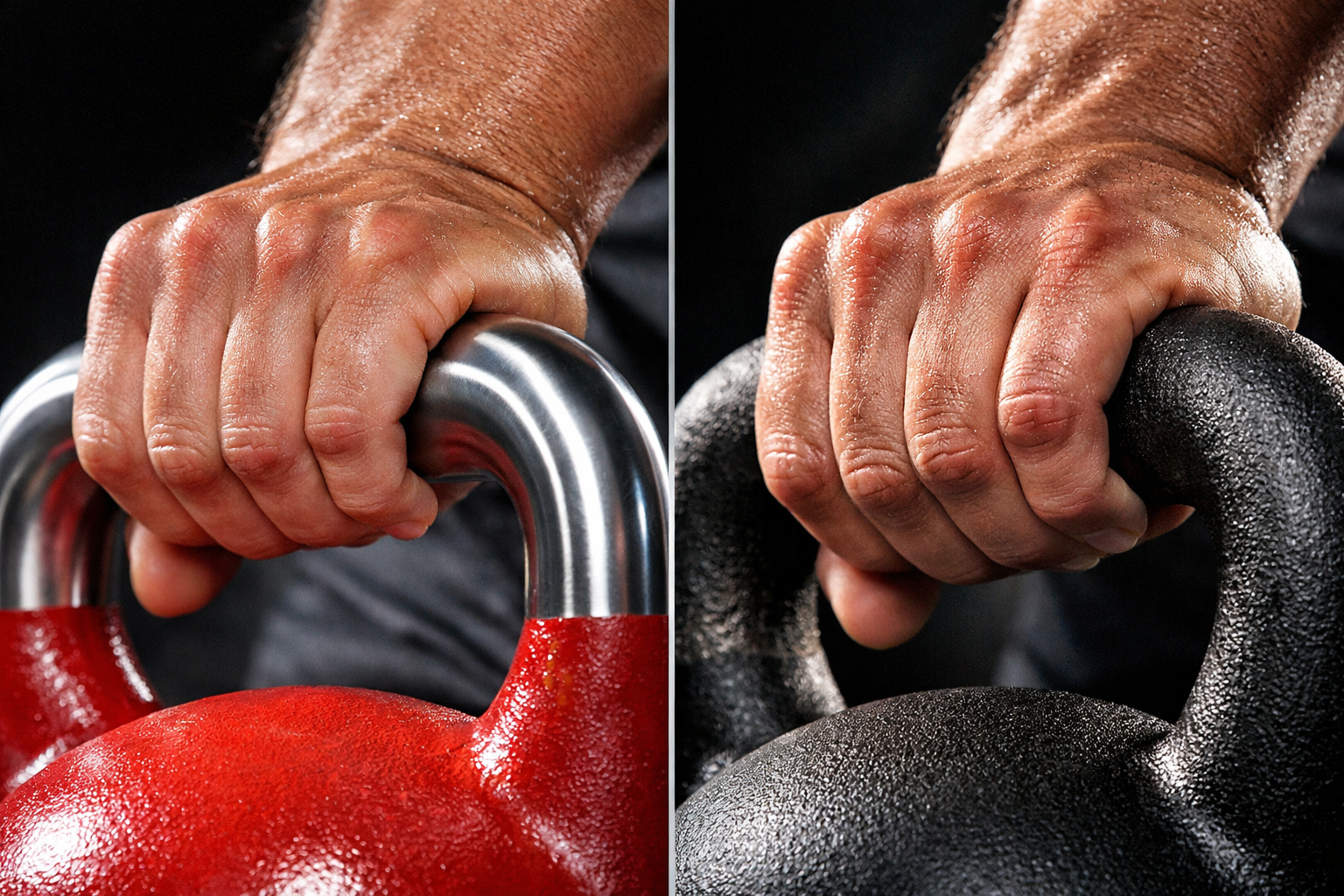
Competition kettlebell handles:
- Smooth steel finish (sometimes lightly textured)
- Consistent 33mm diameter across all weights
- Larger window space for comfortable two-handed grips
- Designed for minimal friction during high-rep ballistic movements
Regular kettlebell handles:
- Powder-coated, vinyl-coated, or bare cast iron
- Variable diameter (thicker on heavier bells)
- Smaller window space on lighter weights
- Textured for secure grip during strength movements
I personally prefer competition handles for snatches and long-cycle work, but when I’m doing kettlebell exercises for abs or heavy goblet squats, the textured grip of a regular bell gives me more confidence.
Making Your Decision: Which Kettlebell Type Is Right for You?
Assess Your Training Goals and Experience Level
Your choice between Competition Kettlebell vs Regular should align directly with your fitness objectives and current skill level.
Choose competition kettlebells if you:
- Plan to compete in kettlebell sport or Girevoy Sport
- Focus primarily on snatches, cleans, jerks, and long-cycle
- Value technical precision and consistent muscle memory
- Train with high-repetition endurance protocols (5-10 minute sets)
- Have budget flexibility for premium equipment
Choose regular kettlebells if you:
- Use kettlebells as part of varied strength training
- Perform primarily swings, squats, deadlifts, and presses
- Want to build progressive grip strength naturally
- Train with moderate repetitions (8-20 reps per set)
- Prefer cost-effective equipment options
For many people, the answer isn’t either/or—it’s both. I keep a set of competition bells (16kg, 24kg, 32kg) for sport-specific training and several regular bells for general strength work. This hybrid approach gives me the best of both worlds.
If you’re working with limited space or budget, consider exploring adjustable kettlebell options that can replace multiple fixed-weight bells, though trainers note these alter weight distribution compared to traditional designs.
Budget Considerations and Long-Term Investment
Let’s talk money. Competition kettlebells typically cost $80-$150 per bell, while quality regular kettlebells range from $40-$90 for the same weight. That price difference adds up quickly when building a complete set.
Here’s a realistic budget comparison:
| Kettlebell Type | Single Bell (16kg) | 3-Bell Set (8kg, 16kg, 24kg) | Complete Set (8-32kg) |
|---|---|---|---|
| Competition | $100-$130 | $280-$360 | $600-$900 |
| Regular | $50-$75 | $140-$200 | $300-$500 |
However, competition kettlebells often outlast regular bells due to superior construction. The Eleiko Competition Kettlebells, for instance, come with extensive warranties and are built to withstand decades of daily use in commercial gyms.
For beginners, I recommend starting with 1-2 regular kettlebells to learn basic movements, then investing in competition bells if you decide to pursue sport-specific training. The 20lb kettlebell makes an excellent starting point for most people learning fundamental techniques.
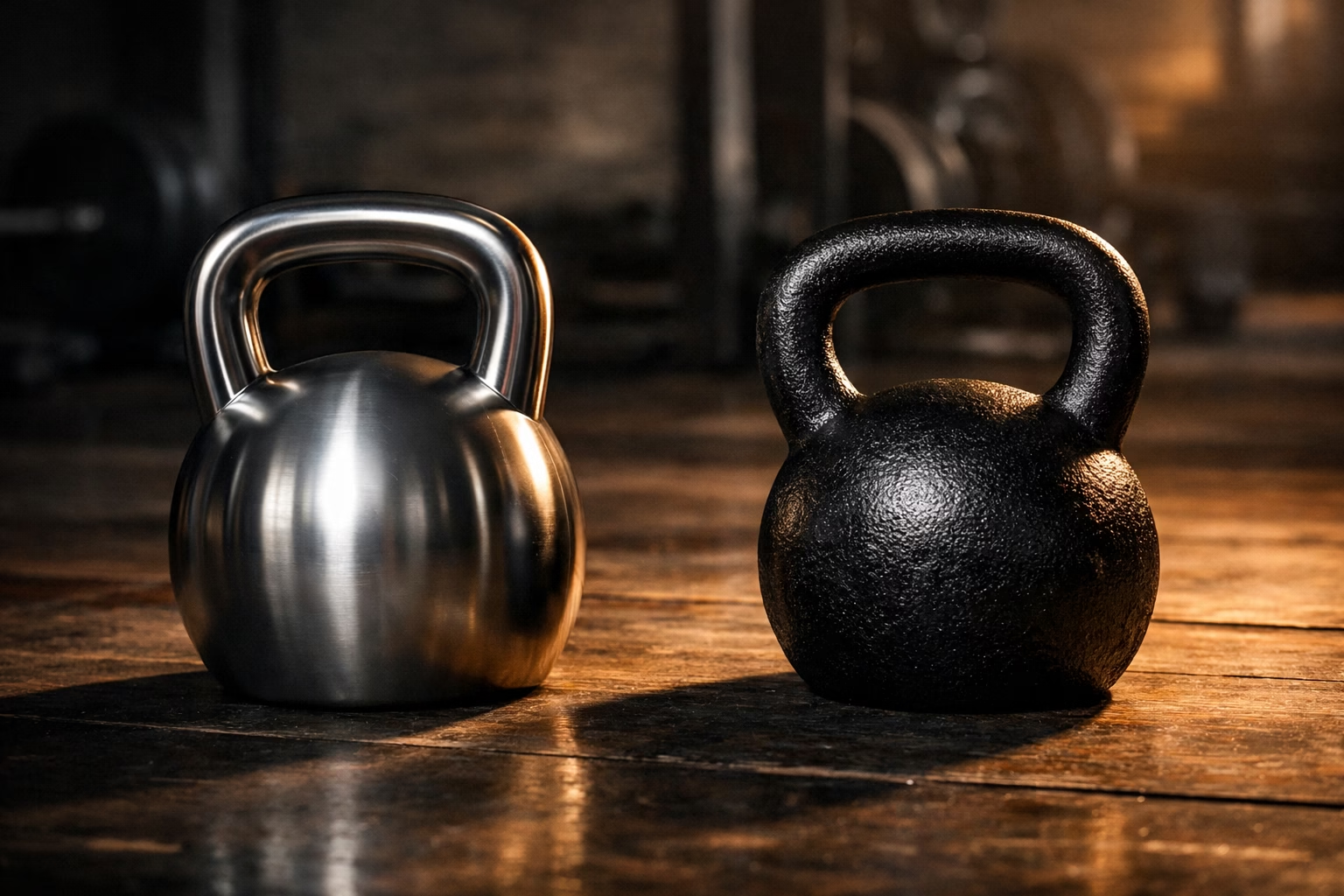
Space and Storage Requirements
This practical consideration often gets overlooked until you’re trying to organize your home gym.
Competition kettlebells:
- Uniform size simplifies stacking and storage
- Require dedicated rack or shelf space
- Flat sides allow for stable stacking
- Color coding enables quick visual identification
Regular kettlebells:
- Varied sizes can be nested for compact storage
- Smaller light bells fit in tight spaces
- Round bottoms may require individual storage spots
- Weight markings sometimes wear off over time
If you’re setting up a home gym in an apartment or small space, the uniform sizing of competition bells actually makes them easier to organize systematically. They stack neatly and take up predictable shelf space.
For those interested in maximizing their home gym efficiency, our guide to best home gym equipment offers additional space-saving strategies.
Practical Training Applications: Competition Kettlebell vs Regular in Action
Sport-Specific Movements and Competitions
Kettlebell sport revolves around three main lifts performed for maximum repetitions in 10 minutes: the snatch, jerk, and long cycle (clean and jerk). Competition kettlebells are engineered specifically for these demanding events.
The uniform size means that when you’re six minutes into a snatch set and fatigue is setting in, the bell still rests on your forearm exactly the same way it did on rep one.
This consistency is invaluable when you’re chasing personal records or competing for qualification to events like the 2026 WKSF World Championships.
Zack Henderson, a kettlebell sport expert, notes that competition bells maintain the same 28kg regular kettlebell size across all weights, which optimizes the rack position for high-repetition efforts. This design consideration directly impacts performance during grueling 10-minute sets.
Key sport movements that demand competition bells:
- Snatch: Smooth handle prevents hand tears during 100+ rep sets
- Jerk: Consistent rack position maintains efficiency throughout the set
- Long Cycle: Predictable balance during the clean-to-jerk transition
- Half Snatch: Uniform dimensions ensure identical technique across weights
General Fitness and Strength Training
For the broader fitness community, regular kettlebells offer versatility that competition bells can’t match. The progressive sizing naturally guides your training progression and provides varied stimulus to your muscles.
When teaching kettlebell workouts for women, I often start clients with an 8kg or 12kg regular bell. The smaller physical size builds confidence and allows proper form development without intimidation. As they progress to 16kg and beyond, the increasing bell size provides tangible evidence of their strength gains.
Movements where regular kettlebells excel:
- Swings: Varied handle thickness progressively strengthens grip
- Goblet Squats: Larger bells on heavier weights provide better counterbalance
- Rows: Textured handles prevent slipping during pulling movements
- Turkish Get-Ups: Progressive sizing challenges stability at each weight level
- Farmer’s Carries: Different shapes engage stabilizer muscles differently
The 11 kettlebell swing benefits you’ll experience work equally well with either bell type, but many people find the textured grip of regular bells more secure during explosive hip hinge movements.
Hybrid Training Approaches
Many serious kettlebell enthusiasts eventually adopt a hybrid approach, keeping both types in their arsenal. This strategy maximizes the benefits of each design philosophy.
Here’s how I structure my own training split:
Competition kettlebells for:
- Monday: Snatch technique and endurance (5-10 minute sets)
- Wednesday: Long cycle practice
- Friday: Clean and jerk volume work
Regular kettlebells for:
- Tuesday: Heavy swings and strength circuits
- Thursday: Kettlebell workout for back and pulling movements
- Saturday: Full-body conditioning with varied weights
This approach lets me develop sport-specific skills while maintaining overall strength and fitness. It’s similar to how powerlifters use both competition barbells and specialty bars for different training purposes.
Conclusion: Making the Right Choice for Your Kettlebell Journey
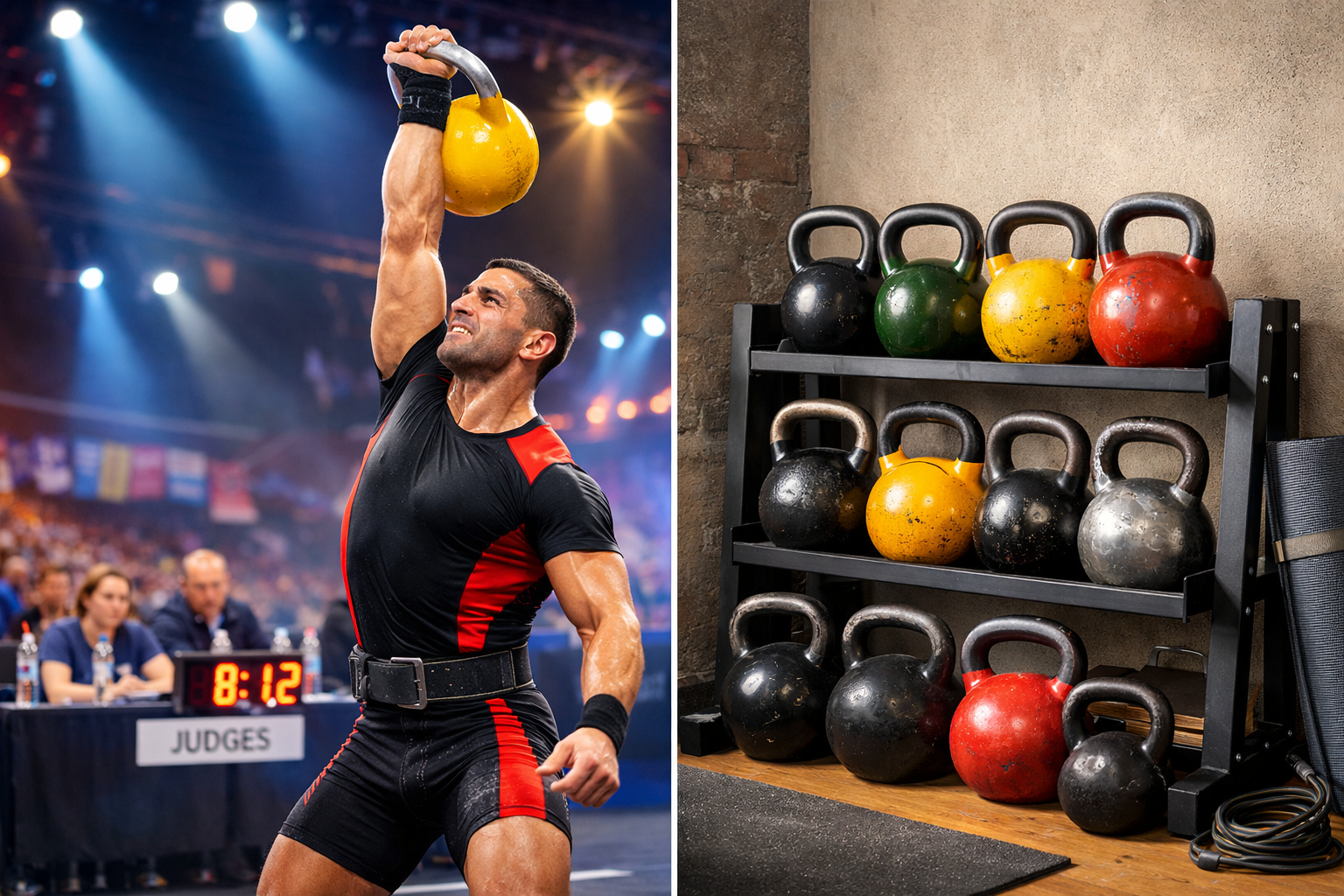
The Competition Kettlebell vs Regular debate doesn’t have a universal winner—it has the right choice for your specific situation.
After training with both types for over a decade and coaching hundreds of clients, I’ve learned that the best kettlebell is the one that aligns with your goals, budget, and training style.
If you’re drawn to kettlebell sport, planning to compete, or prioritize technical precision in Olympic-style lifts, competition kettlebells are worth the investment.
The uniform dimensions, smooth handles, and predictable balance will accelerate your skill development and prevent the frustration of relearning movements with each weight progression.
For general fitness enthusiasts, home gym owners, and those incorporating kettlebells into varied training programs, regular kettlebells offer outstanding value and versatility.
The progressive sizing builds grip strength naturally, the textured handles provide security during explosive movements, and the lower cost allows you to build a more complete weight selection.
Your action steps:
- Define your primary goal: Competition prep or general fitness?
- Assess your budget: Can you invest in premium equipment or need cost-effective options?
- Start with 1-2 bells: Test your preferences before buying a full set
- Consider hybrid ownership: Add the opposite type as your training evolves
- Prioritize quality: Whether competition or regular, buy from reputable manufacturers
Remember, the kettlebell that gets used consistently beats the perfect kettlebell that sits in the corner. Start where you are, use what you have, and let your training goals guide your equipment choices as you progress.
Whether you choose Competition Kettlebell vs Regular bells, or both, you’re investing in one of the most versatile training tools ever created.
Now get out there and swing! 💪