Hiit Training on Treadmill
Last updated: April 8, 2026
Quick Answer: HIIT Training on Treadmill alternates short bursts of high-intensity running or sprinting (at 85–95% of your maximum heart rate) with active recovery periods at a slower pace.
Sessions typically run 15–30 minutes and are one of the most time-efficient methods for burning fat, improving cardiovascular endurance, and boosting VO2max.
Beginners can start with a 1:2 work-to-rest ratio and progress systematically over six weeks.
Key Takeaways
- HIIT treadmill workouts range from 4-minute Tabata sessions to 30-minute structured intervals — most effective sessions fall in the 15–30 minute window, including warm-up and cool-down [2]
- Heart rate targets matter: aim for at least 85% of your maximum heart rate during work intervals; advanced athletes can push to 90–95% [2]
- VO2max can improve by up to 15% in six weeks of consistent HIIT treadmill training [2]
- Beginners should start with a 1:2 work-to-rest ratio: 30-second sprints followed by 60-second recovery walks [1]
- Progressive overload is essential — increase work interval duration every two weeks to keep adaptation happening [1]
- Treadmills give you precise control over speed and incline, removing weather and terrain variables that complicate outdoor HIIT [2]
- Manual treadmills allow faster pace transitions, making them particularly effective for sprint intervals [1]
- Recovery is not optional — rest days between HIIT sessions prevent overtraining and support long-term progress
- Nutrition timing around HIIT sessions affects energy output and recovery quality
- HIIT outperforms steady-state cardio for many fitness goals, including endurance performance in trained athletes [1]
Ready to invest in a quality treadmill for home HIIT training? Browse Top-Rated Treadmill Options Here
What Is HIIT Training on a Treadmill?
HIIT training on a treadmill is a structured workout method that alternates between high-intensity running intervals and lower-intensity recovery periods on a treadmill. The core principle is simple: push hard, recover briefly, repeat.
Unlike traditional steady-state cardio, where you run at a consistent moderate pace for 30–60 minutes, HIIT forces your cardiovascular system to repeatedly spike and recover. This creates a stronger metabolic stimulus in less time.
A 2016 study found that trained rowers who replaced just two steady-state sessions per week with HIIT sessions showed greater improvements in 2,000-meter timed trials than those who stuck to steady-state training only [1].
Why the treadmill specifically? Because it gives you exact control. You set the speed, you set the incline, and the belt keeps you honest. There’s no coasting on a downhill or slowing down when the wind picks up.
The treadmill forces you to match the pace you’ve programmed, which makes interval training more consistent and measurable [2].
“The treadmill eliminates the variables that make outdoor HIIT inconsistent — you get precise programming of speed and incline every single session.” [2]
How Does HIIT Treadmill Training Actually Work Physiologically?
During HIIT, your body alternates between aerobic and anaerobic energy systems. This is what separates it from a steady jog.
During sprint intervals:
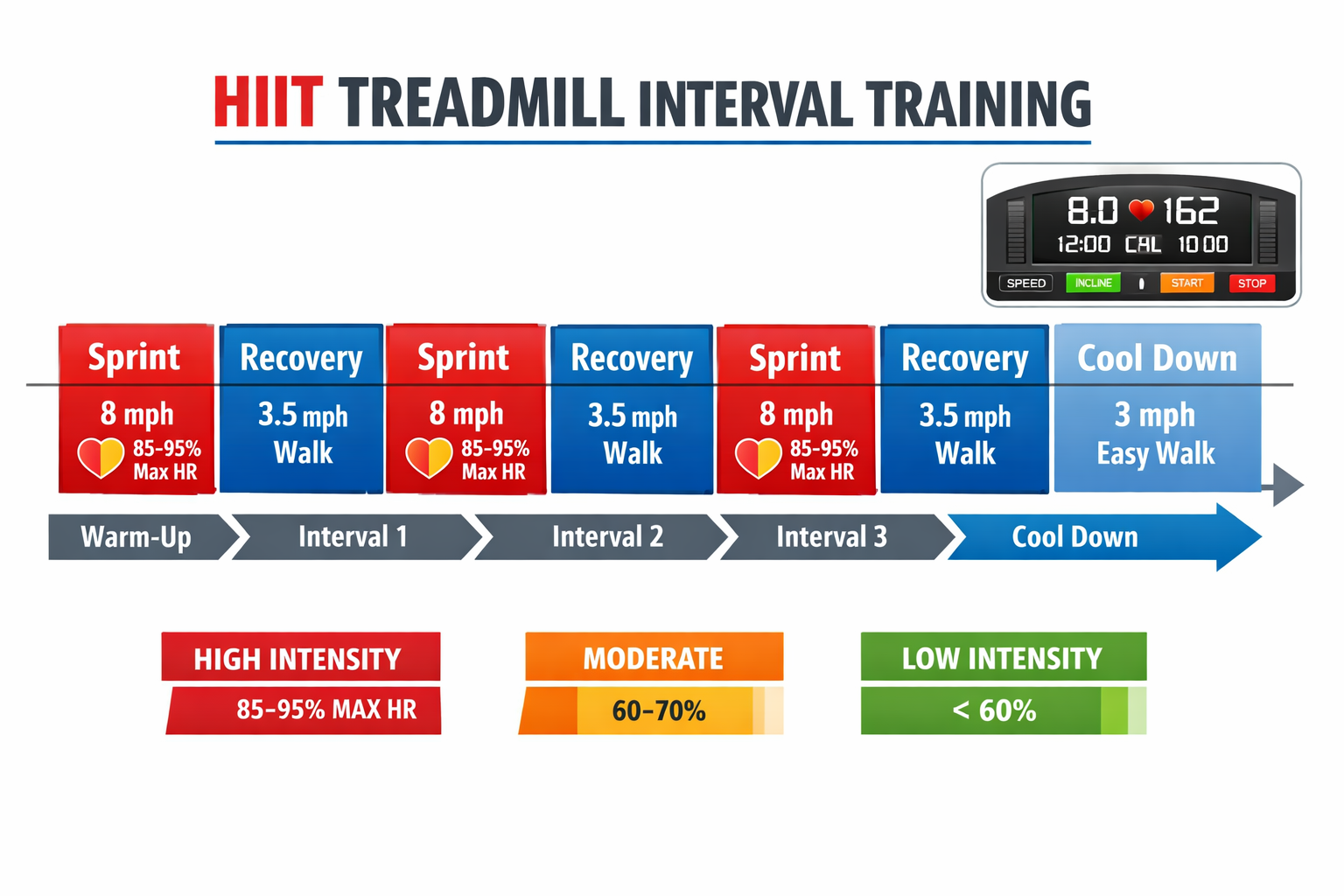
- Your heart rate climbs to 85–95% of its maximum
- Your body draws heavily on anaerobic glycolysis for fast energy
- Lactate accumulates in the muscles
- Oxygen demand exceeds supply temporarily
During recovery periods:
- Your aerobic system works to clear lactate and repay the “oxygen debt”
- Heart rate drops, but stays elevated above resting
- Your body begins restoring phosphocreatine stores
This repeated cycling produces several adaptations over time: increased mitochondrial density, improved lactate threshold, stronger cardiac output, and, critically, a measurable boost in VO2max of up to 15% in six weeks of consistent training [2].
The metabolic boost doesn’t stop when you step off the treadmill, either. The post-exercise oxygen consumption effect (commonly called the “afterburn”) means your body continues burning calories at an elevated rate for hours after a HIIT session. This is one reason HIIT is promoted as efficient fat-burning cardio even in short sessions [7].
For a broader look at why this training style outperforms other cardio formats, see our deep-dive on why HIIT is superior for fat loss and endurance.
What Are the Best HIIT Treadmill Workout Templates by Level?
The right HIIT treadmill workout depends on your current fitness level. Starting too hard leads to injury or burnout; starting too easy wastes the session.
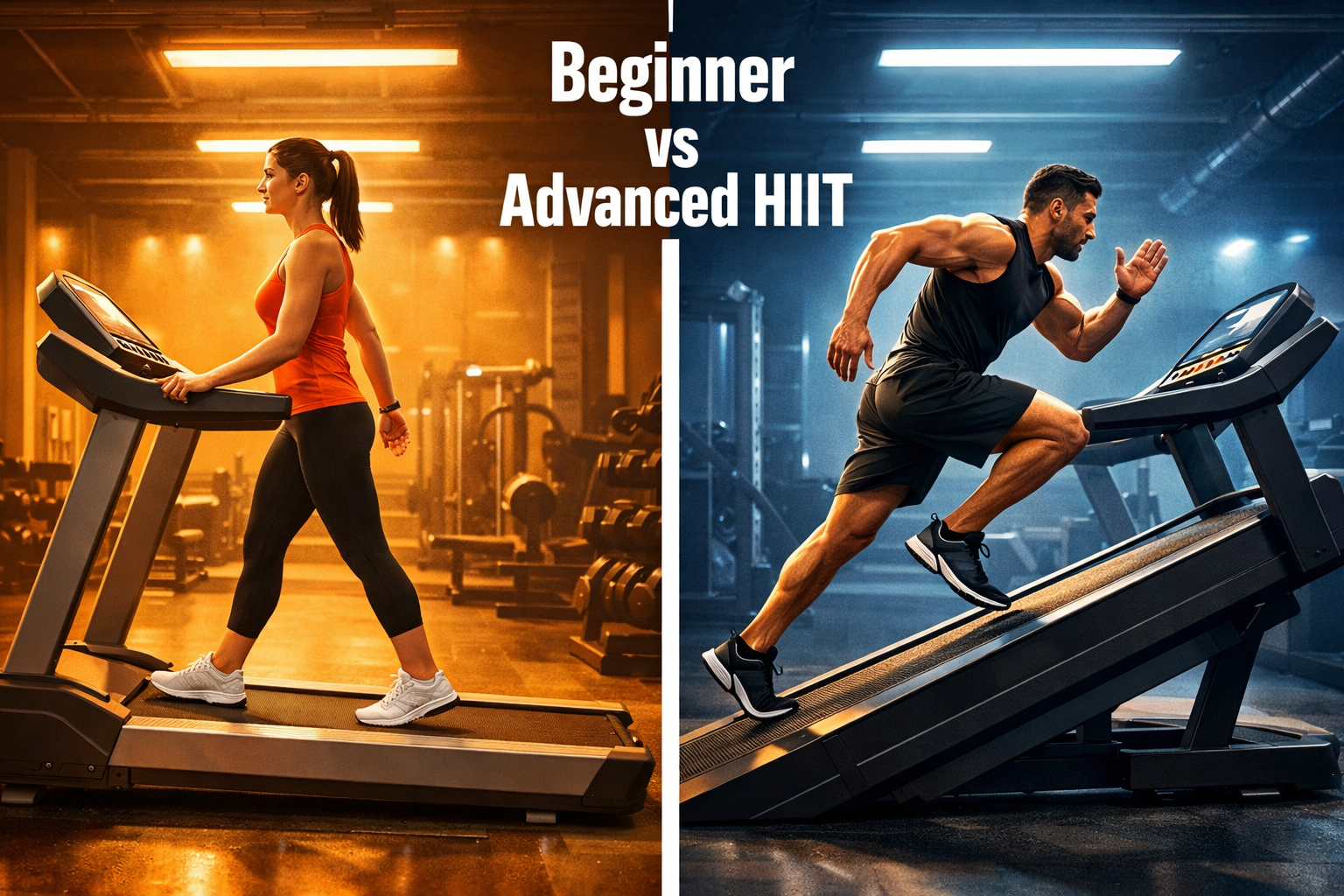
Beginner HIIT Treadmill Workout
Goal: Build tolerance for intensity without overwhelming your joints or cardiovascular system.
Protocol (1:2 work-to-rest ratio): [1]
- Warm up at 3.0–3.5 mph for 5 minutes
- Sprint at 6.0–7.0 mph for 30 seconds
- Walk at 3.0–3.5 mph for 60 seconds
- Repeat for 10 rounds (total interval time: 15 minutes)
- Cool down at 2.5–3.0 mph for 5 minutes
Total session time: ~25 minutes
Heart rate target: 75–85% of max HR during sprint intervals
Intermediate HIIT Treadmill Workout
Protocol (1:1 work-to-rest ratio):
- Warm up at 3.5 mph for 5 minutes
- Run at 7.5–8.5 mph for 45 seconds
- Walk/jog at 3.5–4.0 mph for 45 seconds
- Repeat for 12 rounds
- Cool down for 5 minutes
Total session time: ~28 minutes
Heart rate target: 85–90% of max HR during work intervals
Advanced HIIT Treadmill Workout
Protocol (2:1 work-to-rest ratio with incline):
- Warm up at 4.0 mph, 1% incline for 5 minutes
- Sprint at 9.0–10.5 mph (or 6–8% incline at 7.0 mph) for 60 seconds
- Walk at 3.5 mph for 30 seconds
- Repeat for 10 rounds
- Cool down for 5 minutes
Total session time: ~25 minutes
Heart rate target: 90–95% of max HR during work intervals [2]
How Do You Progress HIIT Treadmill Training Over Six Weeks?
Progressive overload is the mechanism that drives continued improvement. Without it, your body adapts and the workouts stop producing results.
A structured six-week progression looks like this [1]:
| Week | Work Interval | Rest Interval | Rounds |
|---|---|---|---|
| 1–2 | 60 seconds | 90 seconds | 8 |
| 3–4 | 90 seconds | 90 seconds | 8 |
| 5–6 | 120 seconds | 60 seconds | 8 |
Each phase should be completed for at least two sessions before advancing. The key variables you can manipulate are:
- Duration of work intervals (increase gradually)
- Speed during sprint intervals (add 0.3–0.5 mph every 1–2 weeks)
- Incline (adding 1–2% incline increases intensity without requiring faster speeds)
- Rest ratio (shorten recovery as fitness improves)
Common mistake: Increasing speed AND incline AND reducing rest all at once. Change one variable at a time so you can track what’s driving improvement and avoid overtraining.
What Are the Real Benefits of HIIT Training on a Treadmill?
HIIT treadmill training delivers measurable results across multiple fitness markers — not just calorie burn.
Cardiovascular improvements:
- VO2max increases of up to 15% in six weeks [2]
- Lower resting heart rate over time
- Improved cardiac stroke volume
Body composition:
- Elevated post-workout calorie burn (afterburn effect)
- Preserved lean muscle mass compared to long steady-state sessions
- Reduction in visceral fat with consistent training
Performance:
- Better lactate threshold for endurance athletes
- Faster running economy
- Improved speed at aerobic threshold
Time efficiency:
- Effective sessions in 15–30 minutes [2]
- Three sessions per week can produce significant fat loss and cardiovascular gains [7]
- NordicTrack’s 2026 guided iFIT programs are specifically designed around this flexibility for people with busy schedules [5]
If you want to combine treadmill HIIT with resistance training for even greater fat loss, our guide on HIIT kettlebell workouts for burning fat and building muscle covers how to structure both in the same week.
Ready to invest in a quality treadmill for home HIIT training?
Browse Top-Rated Treadmill Options Here
How Do You Stay Safe During HIIT Treadmill Workouts?
Safety during HIIT treadmill training comes down to preparation, pacing, and knowing your limits. Skipping this section is how people get hurt.
Before every session:
- Complete a 5-minute warm-up at easy pace — never skip this
- Check that the treadmill safety clip is attached to your clothing
- Set your target speeds in advance so you’re not fumbling with buttons mid-sprint
- Hydrate before starting (aim for 16 oz of water 30–60 minutes prior)
During the session:
- Never jump on or off a moving belt — straddle the sides to transition if needed
- Keep your gaze forward, not down at your feet
- If you feel chest pain, dizziness, or sharp joint pain, stop immediately
- Use the handrails only for balance during transitions, not as a crutch during sprints
Injury prevention strategies:
- Limit HIIT treadmill sessions to 2–3 per week maximum, with at least one rest day between
- Rotate with lower-impact cardio — see our overview of low-impact HIIT workouts for recovery-friendly alternatives
- Strengthen supporting muscles (glutes, hip flexors, calves) with resistance training
- Replace running shoes every 300–500 miles, worn cushioning increases injury risk
Who should consult a doctor first: Anyone with a history of heart conditions, joint injuries, or who has been sedentary for more than six months should get medical clearance before starting HIIT.
What Equipment Do You Need for HIIT Training on a Treadmill?
You don’t need an expensive setup to start, but the right equipment makes sessions safer and more effective.
Treadmill selection:
- Motorized treadmills are the standard choice — look for a motor of at least 2.5 CHP for running, a belt at least 20 inches wide, and a speed range up to 12 mph
- Manual (curved) treadmills like the Assault AirRunner are considered ideal for sprint intervals because they respond instantly to your pace changes without button manipulation [1] — though they carry a significantly higher price tag
- Minimum features needed: speed control, incline adjustment, and a safety shutoff clip
Wearables and tracking:
- A heart rate monitor (chest strap or wrist-based) lets you verify you’re hitting the 85–95% HR targets that make HIIT effective [2]
- Fitness apps like iFIT (integrated with NordicTrack treadmills) offer guided HIIT programs — iFIT launched a new HIIT-integrated series in April 2026 combining strength and cardio elements [8]
- The Tread Series Season 3 (launched in 2026) offers 25-minute structured HIIT treadmill workouts adapted for all ability levels [4]
Footwear: Running shoes with adequate cushioning and lateral support are non-negotiable for sprint intervals. Trail shoes or cross-trainers are not appropriate substitutes.
Recommended treadmill option: Check current treadmill options on Amazon for models that fit your budget and training goals.
How Does Nutrition Support HIIT Treadmill Training?
Nutrition is the part most HIIT guides skip entirely — and it directly affects how hard you can push and how fast you recover.
Pre-workout (60–90 minutes before):
- Eat a small meal with easily digestible carbohydrates and moderate protein
- Examples: banana with peanut butter, oatmeal with berries, rice cakes with turkey
- Avoid high-fat or high-fiber meals immediately before — they slow digestion and can cause GI distress during sprints
Post-workout (within 30–60 minutes):
- Prioritize protein to support muscle repair: aim for 20–30g
- Include carbohydrates to replenish glycogen stores depleted during anaerobic intervals
- Examples: Greek yogurt with fruit, chicken and rice, protein shake with a banana
Hydration:
- HIIT sessions cause significant fluid loss through sweat
- Drink water consistently throughout the day — not just during the workout
- For sessions over 45 minutes, consider an electrolyte drink to replace sodium and potassium
What to avoid: Training fasted for HIIT (unlike low-intensity cardio) often leads to reduced intensity and earlier fatigue, which defeats the purpose of the protocol. Some experienced athletes do train fasted successfully, but beginners should eat beforehand.
How Do You Stay Mentally Strong During High-Intensity Intervals?
The physical capacity to complete HIIT intervals often exceeds the mental willingness to push through discomfort. This is where most people underperform.
Strategies that work:
- Segment the session mentally. Instead of thinking “8 more rounds,” focus only on finishing the current sprint. One interval at a time.
- Use a countdown, not a count-up. Watching time go down feels faster than watching it accumulate.
- Anchor to a purpose. Know specifically why you’re doing this session — a race goal, a health target, a personal milestone. Vague motivation fades fast.
- Control your breathing during recovery. Slow, deliberate exhales (longer than inhales) activate the parasympathetic nervous system and accelerate heart rate recovery between intervals.
- Pre-commit to your speeds. Decide your sprint speed before you start, not in the moment. In-the-moment decisions almost always result in lowering the intensity.
The mental side of HIIT is trainable, just like the physical side. Each session you push through discomfort builds tolerance for the next one.
For those who want to combine HIIT with other modalities for variety and mental freshness, our guide on 15-minute HIIT workouts offers shorter formats that reduce psychological resistance while maintaining intensity.
How Do You Measure Whether Your HIIT Treadmill Workouts Are Working?
Tracking progress prevents plateaus and keeps motivation high. Here’s what to measure and how often.
Performance metrics (track weekly):
- Sprint speed at the same perceived effort level, if you’re running faster at the same RPE, you’re improving
- Heart rate recovery time, how quickly your HR drops in the first 60 seconds of rest
- Number of rounds completed before form breaks down
Fitness markers (track every 4–6 weeks):
- Resting heart rate (lower = better cardiovascular fitness)
- VO2max estimate (available on most GPS watches and some treadmill consoles)
- 1-mile time trial at moderate effort
Body composition (track monthly, not daily):
- Waist circumference is more meaningful than scale weight for HIIT outcomes
- Progress photos every 4 weeks
Simple tracking rule: If your sprint speed hasn’t increased, your recovery time hasn’t shortened, or your resting HR hasn’t dropped after four weeks, something needs to change — either intensity, frequency, nutrition, or sleep.
You can also complement treadmill HIIT with resistance-based cardio for additional calorie tracking insights, our article on calories burned in kettlebell workouts provides useful comparison data.
Ready to invest in a quality treadmill for home HIIT training?
Browse Top-Rated Treadmill Options Here
Frequently Asked Questions About HIIT Training on a Treadmill
Q: How often should I do HIIT treadmill workouts per week?
A: Two to three sessions per week is the standard recommendation for most people. HIIT is demanding on the nervous system and joints — more than three sessions weekly without adequate recovery leads to diminishing returns and increased injury risk.
Q: Can beginners do HIIT on a treadmill?
A: Yes, with modifications. Beginners should use a 1:2 work-to-rest ratio (30-second sprint, 60-second walk), keep sprint speeds moderate (6.0–7.0 mph), and limit sessions to 20–25 minutes total including warm-up [1].
Q: Is HIIT on a treadmill better than outdoor running intervals?
A: Neither is objectively superior — they serve different purposes. Treadmill HIIT offers precise speed and incline control with no weather variables, making it easier to follow a structured protocol [2]. Outdoor intervals build proprioception and terrain adaptability. Both work.
Q: How many calories does a HIIT treadmill workout burn?
A: Calorie burn varies widely based on body weight, sprint intensity, and session length. A rough estimate for a 155-pound person doing 20 minutes of treadmill HIIT is 200–300 calories during the session, with additional afterburn calories in the hours following.
Q: What’s the minimum effective HIIT treadmill session length?
A: Tabata-style protocols can be effective in as little as 4 minutes of pure work, though most sessions include warm-up and cool-down bringing the total to 15–20 minutes [2]. Sessions shorter than 10 minutes of total work time are unlikely to produce significant cardiovascular adaptation for most people.
Q: Should I use incline during HIIT treadmill intervals?
A: Yes, incline is a useful tool — especially for people whose joints don’t tolerate high speeds well. A 6–8% incline at a moderate speed (6.5–7.5 mph) produces similar cardiovascular intensity to flat sprinting at higher speeds, with less impact stress.
Q: What’s the difference between HIIT and interval training?
A: All HIIT is interval training, but not all interval training is HIIT. HIIT specifically requires work intervals at near-maximal intensity (85–95% max HR). Moderate interval training at 70–80% max HR is beneficial but doesn’t produce the same metabolic or VO2max adaptations.
Q: Can I do HIIT treadmill workouts every day?
A: No. Daily HIIT leads to overtraining, elevated cortisol, disrupted sleep, and increased injury risk. Two to three sessions per week with rest or low-intensity activity in between is the evidence-supported approach.
Q: Do I need a special treadmill for HIIT?
A: Not necessarily. Any motorized treadmill with a speed range up to at least 10 mph and incline adjustment works. Manual curved treadmills are preferred by some for sprint intervals due to faster pace transitions [1], but they’re not required.
Q: What should I do on rest days between HIIT sessions?
A: Active recovery works better than complete rest for most people. Light walking, yoga, mobility work, or low-intensity cycling keeps blood flowing to muscles without adding training stress.
Conclusion: Your Next Steps With HIIT Training on a Treadmill
Hiit Training on Treadmill is one of the most efficient and well-researched approaches to improving cardiovascular fitness, burning fat, and building endurance, all in sessions that fit into a realistic schedule.
The science is clear, the protocols are proven, and the treadmill gives you the control to execute them precisely.
Here’s how to start this week:
- Assess your current fitness level — choose the beginner, intermediate, or advanced template from this guide
- Set your heart rate targets — get a basic heart rate monitor if you don’t have one
- Schedule three sessions this week — treat them like appointments, not options
- Start conservative on speed — it’s easier to increase intensity than to recover from an early injury
- Track one metric from day one — sprint speed, recovery heart rate, or session completion rate
- Plan your nutrition — eat a carb-protein meal 60–90 minutes before each session
For those who want to expand beyond the treadmill, combining HIIT cardio with resistance training produces compounding results. Explore our guides on HIIT kettlebell workouts and 10-minute HIIT kettlebell workouts for complementary training options.
Ready to invest in a quality treadmill for home HIIT training? Browse Top-Rated Treadmill Options Here to find one that matches your space, budget, and training goals.
The only bad HIIT workout is the one you didn’t do. Start simple, stay consistent, and let the progression take care of itself.
References
[1] Hiit Treadmill Workout – https://www.garagegymreviews.com/hiit-treadmill-workout
[2] Hiit Treadmill Workout – https://marathonhandbook.com/hiit-treadmill-workout/
[3] The Best Hiit Treadmill Workouts – https://www.underarmour.com/en-us/t/playbooks/training/the-best-hiit-treadmill-workouts/
[4] Season 3 Workouts – https://www.thetreadseries.com/season-3-workouts
[5] Choosing A Cardio Routine You Can Stick To In 2026 – https://www.nordictrack.com/blog/choosing-a-cardio-routine-you-can-stick-to-in-2026
[7] Detail – https://www.ctcd.edu/sites/myctcd/detail/?p=hiit-workouts-for-weight-loss-in-2026-21-min-science-backed-plan-and-why-it-fails-for-so-many-people-69a009b536590
[8] April Passport Newsletter – https://www.ifit.com/blog/move/april-passport-newsletter