Choosing the Right Kettlebell for Hip Hinge Training
Last updated: October 18, 2026
Quick Answer
Choosing the Right Kettlebell for Hip Hinge Training means picking a weight you can deadlift or swing for about 8 to 15 controlled reps without rounding your back or losing hip control. Most women start around 8 to 16 kg and most men start around 12 to 24 kg, then progress once form stays solid for a full set. The right kettlebell protects your lower back and builds real strength in the glutes, hamstrings, and hips rather than forcing your shoulders or spine to compensate.
Key Takeaways
- A hip hinge trains the glutes, hamstrings, and lower back by bending at the hips, not the knees, and the kettlebell is one of the most efficient tools to teach that pattern.
- Most beginners can learn the kettlebell deadlift with 8 to 16 kg for women and 12 to 24 kg for men, based on current hip hinge coaching guidance from kettlebell weight selection resources.
- You often need more than one kettlebell: a heavier bell for deadlifts and swings, a lighter one for presses, curls, and pullover work.
- Adjustable kettlebells save space and money but can feel less stable during fast hip hinge movements like the swing or clean.
- A kettlebell that is too heavy shows up as a rounded back, shrugged shoulders, or a swing that turns into a squat.
- The kettlebell deadlift and barbell deadlift both train the hip hinge, but the kettlebell is friendlier for home gyms, beginners, and joint comfort.
- Cast iron kettlebells with a wide, flat base and smooth handle are the most dependable choice for hip hinge drills like the deadlift, swing, and clean.
US – View Best Deals at Amazon
UK – View Best Deals at Amazon
What Is a Hip Hinge and Why Use a Kettlebell for It
A hip hinge is a movement pattern where you bend forward by pushing your hips back while keeping a flat back and soft knees, rather than squatting down.
Kettlebells are a popular tool for teaching this pattern because the handle lets you hold the weight close to your body while your hips do the work.
The hip hinge is the foundation of the kettlebell deadlift, the kettlebell swing, and several other posterior chain exercises.
According to Cleveland Clinic guidance on kettlebell training, the offset center of gravity in a kettlebell, compared to a dumbbell or barbell, makes it easier to keep the weight close to the midline during a hinge, which reduces strain on the spine.
That single design detail is a major reason trainers recommend kettlebells specifically for hip hinge work rather than other equipment.
Hip hinge training matters because:
- It strengthens the glutes and hamstrings, the major muscle groups responsible for hip extension.
- It teaches a movement pattern you use every day, from picking up a laundry basket to deadlifting a heavy bag.
- It takes pressure off the knees compared to squat-dominant lifts.
- It builds lower body strength that carries over to sprinting, jumping, and general athletic power.
Before you ever hold a kettlebell, practice the hip hinge with empty hands: push your hips back, keep your chest up, feel a stretch in your hamstrings, then stand tall and squeeze your glutes at the top.
Once that pattern feels automatic, adding a kettlebell is simply a matter of keeping the same shape under load, a point echoed across several current hip hinge exercise guides.
How Heavy Should My Kettlebell Be for Hip Hinge Exercises
Your kettlebell should be heavy enough to challenge your hips and hamstrings for 8 to 15 reps, but light enough that your back stays flat and your form does not break down before the set ends.
This single rule matters more than any fixed number, because body size, experience, and mobility all change what “right” looks like.
As a general starting point, current coaching guidance for the kettlebell deadlift recommends choosing a weight that allows a controlled hip hinge with a neutral spine and strong hip drive on every rep, rather than picking the heaviest bell you can lift once.
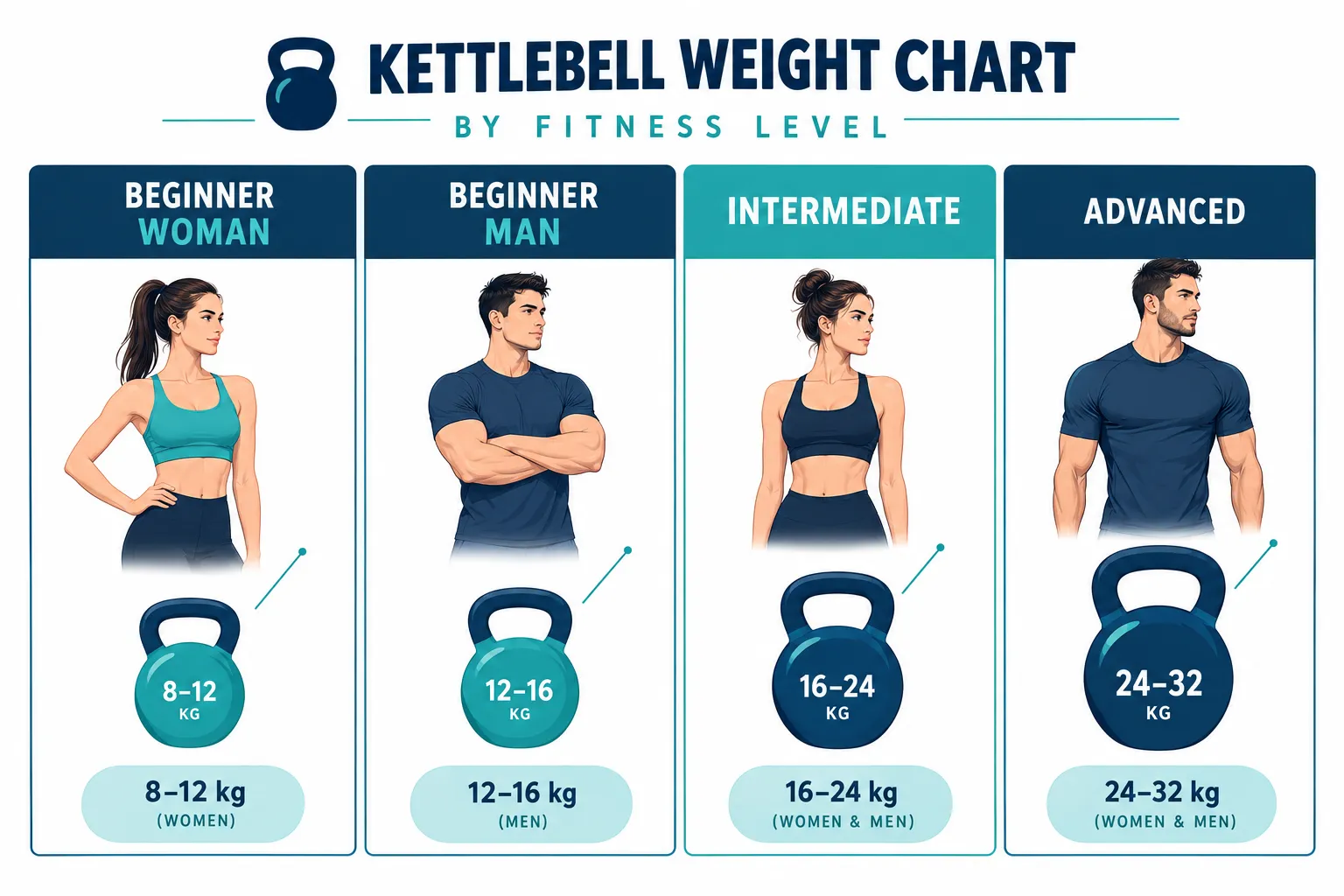
The table below gives a practical kettlebell weight chart by fitness level, based on current deadlift and swing recommendations.
| Fitness Level | Women | Men |
|---|---|---|
| Beginner | 8 to 12 kg | 12 to 16 kg |
| Intermediate | 12 to 16 kg | 16 to 24 kg |
| Advanced | 16 to 24 kg | 24 to 32 kg |
These ranges reflect practical deadlift-specific recommendations suggesting that most women can learn the kettlebell deadlift with 12 to 16 kg and often progress to 20 to 24 kg within a few months, while most men typically start around 16 to 24 kg and reach 28 to 32 kg fairly quickly, according to practical kettlebell deadlift guidance.
Use the chart as a starting point, then adjust up or down after your first few sessions based on how your hips, hamstrings, and lower back feel.
A quick checklist to confirm you have the right weight:
- Can you complete 8 clean reps with a flat back?
- Do you have 1 to 2 reps left in the tank after your set?
- Does your grip fail before your hips do?
- Does your lower back round before your legs fatigue?
If you answer no to the first two or yes to the last two, drop the weight kettlebell you are using by one size.
Choosing the Right Kettlebell for Hip Hinge Training by Exercise
US – View Best Deals at Amazon
UK – View Best Deals at Amazon
Different hip hinge exercises need different kettlebell weights, even within the same workout. A bell that feels moderate for a deadlift can feel heavy for a strict press and light for a goblet squat, so matching the weight kettlebell choice to the specific move matters as much as matching it to your fitness level.
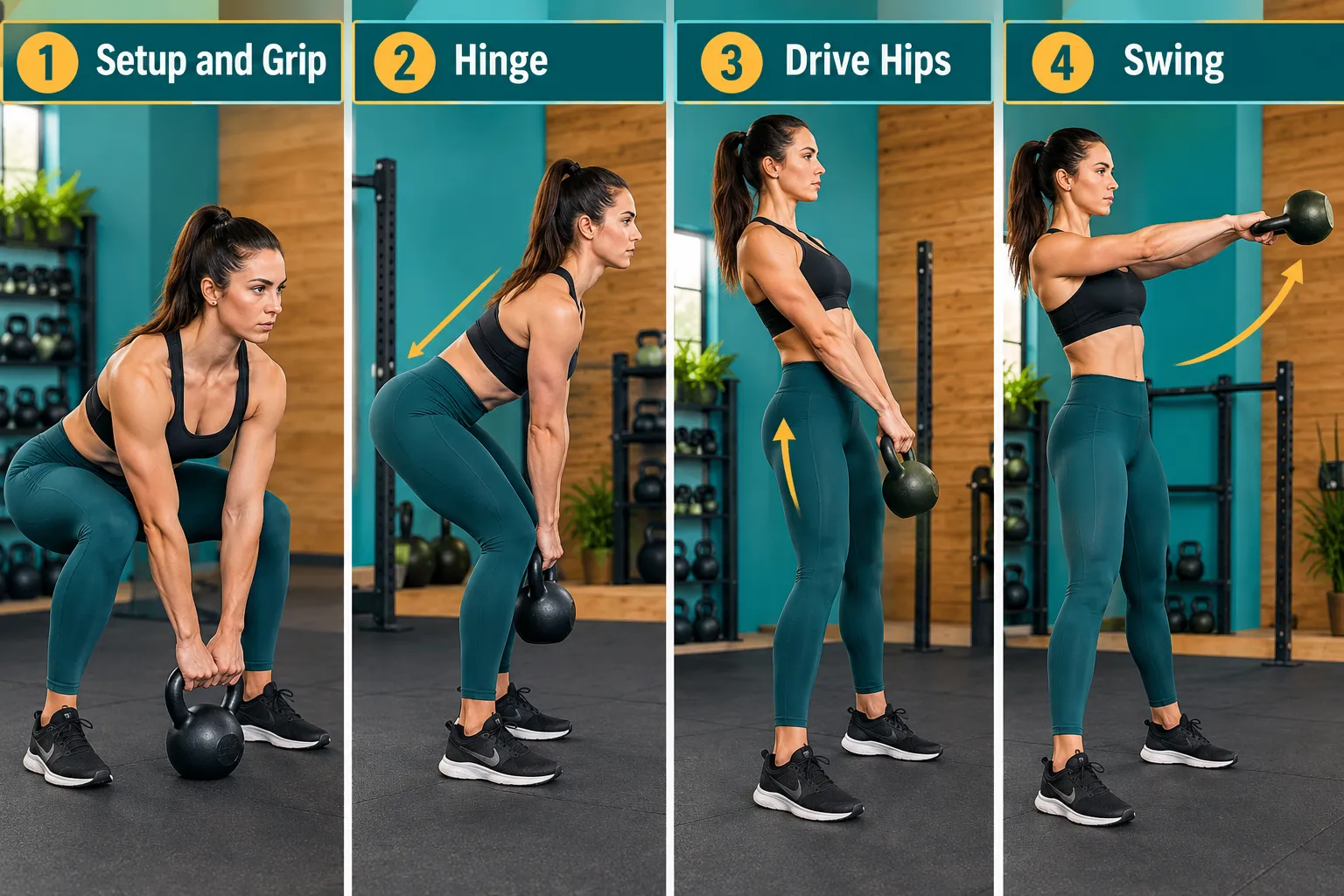
Kettlebell Deadlift: Setup, Grip, and Hip Extension
The kettlebell deadlift is the clearest teaching tool for the hip hinge pattern, and it should usually use your heaviest hip hinge kettlebell.
Step one is setup and grip: stand with feet hip width apart, kettlebell on the floor between your feet, hips back, knees slightly bent, and grip the handle with both hands while keeping your back flat.
Step two is the lift: drive through your heels, extend your hips forward, and stand tall while you squeeze your glutes at the top, then reverse the motion under control to lower the kettlebell back down.
Kettlebell Swing (Chest Swing): High Hip Hinge for Glutes and Hamstrings
The kettlebell swing, sometimes called a kettlebell chest swing because the bell finishes near chest height, is a high hip hinge that trains explosive glute and hamstring activation.
Step one is stance and kettlebell positioning: feet slightly wider than shoulder width, kettlebell a foot or two in front of you.
Step two is pelvis tilt and spine alignment: hinge back with a flat back and tilt your pelvis so your hips, not your lower back, absorb the load.
Step three is hip extension and swing: hike the bell back between your legs, then snap your hips forward to swing it up, keeping shoulder blades pulled down and back rather than letting the bell pull you forward.
Kettlebell Goblet Squat: Keep Your Torso Upright
The goblet squat is not a hinge, but it is worth pairing with hip hinge work because it uses the same kettlebell and trains the opposite pattern.
Step one is to hold the kettlebell right at chest height, cupping the horns with both hands and bringing your elbows close to your ribs.
Step two is to lower your body into the squat while keeping your torso upright and your chest proud.
Step three is to rise back up by driving through your heels and squeezing your glutes, mirroring the hip drive you built in your deadlift and swing work.
Kettlebell Split Stance Row: Stability and Pulling Musculature
The split stance row shifts the focus to pulling musculature while still demanding hip hinge stability.
Step one is positioning and support: stagger your stance, hinge forward from the hips, and rest your free hand on a bench or your front thigh for support.
Step two is rowing the kettlebell to your hip, squeezing your shoulder blade back.
Step three is controlling the weight on the way down, resisting gravity rather than letting it drop.
Kettlebell Clean and Press: Teaching the Full Movement
The kettlebell clean and press (often written as the kettlebell clean amp press in older site markup, a holdover from how the ampersand symbol gets encoded) links a hip hinge with an overhead press.
Step one is the deadlift setup and grip, identical to the standard kettlebell deadlift.
Step two is standing tall and racking the bell against your forearm and shoulder as your hips extend.
Step three and step four both involve reversing the motion, first pressing the bell overhead and locking out, then reversing the press and the clean to return the kettlebell to the floor under control.
Kettlebell Strict Press: Shoulder Mobility and Starting Position
The strict press trains shoulder mobility and strength and typically uses a lighter kettlebell than your deadlift or swing. Step one is starting position and body foundation: stand tall, feet hip width apart, kettlebell racked at shoulder height, core braced.
Step two is the overhead press technique itself: press the bell straight up until your arm is fully extended next to your head, then lower it back to the rack position with control.
Many lifters pair this with shoulder lateral raise work using a lighter dumbbell to build balanced shoulder strength around the press.
Do I Need Different Kettlebells for Different Exercises
Yes, most people eventually need at least two kettlebells for a complete hip hinge and full body routine. One heavier bell handles deadlifts, swings, and rows, while a lighter bell handles presses, curls, and pullover work.
Hip hinge moves like the deadlift and swing use the biggest major muscle groups in your body, the glutes and hamstrings, so they tolerate and benefit from heavier loads.
Pressing, curling, and pullover work isolate smaller muscles in the arms, chest, and shoulders, so the same heavy kettlebell that feels right for a hinge will usually be too much for strict curls or a controlled pullover.
If you are building out a small home gym, our guide to benefits of kettlebell training and our breakdown of the kettlebell hip hinge pattern both explain why a two bell setup covers most needs without overspending.
For accessory work, check our guide to a killer kettlebell biceps workout for curls programming that pairs well with heavier hinge days.
A practical two kettlebell setup looks like this:
- Heavy bell (hip hinge work): deadlifts, swings, split stance rows, clean and press.
- Light bell (accessory work): strict press, curls, pullover, shoulder lateral raise.
This split keeps every major lift in its proper strength range instead of forcing one kettlebell to serve two very different jobs.
Best Kettlebell Brands for Hip Hinge Training
The best kettlebells for hip hinge training share three features: a wide flat base that will not tip during the deadlift setup, a smooth handle that supports fast grip changes during a swing or clean, and a build quality solid enough to handle repeated drops.
Cast iron kettlebells with a vinyl or powder coat finish remain the standard choice for home hip hinge training.
US – View Best Deals at Amazon
UK – View Best Deals at Amazon
When shopping, look for a bell built like a workhorse, as dependable as a b17 flying fortress, meaning it should hold up to years of hip hinge drills without the handle loosening or the coating chipping.
Our best kettlebell brands roundup compares several cast iron and competition style options side by side, and our review of the Yes4All kettlebell vinyl coated cast iron model covers one of the more consistently recommended budget options for beginners learning the deadlift and swing.
For those who want one bell that grows with them, the Yes4All 10-40lb adjustable kettlebell weights set is worth a look, as is our dedicated adjustable kettlebell brands comparison for a head to head breakdown.
Are Adjustable Kettlebells Good for Hip Hinge Training
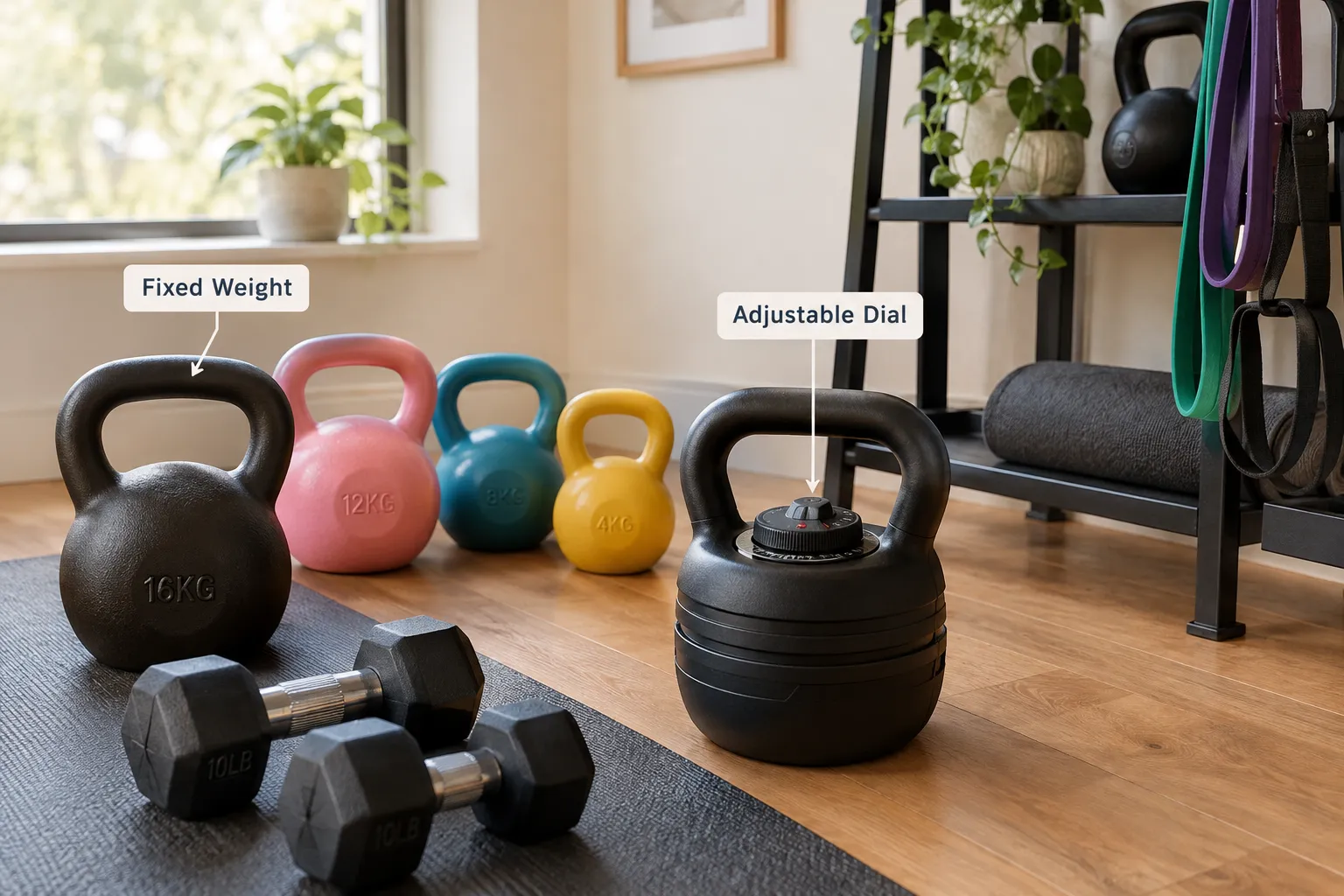
Adjustable kettlebells work reasonably well for hip hinge training, especially for deadlifts, but they are less ideal for fast ballistic moves like the swing or clean because the shifting internal plates can feel less secure mid rep.
If you have limited space or budget, an adjustable bell is still a smart compromise over owning five separate fixed weights.
Our full review of adjustable kettlebells for strength training walks through how the dial and locking mechanisms hold up under heavier hip hinge loads.
The main tradeoff is stability: a fixed cast iron bell keeps its center of mass constant through an entire swing, while an adjustable kettlebell’s selector dial adds a small amount of internal movement that some lifters notice during ballistic hip extension.
For slower, controlled lifts like the deadlift, split stance row, or strict press, this difference matters very little, and an adjustable set like the one covered in our adjustable kettlebell set guide can comfortably replace three or four fixed bells.
Can I Use a Dumbbell Instead of a Kettlebell for Hip Hinges
You can use a dumbbell for some hip hinge exercises, such as the Romanian deadlift, but a kettlebell is generally easier to control for ballistic moves like the swing because of its handle and offset center of gravity. A dumbbell works fine when the goal is a slow, controlled hinge rather than an explosive hip drive.
Here is a quick side by side comparison:
| Factor | Kettlebell | Dumbbell |
|---|---|---|
| Grip during hinge | Single handle, easy to hold close to hips | Two hands or one in each, can drift away from the body |
| Swing movements | Built for ballistic hip extension | Not designed for fast swings |
| Deadlift and RDL | Works well, close center of mass | Works well, especially for single arm or single leg work |
| Space efficiency | Compact, one piece | Takes more rack space per pair |
Romanian deadlift guides updated in 2026 note that kettlebell RDLs are often chosen for hip hinge training because the kettlebell’s center of mass and grip make it convenient and relatively easy on the hands for sets of 8 to 12 reps, a point covered in detail by this Romanian deadlift and kettlebell RDL guide.
If you already own a pair of dumbbells, they are a fine substitute for deadlifts and single leg work, but a kettlebell is still the better tool once swings and cleans enter your program.
What Is the Difference Between a Kettlebell and a Medicine Ball for Hip Hinges
A medicine ball lacks a handle, which makes it harder to control during a fast hip hinge movement like a swing, while a kettlebell’s handle allows a secure grip that supports both slow deadlifts and explosive ballistic swings. Medicine balls are better suited to slams and rotational throws than to true hip hinge training.
Some beginner programs use a light medicine ball to teach the hip hinge shape without worrying about grip, since you simply hug it to your chest.
But once you want to build real hip hinge strength, a kettlebell is the superior tool because the resistance training stimulus scales up far more easily; you can buy heavier kettlebells, but a heavier medicine ball becomes awkward to hold against your torso.
How Do I Know if My Kettlebell Is Too Heavy
Your kettlebell is too heavy for hip hinge work if your lower back rounds, your shoulders shrug up toward your ears, or your swing turns into a squat because your knees bend too much to compensate. Any of these signs means you should drop down one kettlebell size immediately.
US – View Best Deals at Amazon
UK – View Best Deals at Amazon
Other warning signs include:
- Grip failing well before your hips or hamstrings feel fatigued.
- Needing momentum or a bounce off the floor to start the next deadlift rep.
- Feeling the lift mostly in your lower back rather than your glutes and hamstrings.
- Breath holding or straining through your neck during a swing.
According to form guidance for the kettlebell deadlift, the weight should always allow controlled hip hinging with a neutral spine, challenging the glutes and hamstrings without spinal flexion.
If you cannot maintain that shape for your planned rep range, the bell is too heavy, full stop, regardless of how advanced you think you are.
Common Mistakes When Choosing Kettlebell Weight
The most common mistake is picking a kettlebell based on ego rather than form, grabbing the heaviest bell on the rack instead of the one that lets you perform every rep correctly.
A close second is assuming one kettlebell weight should work for every exercise in a session.
Other frequent mistakes:
- Jumping too many kilograms at once instead of progressing gradually after a few weeks of clean reps.
- Ignoring reps in reserve and training every set to failure, which wears down form over a workout.
- Choosing weight based on what a friend uses rather than your own hip hinge mechanics and mobility.
- Using the same bell for curls, presses, and deadlifts, then wondering why the arms fatigue before the hips do.
At a meta level, your kettlebell choice should serve the movement, not your ego. Start lighter than you think you need, confirm your hip hinge pattern looks clean on video or in a mirror, then add weight once the pattern holds for every rep in the set.
Kettlebell Hip Hinge Form Tips to Avoid Injury
The safest way to protect your back during kettlebell hip hinge training is to keep the bell close to your body, maintain a flat back, and let your hips, not your lower spine, generate the movement.
Form matters more than weight, and a lighter kettlebell with perfect mechanics builds more long term strength than a heavy one with a rounded back.
Key cues to remember:
- Hips back, chest forward: start every rep by pushing your hips behind you, not by bending your knees.
- Keep the kettlebell close: let it travel near your shins and thighs rather than drifting away from your body.
- Push through the heels: your weight should stay in your heels and mid foot, not your toes.
- Brace and breathe: take a breath, brace your core like you are about to be tapped in the stomach, then hinge.
- Squeeze your glutes at the top: this locks in hip extension and takes pressure off your lower back.
- Aim for a flat back on every single rep, even the last one in a tiring set.
Continue practicing the hinge without weight whenever your form feels shaky, and support your early sessions with a mirror, a coach, or a phone camera so you can check your position against these cues.
Kettlebell Price Comparison: Where to Buy the Right Kettlebell
Kettlebell prices vary mainly by material, size, and brand, with basic vinyl coated cast iron bells costing less per kilogram than premium competition style kettlebells.
Shoppers in the US, UK, Canada, or Brasil can generally find solid starter kettlebells through major fitness retailers and online marketplaces without paying for features they do not need yet.
A few buying tips:
- Fixed cast iron kettlebells typically offer the best value per kilogram for hip hinge training.
- Adjustable kettlebell sets cost more upfront but can replace three to five fixed bells over time.
- Budget vinyl coated options, like the one covered in our Amazon Basics vinyl kettlebell review, are a reasonable entry point if you are not yet sure how often you will train.
- Check seller reviews for handle quality and seam smoothness, since a rough seam can tear up your palms during high rep swings.
If this guide helped you narrow down your options, feel free to share it using the facebook twitter pinterest icons below, or save it to twitter pinterest linkedin for later reference.
A Simple Hip Hinge Kettlebell Workout for Beginners
A beginner hip hinge kettlebell workout should combine the deadlift and swing with adequate rest, using a moderate weight kettlebell for 2 to 3 sessions per week. This builds the pattern without overloading a new lifter’s back or grip.
Try this starting template:
- Kettlebell deadlift: 3 sets of 8 reps, moderate weight, 60 to 90 seconds rest.
- Kettlebell swing: 3 sets of 12 to 15 reps, same or slightly lighter bell, 60 seconds rest.
- Goblet squat: 2 sets of 10 reps.
- Split stance row: 2 sets of 10 reps per side.
- Strict press: 2 sets of 8 reps per side, using your lighter kettlebell.
Get through this routine twice a week for the first month, then increase weight kettlebell use gradually once every set finishes with one or two reps in reserve and a clean hip hinge pattern.
Our kettlebell weights for beginners guide and our hip hinge kettlebell breakdown both offer additional programming detail if you want to extend this plan into a longer cycle.
US – View Best Deals at Amazon
UK – View Best Deals at Amazon
Kettlebell Hip Hinge vs Barbell Deadlift: Which Is Better
Neither tool is objectively better; the kettlebell hip hinge is friendlier for beginners, home gyms, and joint comfort, while the barbell deadlift allows much heavier total loads once technique is established.
Choose the kettlebell if you train at home or are new to hinging, and add the barbell once you want to push past the weight a kettlebell set can offer.
Barbells often rely on bumper plates cast in rubber or plates cast iron for loading, and swapping cast iron plates means iron plates change the bar’s total weight in large jumps, unlike kettlebells, which come in fixed single units that let you progress in smaller steps.
Some home gyms also use an aluminum pulley set for cable rows, but a pulley set weight stack cannot replicate the free moving hip hinge pattern a kettlebell or barbell provides.
For most people starting out, a kettlebell deadlift teaches the hip hinge pattern more safely, and our kettlebell swing guide shows how that same pattern carries over into explosive training once the basics feel automatic.
Frequently Asked Questions
How to choose a kettlebell?
Choose a kettlebell weight that lets you deadlift or swing for 8 to 15 reps with a flat back and strong hip drive. Most women start around 8 to 16 kg and most men start around 12 to 24 kg. Pick a cast iron bell with a wide base and smooth handle, and plan to own at least two sizes for different exercises.
What do hip hinge movements train?
Hip hinge movements primarily train the glutes, hamstrings, and lower back through hip extension rather than knee bending. They also reinforce a neutral spine position, improve lower body strength, and teach a safer way to lift objects off the ground in daily life, reducing strain on the lumbar spine during bending tasks.
How to do a hip thrust with a kettlebell?
Sit on the floor with your upper back against a bench, kettlebell resting across your hip crease, feet flat and knees bent. Drive through your heels, squeeze your glutes, and extend your hips until your body forms a straight line from shoulders to knees. Lower under control and repeat for 8 to 12 reps.
Which hand to hold kettlebell for single leg deadlift?
Most coaches recommend holding the kettlebell in the hand opposite your standing leg, since this challenges the hips to resist rotation and builds stability. Some programs also use the same side hand for a different balance challenge, so try both and use whichever lets you keep a flat back and level hips through the full range of motion.
Conclusion
Choosing the Right Kettlebell for Hip Hinge Training comes down to matching the weight kettlebell choice to your current strength, not to what looks impressive on a rack.
Start with a bell you can deadlift and swing for a clean set of 8 to 15 reps, confirm your hips, not your lower back, are doing the work, and add weight only once that pattern holds steady.
A heavier bell for deadlifts and swings, paired with a lighter one for presses, curls, and pullover work, covers nearly every hip hinge and accessory need in a home gym.
From here, perform a short self check: record your next deadlift set on video, compare it against the form cues in this guide, and adjust your kettlebell size before your next session.
If you are ready to buy, compare current options and pricing through this US retailer link or this UK retailer link, and remember that the best kettlebell is simply the one that lets you hinge safely, set after set, for years to come.