A Beginner Kettlebell Program
Latest Update: October 18, 2026
A Beginner Kettlebell Program, First Movements and Weekly Progression should give you a clear order for learning the lifts, a manageable weekly schedule, and a way to progress without rushing technique. We start with controlled strength movements, build the hip hinge, then add faster lifts only when your movement stays consistent.
Key Takeaways
- Choose a kettlebell you can control for each movement. A load suited to deadlifts may be too heavy for presses.
- Learn the kettlebell deadlift, goblet squat, row, and press before adding faster lifts.
- Build a repeatable hip hinge before practising the kettlebell swing.
- Start with two training days that are not consecutive, and leave room between sessions.
- Progress one variable at a time, such as repetitions, sets, load, or movement difficulty.
- Track each exercise, the bell load, your repetitions, and whether your technique stayed consistent.
- Use a shallower range, an unloaded rehearsal, or a lighter bell when a movement is not controlled.
View Best Deals at Amazon
Choose a suitable bell and prepare your training space
Choose a kettlebell you can control for the movement you plan to practise. A bell that works for a deadlift may be too heavy for an overhead press, so do not choose a single weight based on one exercise and assume it suits every lift.
Commercial kettlebells are offered in capacities from 3 pounds to 100 pounds or more, according to Cureus. For a beginner, control matters more than selecting the heaviest bell you can move once.
If a bell feels too heavy for a movement, rehearse the pattern without a bell or choose a lighter load. Do not shorten the movement or strain through a repetition to make a mismatched weight work.
Before each session, warm up with easy bodyweight hinges and squats, then practise the first movement with light effort.
Clear enough space to set the bell down and move without obstacles, and hold the handle securely without squeezing it too tightly.
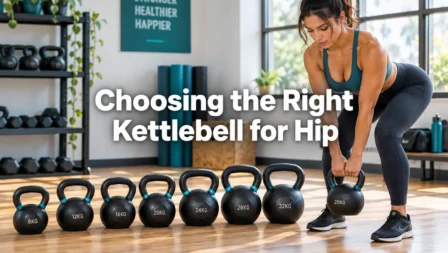
Use the images below as a visual reference when comparing beginner weight choices and kettlebell styles.
Learn controlled strength movements before fast lifts
View Best Deals at Amazon
Start with the kettlebell deadlift to learn the hip hinge. Send your hips back, keep your spine neutral, and stand by driving your hips forward rather than pulling with your arms.
Next, add the goblet squat. Hold the bell close to your chest and keep your whole foot grounded so the load stays balanced as you lower and stand.
Practise presses and single arm rows with a load you can control. Keep your wrist aligned with your forearm, and avoid leaning or twisting to finish a repetition.
Cleveland Clinic advises aiming for two to three sets of eight to 10 repetitions for each exercise. Stop each set while you can still repeat the same technique on the next repetition.
Our 20 Minute Kettlebell Workout for Beginners describes five movements, the squat and press, swing, deadlift, clean and press, and goblet squat. It gives beginners a movement reference, while the sequence below keeps fast lifts for later practice.
The images show a kettlebell set and a training scene to help make the basic movement patterns easier to picture.
For the deadlift and squat, breathe out as you stand and reset before the next repetition. For a press, keep the wrist stacked over the forearm and finish without arching your back to move the bell.
View Best Deals at Amazon
Build the hip hinge before practising swings
Practise repeated hip hinges and deadlifts before adding a kettlebell swing. A swing depends on sending your hips back, then extending them powerfully, so the movement should come from the hips rather than a squat or an arm lift.
Before adding speed, keep the hinge controlled, the spine neutral, and the bell close to your body. Your arms guide the bell through its path, but they should not pull it upward to create the lift.
Begin swing practice with small, deliberate sets. End the set if the hinge turns into a squat, your back rounds, or your arms start lifting the bell.
Learn the clean only after you can guide the swing along a controlled path. Leave snatches and other faster or more complex lifts for later practice, and use sumo swing guide only if that variation is relevant to the movement you are learning.
A beginner kettlebell swing is a hip hinge with a powerful extension, not a squat performed quickly. Keep the movement precise before you add more repetitions or speed.
Use a weekly schedule that leaves room to recover
A good kettlebell routine for beginners starts with two nonconsecutive training days, such as Monday and Thursday. Spacing sessions gives you time between practices rather than packing demanding work into consecutive days.
Session A can pair deadlifts, goblet squats, and rows. Session B can repeat controlled strength work and include swings only when you have established the hinge prerequisites.
For a concrete starting workload, use two sets of eight repetitions for deadlifts and goblet squats, and eight rows per side in each session.
This uses the low end of the two to three sets of eight to 10 repetitions noted earlier. Rest until your breathing is steady and you can reset your grip and position without rushing; take longer if needed.
Repeat those controlled lifts in Session A and Session B. Once your hinge stays consistent, add two sets of eight swings at the end of Session B.
Set the bell down between swing sets, reset your hinge, and stop early if your movement changes.
Len Kravitz, University of New Mexico, reports that each subject trained twice a week with at least 72 hours between training sessions.
Each subject trained twice a week with at least 72 hours between sessions.
Keep other days easy or use them for general movement. If fatigue makes your technique less consistent, reduce the work in your next session instead of forcing the planned volume.
View Best Deals at Amazon
A basic kettlebell workout plan can stay simple: repeat the same strength movements in both sessions, then add swings to one day when your hinge stays controlled.
You do not need a separate hard conditioning session to make the first weeks productive.
Progress one training variable at a time
Repeat the same load and repetitions until every working set looks controlled, with a neutral spine and a steady bell path. Consistent technique is the first sign that you are ready to progress.
Once the current work is repeatable, add a small amount of volume or load, not both at once. Keep speed and movement difficulty steady while you make that change, so you can judge how it affects control.
Use this flexible four week outline as a starting point, not a deadline. Repeat a week when you need more practice.
| Week | Training focus | Progression choice |
|---|---|---|
| Week 1 | Practise deadlifts, goblet squats, and rows on two days. | Choose a manageable load and focus on repeatable movement. |
| Week 2 | Repeat the same movements, load, and repetitions. | Build consistency before changing the plan. |
| Week 3 | Continue the same work if technique needs practice. | If every set stays controlled, add one repetition per set, up to 10; otherwise keep the same repetitions. |
| Week 4 | Keep the same movement difficulty. | Once an exercise reaches 10 controlled repetitions in every set, move to the next available bell and return to eight repetitions per set. If it has not reached 10, keep the load and add one repetition per set only when every repetition stays controlled. |
Record the movement, bell load, repetitions, and whether technique stayed consistent. These notes make the next session target clear and help you distinguish a genuine improvement from a rushed increase.
An EMOM workout is optional conditioning after you have established the basic movements.
Our Kettlebell EMOM, 20 Minute Workout gives a 20 minute finisher with beginner, intermediate, and advanced examples, plus guidance on choosing weights and modifying the workout.
It belongs later in the plan, not at the foundation of your first sessions.
These program images offer additional visual context for kettlebell training and workout planning.
View Best Deals at Amazon
Adapt the plan when a movement does not fit
If you cannot control the full squat pattern, use a shallower range or rehearse the movement without a bell. Build the range only as the movement allows, rather than forcing a deeper position.
When one kettlebell suits some exercises but not others, keep the movements you can control with that bell and use a bodyweight pattern or lighter load for the rest.
A single weight does not need to fit every exercise in your beginner kettlebell program.
If pain or a mobility restriction changes how you can perform a movement, stop that drill and seek guidance from a qualified coach.
Discuss relevant health concerns with a healthcare professional before choosing how to train.
Do not make up a missed session by doubling the next workout. Resume the plan at its usual session, then progress only when your technique stays consistent.
For additional guidance on adjusting practice to your starting point, see our kettlebell training guidance for adults over 40 and our guide to kettlebell training for seniors.
Frequently Asked Questions
How long should a beginner rest between kettlebell sets?
Start with a comfortable rest, then take longer if you need it to regain steady breathing and reset your grip. The next set should begin when you can focus on the movement rather than rushing to the bell.
What should I do if I miss one of my planned workouts?
Move the remaining session to the next open day while keeping your usual space between training days. If that does not fit your week, return to your normal schedule the following week instead of compressing sessions.
When should a beginner learn the Turkish get up?
Learn it after you are comfortable standing up and lowering yourself to the floor with control. Practise the floor to standing sequence without a bell first, then join the separate positions into one smooth movement.
Can I combine kettlebell training with running in the same week?
Yes, you can schedule running and kettlebell practice in the same week. Keep harder runs away from the session where you are learning a new movement, and use an easy run when you want to keep the effort modest.
Do I need a mirror to check my kettlebell form?
No, a mirror is optional. A short video from the side can help you review your hip hinge and bell path, while keeping your attention on the movement during the set.
Is there a free PDF for a beginner kettlebell program?
A separate downloadable PDF is not provided here, but you can save or print the weekly schedule and session prescription above as your plan. Copy the exercises, sets, repetitions, and loads into a notebook, then use the progression table to track your technique and next step.
Conclusion
A Beginner Kettlebell Program, First Movements and Weekly Progression works best when you build controlled strength before adding speed, then increase only one training variable at a time.
Start with two spaced sessions, track your movement quality, and let consistent technique guide the next step.