Tabata Workouts for Beginners
Latest Upadte: April 24, 2026
Just four minutes of exercise can deliver the same cardiovascular benefit as 45 minutes of moderate-intensity cardio, that’s the finding that launched Tabata training into mainstream fitness culture and hasn’t stopped turning heads since.
If you’re new to high-intensity training, Tabata Workouts For Beginners offer one of the most time-efficient, science-backed entry points into serious fitness, no gym membership required.
This guide breaks down exactly what Tabata is, how it works, and how you can start safely as a complete beginner in 2026.
Key Takeaways 🎯
- Tabata = 20 seconds of max effort + 10 seconds of rest, repeated 8 times for a 4-minute block
- Beginners should start with bodyweight-only exercises before adding weights or equipment
- A full beginner Tabata session needs only 20–30 minutes, including warm-up and cool-down
- Tabata training boosts both aerobic and anaerobic fitness simultaneously
- Rest and recovery days are essential, limit Tabata sessions to 3–4 times per week
What Is Tabata Training? Understanding the Protocol
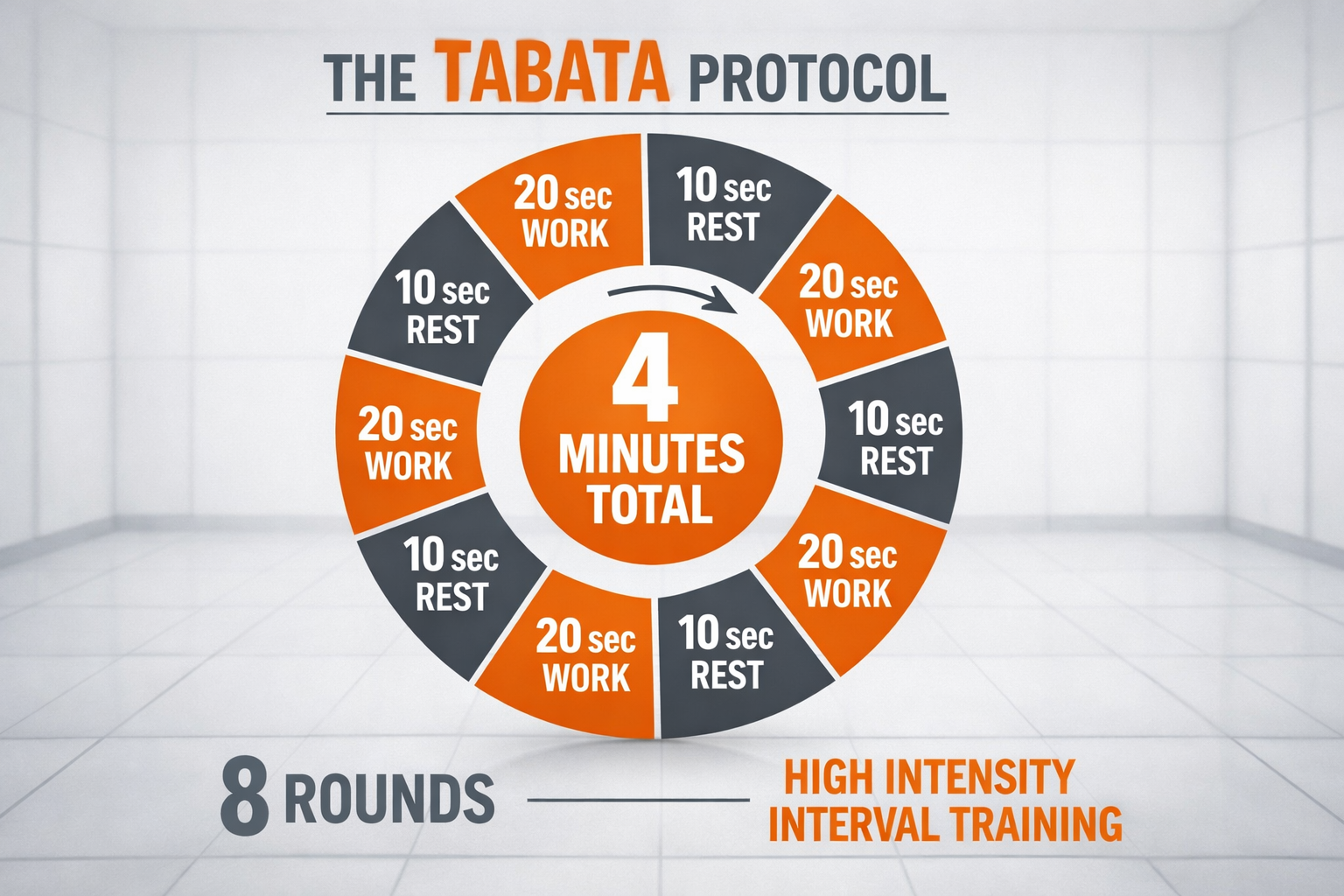
Tabata training is a specific form of High-Intensity Interval Training (HIIT) developed by Japanese scientist Dr. Izumi Tabata in 1996.
His research at the National Institute of Fitness and Sports in Tokyo showed that this precise interval structure improved both aerobic capacity and anaerobic endurance more effectively than steady-state cardio.
The Tabata Formula
| Phase | Duration | Intensity |
|---|---|---|
| Work Interval | 20 seconds | Maximum effort (90–100%) |
| Rest Interval | 10 seconds | Complete rest |
| Rounds per Set | 8 rounds | — |
| Total Set Duration | 4 minutes | — |
“The beauty of Tabata is its brutal simplicity. You work as hard as you possibly can for 20 seconds, rest for 10, and repeat. That’s it.”
One “Tabata” equals a single 4-minute block. A beginner workout might include 3–5 of these blocks with longer rest periods between them, totaling 20–30 minutes of structured training.
How Tabata Differs From Regular HIIT
While all Tabata is HIIT, not all HIIT is Tabata. Standard HIIT workouts vary widely in their work-to-rest ratios (often 1:1 or 1:2).
Tabata uses a strict 2:1 work-to-rest ratio (20 seconds on, 10 seconds off), which creates a uniquely intense metabolic demand.
If you’re exploring related formats, check out these HIIT kettlebell workouts for fat burning and muscle building for a complementary approach.
Why Tabata Workouts for Beginners Are Worth It 💪
Many beginners assume Tabata is only for advanced athletes. That’s a myth worth busting immediately.
Here’s why beginners actually benefit most:
- ✅ Short sessions reduce the intimidation factor of long workouts
- ✅ Bodyweight exercises mean zero equipment needed to start
- ✅ Structured intervals remove guesswork, you always know what’s coming
- ✅ Measurable progress is easy to track (more reps per round over time)
- ✅ Metabolic boost continues for hours after the workout ends (the “afterburn” effect)
The Science Behind the Results
Dr. Tabata’s original study found that participants doing the protocol five days per week for six weeks improved their VO2 max by 14% and anaerobic capacity by 28%.
These are significant numbers for any fitness level, but especially meaningful for beginners starting from a lower baseline.
For those interested in pairing Tabata with other beginner-friendly formats, our guide to bodyweight Tabata workouts is a great companion resource.
Your First Tabata Workouts for Beginners: Step-by-Step

Starting Tabata Workouts for Beginners the right way means prioritizing form over speed, building a foundation before adding intensity, and listening to your body throughout.
Step 1: Master Your Warm-Up (5–7 Minutes)
Never skip the warm-up. Cold muscles are injury-prone muscles.
Beginner warm-up routine:
- 60 seconds: March in place
- 60 seconds: Arm circles (forward and backward)
- 60 seconds: Hip circles
- 60 seconds: Bodyweight squats (slow and controlled)
- 60 seconds: Leg swings
- 30 seconds: Light jumping jacks
Step 2: Choose Beginner-Friendly Tabata Exercises
The best exercises for your first Tabata sessions are ones you can perform with good form even when fatigued. Here are the top picks:
| Exercise | Muscles Targeted | Difficulty |
|---|---|---|
| Bodyweight Squats | Quads, glutes, hamstrings | ⭐ Easy |
| Modified Push-Ups | Chest, shoulders, triceps | ⭐ Easy |
| High Knees (low impact) | Core, hip flexors, cardio | ⭐⭐ Moderate |
| Glute Bridges | Glutes, hamstrings | ⭐ Easy |
| Mountain Climbers (slow) | Core, shoulders, cardio | ⭐⭐ Moderate |
| Step Jacks | Full body, cardio | ⭐ Easy |
Step 3: A Sample Beginner Tabata Workout
Total time: ~25 minutes
Warm-up: 5 minutes (as above)
Block 1 — Lower Body (4 minutes)
- 20 sec: Bodyweight squats → 10 sec rest (×8)
Rest: 90 seconds
Block 2 — Upper Body (4 minutes)
- 20 sec: Modified push-ups → 10 sec rest (×8)
Rest: 90 seconds
Block 3 — Cardio (4 minutes)
- 20 sec: Step jacks → 10 sec rest (×8)
Cool-down: 5 minutes of light stretching
Pro tip: Use a free Tabata timer app on your phone. Trying to track 20/10 intervals manually will break your focus and your rhythm.
Step 4: Progress Gradually
After 2–3 weeks of the above, you can:
- Add a 4th Tabata block
- Replace modified push-ups with standard push-ups
- Increase step jacks to actual jumping jacks
- Begin exploring Tabata workouts with weights for added resistance
Common Mistakes Beginners Make (And How to Avoid Them)
Even a well-designed protocol can backfire if you approach it incorrectly. Here are the most frequent beginner errors:
❌ Going Too Hard Too Fast
Tabata demands maximum effort, but “maximum” is relative to your current fitness level. A beginner’s 100% effort looks very different from an advanced athlete’s. Don’t try to keep up with online videos featuring elite athletes.
❌ Skipping Rest Periods
The 10-second rest is not optional. It’s built into the protocol for a reason. Cutting it short defeats the purpose and increases injury risk.
❌ Poor Footwear
Lateral movement, jumping, and quick direction changes require proper support. Wearing the wrong shoes during high-intensity work is a common cause of ankle and knee issues. Check out this helpful guide on choosing good workout shoes before your first session.
❌ Training Every Day
Tabata is intense. Your muscles and nervous system need recovery time. 3–4 sessions per week is the sweet spot for beginners. On off days, consider walking, yoga, or light mobility work.
❌ Ignoring Form Breakdown
When your form falls apart during the 20-second work interval, slow down or stop. Sloppy reps under fatigue are how injuries happen. Quality always beats quantity.
How to Build a Weekly Tabata Schedule for Beginners
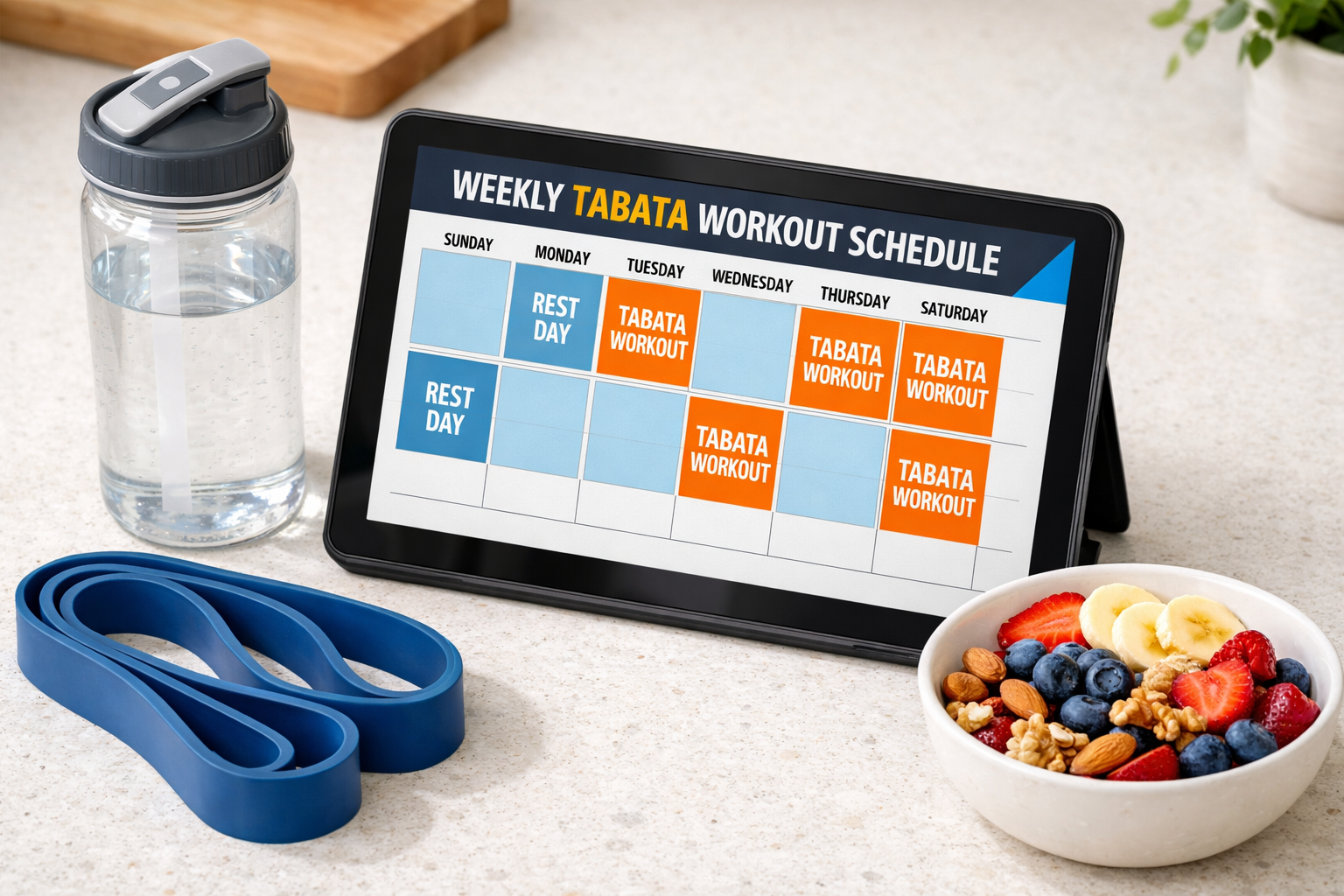
Consistency beats intensity every time, especially for beginners. Here’s a realistic weekly structure:
| Day | Activity |
|---|---|
| Monday | Tabata Session (Lower Body focus) |
| Tuesday | Rest or light walk |
| Wednesday | Tabata Session (Upper Body focus) |
| Thursday | Active recovery (yoga, stretching) |
| Friday | Tabata Session (Full Body) |
| Saturday | Rest |
| Sunday | Optional: light activity or rest |
This schedule gives your body 48 hours between intense sessions, which research consistently shows is the minimum recovery window for high-intensity training.
As you grow stronger and more conditioned, you might explore complementary training styles. For example, pairing Tabata with a 20-minute kettlebell workout on alternate days is an excellent progression strategy.
If you’re over 50 or working with specific physical considerations, our dedicated guide to Tabata workouts for seniors offers age-appropriate modifications and safety guidelines.
Tabata vs. Other Beginner Workout Formats
Not sure if Tabata is the right fit for you right now? Here’s how it compares:
| Format | Session Length | Equipment Needed | Intensity Level | Best For |
|---|---|---|---|---|
| Tabata | 20–30 min | None required | Very High | Time-efficient fat loss & cardio |
| Steady-State Cardio | 30–60 min | None | Low–Moderate | Endurance base building |
| Traditional Strength | 45–60 min | Weights | Moderate | Muscle building |
| CrossFit beginner workouts | 45–60 min | Varies | High | Functional fitness |
| Yoga | 30–60 min | Mat | Low | Flexibility, recovery |
Tabata wins on time efficiency and metabolic impact. It’s not always the best standalone option, but it’s an exceptional tool in a well-rounded fitness plan.
Nutrition Tips to Support Your Tabata Training
Exercise is only half the equation. To get the most from tabata workouts for beginners, fuel your body properly:
- 🥗 Pre-workout (60–90 min before): Light meal with complex carbs and protein (e.g., oatmeal with Greek yogurt)
- 💧 Hydration: Drink at least 500ml of water before training; sip during rest periods
- 🍗 Post-workout (within 45 min): Protein-rich meal to support muscle repair (e.g., chicken, eggs, legumes)
- 🚫 Avoid: Heavy meals immediately before training, Tabata’s intensity makes this a recipe for discomfort
Conclusion: Start Small, Stay Consistent, See Results
Tabata training is one of the most powerful fitness tools available to beginners in 2026 — precisely because it demands so little time while delivering outsized results.
The key is starting at your own pace, mastering the basics, and building intensity gradually over weeks, not days.
Your actionable next steps:
- ✅ Download a free Tabata timer app today
- ✅ Complete your first beginner Tabata session this week using the sample workout above
- ✅ Schedule 3 sessions per week into your calendar for the next 30 days
- ✅ Track your reps per round to measure progress objectively
- ✅ After 4 weeks, explore the best Tabata workouts to level up your training
The hardest part of any fitness journey is starting. With Tabata, that start takes just four minutes. You’ve got this. 🔥
References
- Tabata, I., Nishimura, K., Kouzaki, M., Hirai, Y., Ogita, F., Miyachi, M., & Yamamoto, K. (1996). Effects of moderate-intensity endurance and high-intensity intermittent training on anaerobic capacity and VO2max. Medicine & Science in Sports & Exercise, 28(10), 1327–1330.
- Emberts, T., Porcari, J., Dobers-tein, S., Steffen, J., & Foster, C. (2013). Exercise intensity and energy expenditure of a Tabata workout. Journal of Sports Science & Medicine, 12(3), 612–613.
- American College of Sports Medicine. (2018). ACSM’s Guidelines for Exercise Testing and Prescription (10th ed.). Wolters Kluwer.
- Gillen, J. B., & Gibala, M. J. (2014). Is high-intensity interval training a time-efficient exercise strategy to improve health and fitness? Applied Physiology, Nutrition, and Metabolism, 39(3), 409–412.