Hiit Training Workout For Beginners
Last updated: April 5, 2026
Quick Answer: A Hiit Training Workout For Beginners alternates short bursts of high-effort exercise (20–40 seconds) with brief rest periods (10–20 seconds), repeated for 10–20 minutes total.
You don’t need equipment or a gym. Starting with bodyweight moves like squats, mountain climbers, and modified push-ups gives you a safe, effective entry point that builds cardiovascular endurance and burns fat without overwhelming your body.
Key Takeaways
- HIIT stands for High-Intensity Interval Training — it alternates work and rest periods to keep your heart rate elevated and maximize calorie burn in less time.
- Beginners should start with 10–15 minute sessions, 2–3 times per week, and build up gradually over 4–6 weeks.
- No equipment is required — bodyweight exercises like squats, jumping jacks, and mountain climbers are fully effective for beginners.
- Low-impact modifications exist for every exercise, making HIIT accessible regardless of fitness level, age, or joint sensitivity.
- Warm-up and cool-down are non-negotiable — skipping them increases injury risk and slows recovery.
- Heart rate monitoring helps you train smarter — aim for 80–90% of your max heart rate during work intervals [2].
- HIIT improves cardiovascular health, boosts metabolism, and supports fat loss — all documented benefits recognized by fitness and health authorities [1].
- Recovery matters as much as the workout itself — rest days, sleep, and nutrition all affect your results.
- Progression is the key to long-term success — increase duration, intensity, or complexity every 2–3 weeks.
- Mental health benefits are real — HIIT triggers endorphin release, reduces stress, and builds confidence over time.
What Is HIIT and How Does It Work?
HIIT, or High-Intensity Interval Training, is a workout method that alternates short bursts of intense effort with brief recovery periods.
A typical interval might be 30 seconds of hard work followed by 15 seconds of rest, repeated for several rounds.
The goal is to push your heart rate high during the work phase, then let it partially recover before the next round.
The science behind it is straightforward. When you push hard for short bursts, your body burns more calories both during and after the workout, a phenomenon often called excess post-exercise oxygen consumption (EPOC).
This means your metabolism stays elevated for hours after you finish [2].
How a basic HIIT interval works:
- Work phase: Exercise at 80–90% of your maximum effort for 20–40 seconds [2]
- Rest phase: Slow down, breathe, or stop completely for 10–20 seconds
- Repeat: Complete 6–10 rounds per exercise or circuit
- Total session: 10–20 minutes for beginners, under 30 minutes for most people [2]
“High-intensity interval training is recognized as a highly effective way to improve cardiovascular health, boost metabolism, and increase overall fitness.”
Who HIIT is for: Anyone who wants time-efficient cardio, fat loss, or improved endurance, including complete beginners, provided they start with appropriate modifications.
Who should check with a doctor first: Anyone with heart conditions, joint injuries, high blood pressure, or who has been sedentary for a year or more. A quick medical clearance is worth it.
What Are the Benefits of HIIT for Beginners?
HIIT delivers more fitness improvement per minute than most other workout styles, which makes it especially valuable for beginners who are short on time. You don’t need an hour at the gym to see real results.
Here’s what science and practice confirm about HIIT benefits:
| Benefit | What It Means for Beginners |
|---|---|
| Improved cardiovascular health | Stronger heart, better endurance [1] |
| Increased calorie burn | Burns fat during and after the workout [2] |
| Muscle preservation | Builds and maintains lean muscle mass |
| Time efficiency | Real results in 10–20 minutes [2] |
| No equipment needed | Works anywhere, any time |
| Mental health boost | Reduces anxiety, improves mood |
| Metabolic conditioning | Speeds up resting metabolism over time |
Mental health angle most beginners overlook: HIIT triggers a significant endorphin response.
Many beginners report that after 2–3 weeks of consistent training, their stress levels drop noticeably and their sleep improves. This psychological reward loop is one of the strongest motivators to keep going.
For different age groups: Older beginners (50+) benefit from low-impact HIIT variations that protect joints while still elevating heart rate.
Younger beginners (20s–30s) can typically progress to higher-impact moves faster. If you’re over 50, check out beginner-friendly kettlebell workouts designed for women over 50 for age-appropriate progressions.
How to Start a HIIT Training Workout For Beginners at Home
One tool worth considering is the TRX Pro3 Home Gym System, a professional-grade suspension trainer that works.
You can start a HIIT training workout for beginners at home today with zero equipment and a 6×6 foot space. The key is choosing the right exercises, setting a realistic work-to-rest ratio, and committing to consistency over perfection.
Step 1: Warm Up (5 Minutes)
Never skip this. A proper warm-up reduces injury risk and improves performance.
- March in place — 60 seconds
- Arm circles (forward and backward) — 30 seconds each direction
- Hip circles — 30 seconds
- Leg swings (front to back, side to side) — 30 seconds per leg
- Dynamic squats (slow, controlled) — 60 seconds
Step 2: Choose Your Work-to-Rest Ratio
Beginners should start with a 1:2 ratio (work twice as long as you rest):
- Option A: 20 seconds work / 40 seconds rest (very beginner)
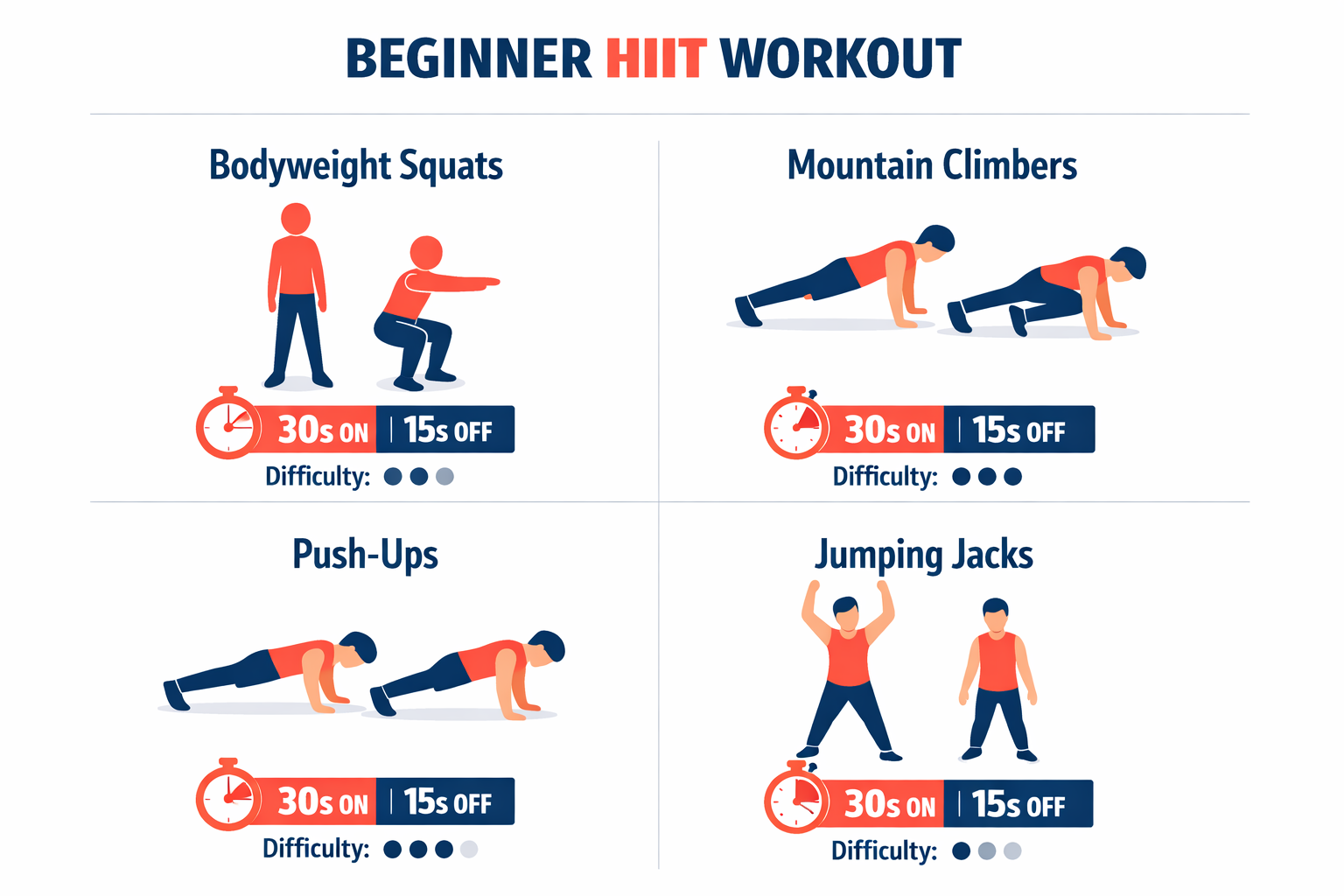
- Option B: 30 seconds work / 15 seconds rest (standard beginner) [2]
- Option C: 40 seconds work / 20 seconds rest (progressing beginner)
Step 3: The 15-Minute Beginner HIIT Workout
Complete this circuit twice with a 60-second rest between rounds:
Round 1 & 2 (6 exercises, 30 seconds each, 15 seconds rest between):
- Jumping jacks — full body warm-up, low skill requirement
- Bodyweight squats — legs, glutes, core
- Mountain climbers — core, cardio, upper body [2]
- Push-ups (on knees if needed) — chest, shoulders, triceps [1]
- Lateral bounds (or side steps for low-impact) — legs, glutes, balance [2]
- High knees (or marching in place) — cardio, hip flexors, core
For a structured 15-minute HIIT workout with detailed timing, that resource walks through the exact sequence.
Step 4: Cool Down (5 Minutes)
- Standing quad stretch — 30 seconds per leg
- Standing hamstring stretch — 30 seconds per leg
- Child’s pose — 60 seconds
- Seated spinal twist — 30 seconds per side
- Deep breathing — 60 seconds
What Are the Best Beginner HIIT Exercises With No Equipment?
The best no-equipment HIIT exercises for beginners are movements that use multiple muscle groups simultaneously, keep the heart rate elevated, and can be modified for different fitness levels. Multi-muscle exercises maximize efficiency, you get more done in less time [1].
Top 8 Beginner-Friendly HIIT Exercises
1. Jumping Jacks
- Standard: Full jump with arms overhead
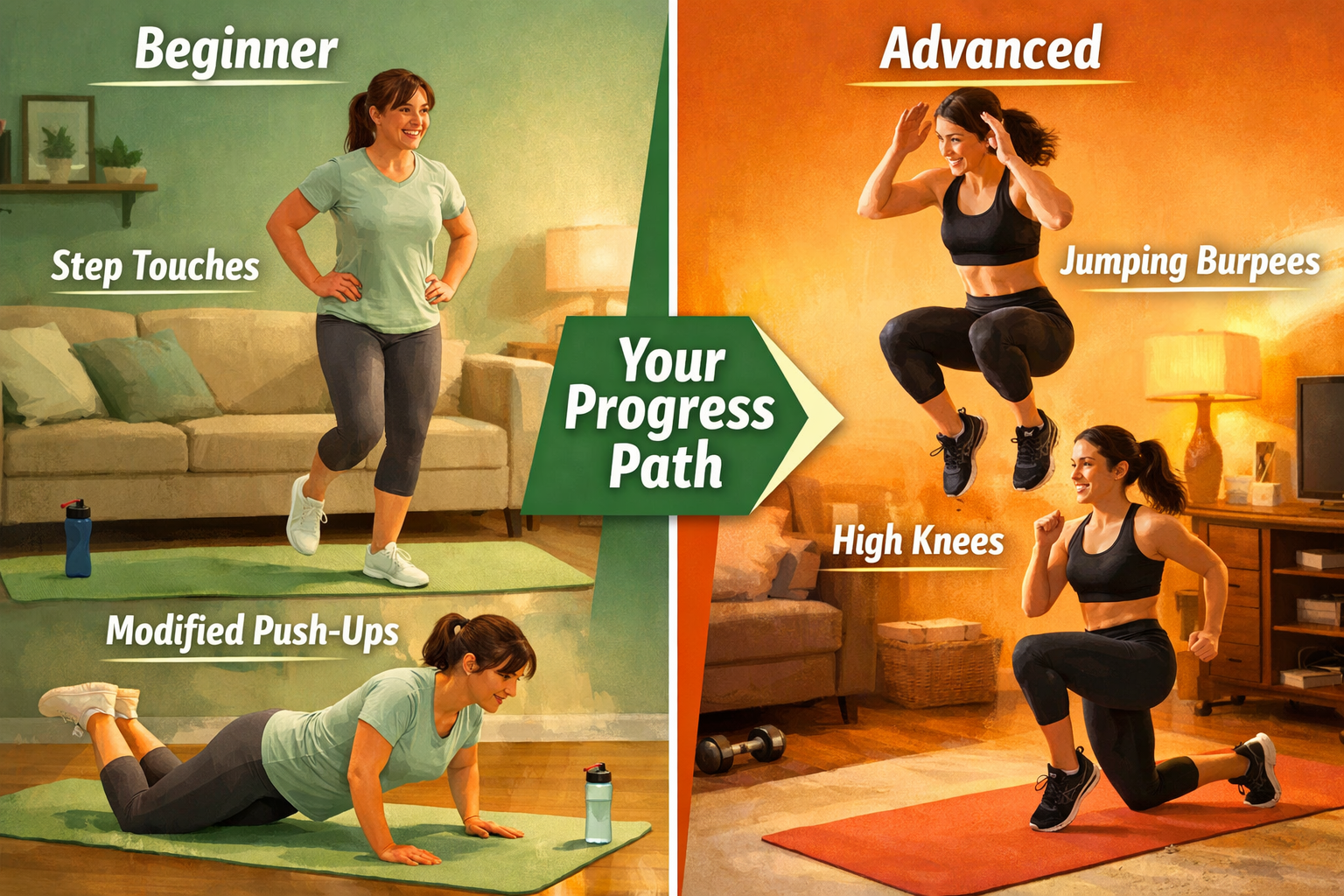
- Low-impact: Step side to side, arms raise without jumping
- Targets: Full body, cardio
2. Bodyweight Squats
- Standard: Feet shoulder-width, lower to 90 degrees
- Low-impact: Sit-to-stand from a chair
- Targets: Quads, glutes, hamstrings
3. Mountain Climbers
- Standard: Plank position, drive knees to chest alternately
- Low-impact: Slow, controlled knee drives or standing marches
- Targets: Core, shoulders, cardio [2]
4. Push-Up Burpees
- Standard: Full burpee with push-up and jump
- Low-impact: Walk feet out to plank, do a knee push-up, walk back
- Targets: Full body [2]
5. High Knees
- Standard: Run in place, knees to hip height
- Low-impact: March in place with exaggerated knee lift
- Targets: Core, hip flexors, cardio
6. Lateral Bounds
- Standard: Hop side to side on one foot
- Low-impact: Step side to side, no hop
- Targets: Legs, glutes, balance [2]
7. Plank Hold
- Standard: Forearm plank, hold for 20–30 seconds
- Low-impact: Elevated plank with hands on a couch or wall
- Targets: Core, shoulders
8. Glute Bridges
- Standard: Lie on back, feet flat, push hips to ceiling
- Low-impact: Same movement, smaller range of motion
- Targets: Glutes, hamstrings, lower back
For those ready to add tools, low-impact HIIT workouts with resistance bands or light weights can bridge the gap between bodyweight and weighted training.
How Often Should Beginners Do HIIT Workouts?
Beginners should do HIIT 2–3 times per week, with at least one full rest day between sessions. More is not better when you’re starting out — your muscles and cardiovascular system need time to adapt and recover.
Recommended weekly schedule for beginners:
| Day | Activity |
|---|---|
| Monday | HIIT workout (15 min) |
| Tuesday | Rest or light walking |
| Wednesday | HIIT workout (15 min) |
| Thursday | Rest or gentle stretching |
| Friday | HIIT workout (15 min) |
| Saturday | Active recovery (yoga, walking) |
| Sunday | Full rest |
Progression timeline:
- Weeks 1–2: 10–15 minute sessions, 2x per week, 1:2 work-to-rest ratio
- Weeks 3–4: 15–20 minute sessions, 3x per week, 1:1 work-to-rest ratio
- Weeks 5–6: 20–25 minute sessions, 3x per week, introduce new exercises
- Week 7+: Consider adding light equipment like kettlebells or suspension trainers
Common mistake: Doing HIIT every day in the first week because you feel motivated. This leads to burnout, soreness, and often quitting by week two. Consistency over 8 weeks beats intensity in week one every time.
HIIT vs. Traditional Cardio: Which Is Better for Beginners?
For most beginners, HIIT produces comparable or better cardiovascular and fat-loss results in significantly less time than steady-state cardio. That said, both have a place in a well-rounded fitness routine.
| Factor | HIIT | Traditional Cardio (Jogging, Cycling) |
|---|---|---|
| Time required | 10–20 minutes | 30–60 minutes |
| Calorie burn (during) | Moderate-high | Moderate |
| Calorie burn (after) | High (EPOC effect) | Low |
| Joint impact | Varies (modifiable) | Low-moderate |
| Muscle building | Yes (some) | Minimal |
| Equipment needed | None required | Often needed |
| Beginner-friendly | Yes, with modifications | Yes |
| Mental engagement | High (intervals keep focus) | Can be monotonous |
Choose HIIT if: You have limited time, want faster metabolic results, or get bored easily with steady-state exercise.
Choose traditional cardio if: You have joint issues, are recovering from injury, or are just starting to build a baseline fitness level.
Best approach: Combine both. Two HIIT sessions and one longer walk or easy bike ride per week covers all your bases. For more on why HIIT is superior for certain fitness goals, that breakdown covers the physiological reasoning in detail.
What Equipment Can Enhance a Beginner HIIT Training Workout?
You need zero equipment to start a HIIT training workout for beginners, but adding simple tools can significantly expand your exercise variety and increase results over time.
The key is choosing equipment that matches your current level.
Beginner-friendly equipment options:
- Yoga mat: Protects joints during floor work, improves grip
- Resistance bands: Add load without heavy weights, great for glute and upper body work
- Kettlebells: Excellent for swings, goblet squats, and farmer’s walks — multi-muscle moves that fit perfectly into HIIT circuits [1]
- Suspension trainer (TRX): Allows bodyweight training with adjustable difficulty
One tool worth considering as you progress is the TRX Pro3 Home Gym System, a professional-grade suspension trainer that works for strength training, HIIT, cardio, and full-body workouts.
It anchors to a door and scales from beginner to advanced by simply adjusting your body angle. No weights needed.
For those interested in combining HIIT with kettlebell training, the HIIT kettlebell workout guide for burning fat and building muscle is a natural next step after 4–6 weeks of bodyweight HIIT.
You can also explore TRX training with kettlebells for a powerful combination approach.
Good workout shoes matter more than most beginners realize. Proper footwear reduces joint stress during high-impact moves.
See the importance of good workout shoes for guidance on what to look for before your first session.
Nutrition and Recovery Tips to Support Your HIIT Training
What you eat and how you recover directly affect whether your HIIT workouts produce results or lead to burnout. Training hard without supporting your body is like driving fast with an empty gas tank.
Nutrition Basics for HIIT Beginners
- Pre-workout (30–60 min before): Light carbs + small protein — banana with peanut butter, Greek yogurt, or oatmeal
- Post-workout (within 45 min): Protein + carbs to rebuild muscle — eggs with toast, protein shake with fruit, or chicken with rice
- Hydration: Drink 16–20 oz of water before your session; sip during; rehydrate after
- Avoid: Heavy meals within 90 minutes of training — they slow you down and cause discomfort
Recovery Strategies That Actually Work
- Sleep 7–9 hours per night — this is when muscle repair happens
- Active recovery days — light walking or stretching keeps blood flowing without adding stress
- Foam rolling — 5–10 minutes post-workout reduces muscle soreness
- Cold water immersion or contrast showers — reduces inflammation after intense sessions
- Protein intake — aim for 0.7–1g of protein per pound of bodyweight on training days (estimate based on general sports nutrition guidance)
Common mistake: Beginners often undereat on training days, thinking it accelerates fat loss. It actually slows recovery, reduces muscle retention, and makes the next workout harder. Fuel the work.
Frequently Asked Questions About HIIT Training Workouts For Beginners
Q: How long should a beginner HIIT workout be?
A: Start with 10–15 minutes, including warm-up and cool-down. The actual work intervals might only be 8–10 minutes. Most effective HIIT sessions are under 30 minutes [2].
Q: Can I do HIIT every day as a beginner?
A: No. Beginners should do HIIT 2–3 times per week with rest days between sessions. Daily HIIT without adequate recovery leads to overtraining and injury.
Q: Is HIIT safe for overweight beginners?
A: Yes, with low-impact modifications. Replace jumping moves with stepping alternatives, use a chair for support if needed, and focus on effort level rather than specific exercises. Always consult a doctor if you have health concerns.
Q: Do I need to monitor my heart rate during HIIT?
A: It helps. During work intervals, aim for 80–90% of your maximum heart rate (estimated as 220 minus your age) [2]. A simple fitness tracker or smartwatch makes this easy.
Q: What’s the difference between HIIT and Tabata?
A: Tabata is a specific HIIT protocol: 20 seconds work, 10 seconds rest, 8 rounds (4 minutes total). It’s one of the most intense HIIT formats. Beginners should start with longer rest periods before attempting Tabata. See best Tabata workouts for more detail.
Q: Can HIIT help with weight loss?
A: Yes. HIIT burns calories during the session and continues burning after through the EPOC effect. Combined with consistent nutrition, it’s an effective fat-loss tool [2].
Q: What should I wear for a beginner HIIT workout?
A: Breathable athletic wear and supportive cross-training shoes. Avoid running shoes for lateral movements — they lack the side support needed. See good workout shoes for flat feet if you have specific foot concerns.
Q: How soon will I see results from HIIT?
A: Most beginners notice improved endurance within 2–3 weeks. Visible body composition changes typically appear after 4–8 weeks of consistent training combined with proper nutrition.
Q: Can older adults do HIIT?
A: Absolutely. Low-impact HIIT is well-suited for adults over 50 and 60. The key is choosing joint-friendly exercises and allowing more recovery time between sessions [1].
Q: What if I can’t complete all the intervals?
A: Rest longer. It’s better to complete the workout with extended rest than to quit halfway through. As your fitness improves, reduce rest time gradually.
Conclusion: Your Next Steps Start Today
A Hiit Training Workout For Beginners doesn’t require a gym membership, expensive equipment, or hours of free time.
It requires a small space, a willingness to push yourself for short bursts, and the discipline to show up consistently.
Start with 10–15 minutes, two times this week. Use the bodyweight circuit outlined above. Warm up properly, cool down completely, and rest the day after. That’s it.
Your actionable next steps:
- This week: Complete one 15-minute beginner HIIT session using the circuit in this guide
- Week 2: Add a second session; track how your heart rate and recovery feel
- Week 3–4: Extend to 20 minutes; try a 10-minute HIIT kettlebell workout to add variety
- Week 5–6: Introduce light equipment — resistance bands, a kettlebell, or a suspension trainer like the TRX Pro3
- Month 2+: Follow a structured progression plan; consider a 20-minute kettlebell workout for beginners as your next challenge
The hardest part isn’t the workout. It’s starting. You now have everything you need to begin.
TRX Pro3 Home Gym System, a professional-grade suspension trainer that works for strength training, HIIT, cardio, and full-body workouts.
References
[1] AARP Fitness Videos – https://www.aarp.org/videos/health/fitness/6298721780001/
[2] HIIT Training At Home – https://www.nourishmovelove.com/hiit-training-at-home/
[3] YouTube HIIT Workout Playlist – https://www.youtube.com/playlist?list=PLuQkxC0xJaxWTbyFqtaDCbXNRkOOvSk5Q
[4] How to Burn Fat With HIIT Workouts in 2026 – https://www.ctcd.edu/sites/myctcd/detail/?p=how-to-burn-fat-with-hiit-workouts-in-2026-a-real-world-guide-from-your-morning-mug-to-your-last-interval-6999aee6bad07