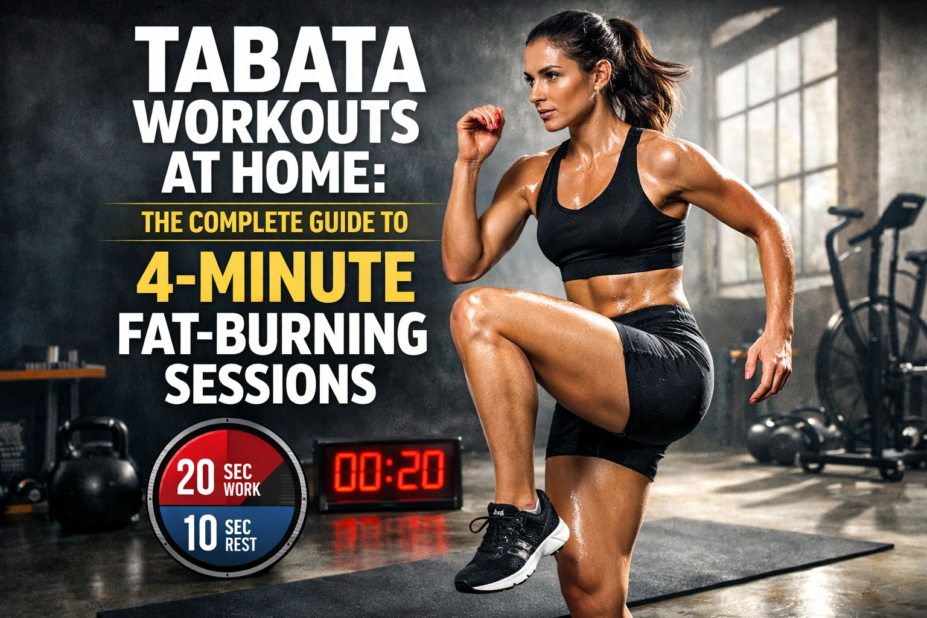
Tabata Workouts at Home
Latest Update: April 23, 2026
A 1996 study from the National Institute of Fitness and Sports in Japan changed how the world thinks about cardio forever.
Dr. Izumi Tabata discovered that just four minutes of high-intensity interval training produced greater aerobic and anaerobic gains than 60 minutes of moderate steady-state exercise.
That finding launched one of the most efficient training methods ever documented, and the best part? You can do Tabata Workouts at Home with zero equipment and a tiny patch of floor space.
Whether you’re short on time, skipping the gym, or simply want a smarter way to burn fat and build endurance, this guide covers everything you need to get started today.
Key Takeaways
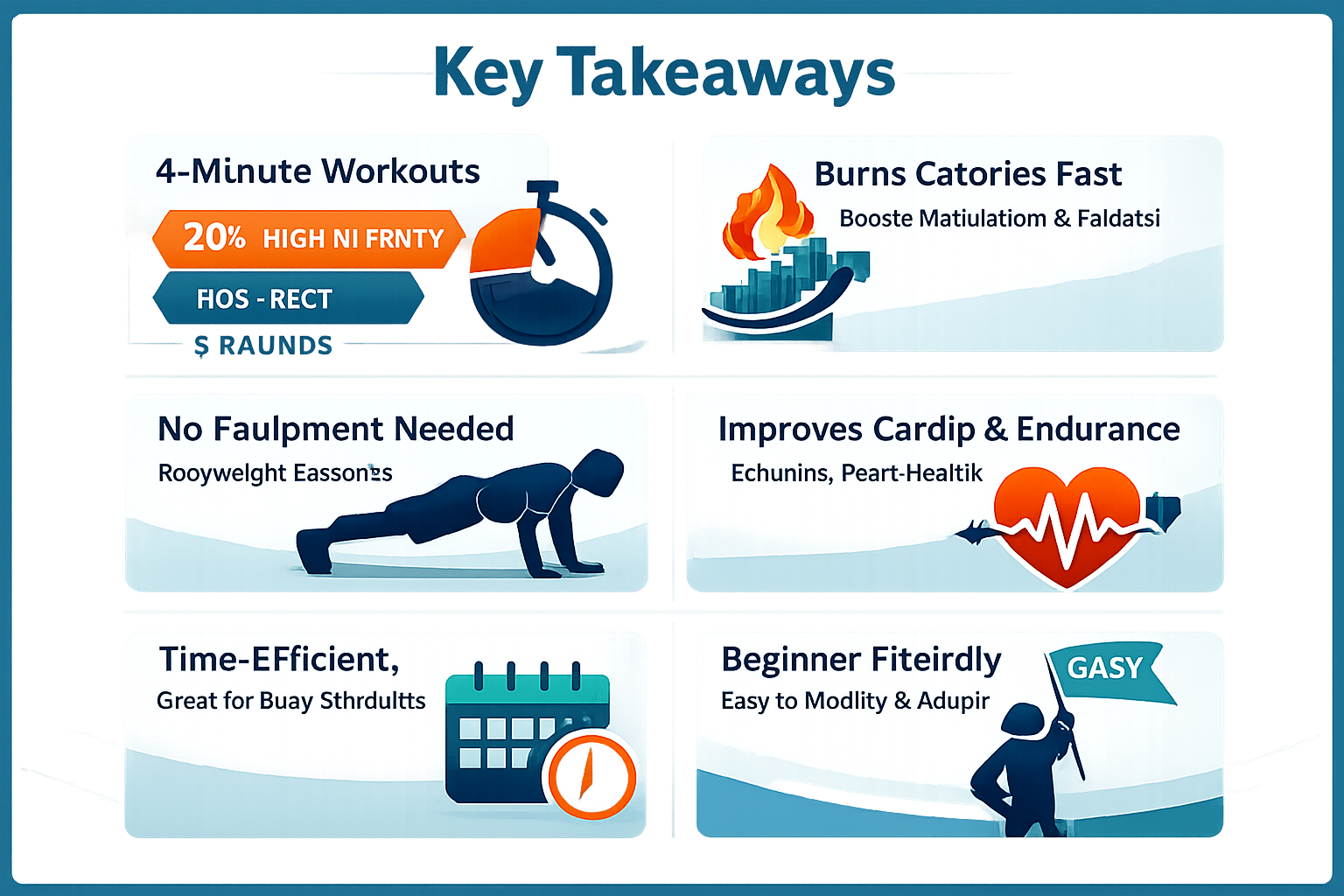
- ✅ Tabata = 20 seconds of max effort + 10 seconds of rest, repeated 8 rounds (4 minutes total).
- ✅ You need no equipment to do effective tabata workouts at home, bodyweight alone is enough.
- ✅ A full tabata session (4–8 rounds with different exercises) burns calories for up to 24 hours post-workout via the afterburn effect.
- ✅ Beginners, seniors, and advanced athletes can all modify tabata to match their fitness level.
- ✅ Adding light dumbbells or kettlebells can significantly increase intensity and muscle-building benefits.
What Is the Tabata Protocol? (And Why It Works)
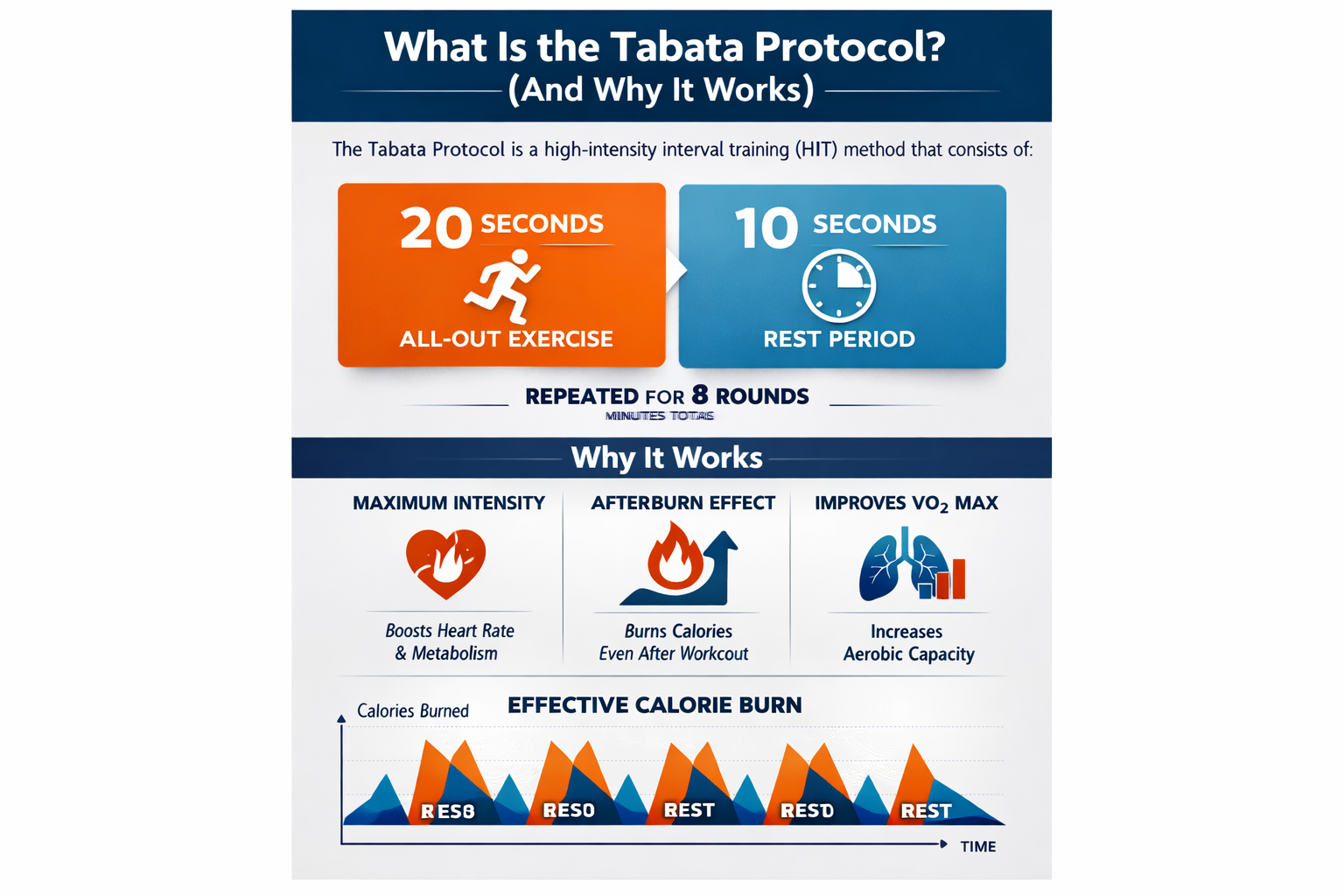
The tabata protocol is elegantly simple:
| Phase | Duration | Effort Level |
|---|---|---|
| Work Interval | 20 seconds | Maximum (90–100% effort) |
| Rest Interval | 10 seconds | Complete rest |
| Rounds per Exercise | 8 rounds | — |
| Total Time per Exercise | 4 minutes | — |
That’s it. The magic is in the intensity, not the duration.
During the 20-second work phase, you push as hard as physically possible. During the 10-second rest, you recover just enough to do it again.
This creates a massive oxygen debt, your body then burns extra calories for hours after the workout ends. Scientists call this Excess Post-Exercise Oxygen Consumption (EPOC), but most people just call it “the afterburn effect.”
💡 Pull Quote: “Four minutes of true tabata effort is harder — and more effective, than 45 minutes on a treadmill.”
How Many Rounds Should You Do?
A single 4-minute tabata round is a complete workout if done at true maximum intensity. However, most home tabata workouts string together 4 to 8 different exercises, each lasting 4 minutes, for a total session of 16–32 minutes. Rest 1–2 minutes between exercises.
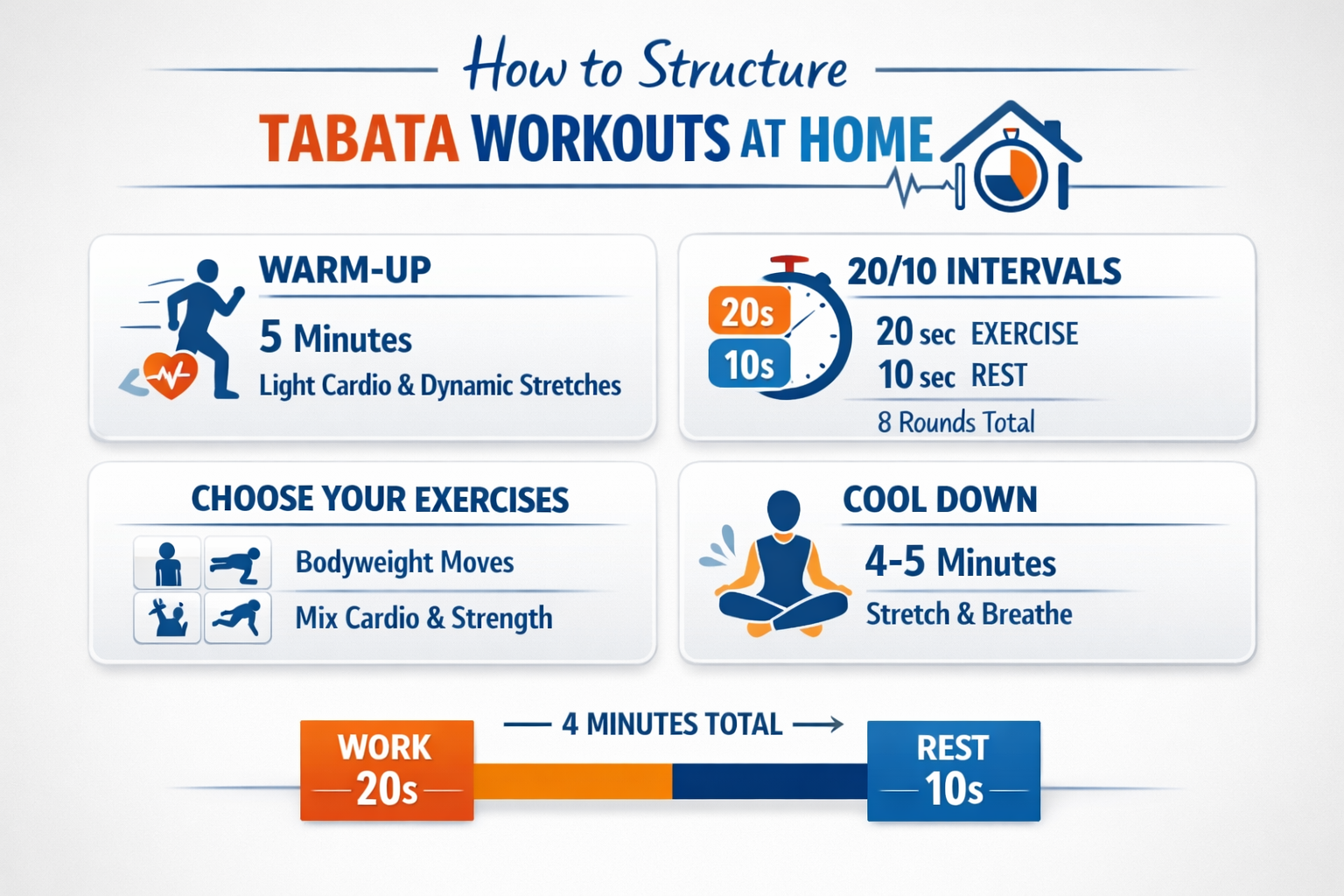
How to Structure Tabata Workouts at Home
The beauty of doing Tabata Workouts at Home is total flexibility. You don’t need a gym, a trainer, or expensive machines. Here’s how to build a complete session from scratch.
Step 1: Choose Your Exercises
Pick 4–6 bodyweight movements that target different muscle groups. A well-rounded home tabata session might look like this:
Beginner Home Tabata (4 exercises, ~20 minutes):
- 🏃 High Knees — cardio + hip flexors
- 💪 Push-Ups — chest, shoulders, triceps
- 🦵 Bodyweight Squats — quads, glutes, hamstrings
- 🔥 Mountain Climbers — core + cardio
Intermediate Home Tabata (6 exercises, ~28 minutes):
- Burpees — full body
- Jump Squats — lower body power
- Push-Up to Shoulder Tap — upper body + core stability
- Speed Skaters — lateral movement + glutes
- Plank to Downward Dog — core + flexibility
- Alternating Reverse Lunges — unilateral leg strength
For a deeper dive into bodyweight-only options, check out these bodyweight tabata workouts that require absolutely no equipment.
Step 2: Set Up Your Timer
You’ll need a reliable tabata timer. Free apps like Tabata Timer (iOS/Android) handle the 20/10 countdown automatically. Set it and go — no thinking required.
Step 3: Warm Up (Non-Negotiable)
Spend 5 minutes warming up before your first round. Try:
- Arm circles (30 seconds)
- Leg swings (30 seconds each side)
- Hip circles (30 seconds)
- Light jumping jacks (60 seconds)
- Dynamic lunges (60 seconds)
Skipping the warm-up when working at near-maximum intensity is a fast track to injury.
Step 4: Cool Down and Stretch
After your final round, spend 5–10 minutes stretching. Focus on hip flexors, hamstrings, quads, and shoulders, the muscles most taxed by typical tabata movements.
The Best Tabata Exercises for Home Workouts
Not all exercises are created equal for the tabata format. The best choices are compound movements — exercises that use multiple muscle groups simultaneously.
This maximizes calorie burn and cardiovascular demand in your 20-second windows.
Top 10 Tabata-Friendly Home Exercises
- Burpees — The gold standard. Full-body, brutal, effective.
- Jump Squats — Explosive lower-body power.
- Push-Ups — Classic upper-body strength builder.
- Mountain Climbers — Core + cardio combo.
- High Knees — Simple, effective cardio spike.
- Speed Skaters — Lateral agility + glute activation.
- Plank Shoulder Taps — Core stability under fatigue.
- Tuck Jumps — Maximum explosive output.
- Alternating Reverse Lunges — Unilateral leg strength.
- Inchworm Push-Ups — Mobility + upper body strength.
Modifying for Beginners and Seniors
Tabata doesn’t have to be extreme to be effective. If you’re new to exercise or need a lower-impact approach:
- Replace jump squats with regular squats
- Replace burpees with step-back lunges
- Replace tuck jumps with high knees at a moderate pace
For those over 60, there are excellent tabata workouts for seniors that preserve the protocol’s benefits while protecting joints.
Adding Equipment to Elevate Your Home Tabata
Once bodyweight tabata feels manageable, adding light equipment dramatically increases the challenge and muscle-building potential. You don’t need a full home gym, just a few smart additions.
Dumbbells
A pair of adjustable dumbbells is the single most versatile piece of home gym equipment you can own. With dumbbells, you can turn any tabata round into a strength-cardio hybrid:
- Dumbbell Thrusters (squat to overhead press)
- Renegade Rows
- Dumbbell Swings
- Alternating Dumbbell Snatches
For a quality adjustable option, the Bowflex SelectTech 552 Dumbbells are a top-rated choice that replace 15 separate sets of weights, perfect for a compact home setup. If you want a heavier option for progressive overload, PowerBlock Dumbbells 90 go up to 90 lbs per hand.
Kettlebells
Kettlebells are arguably the perfect tabata tool. Their offset center of gravity forces your stabilizer muscles to work overtime, and movements like swings and cleans are naturally explosive.
Check out our guide to HIIT kettlebell workouts to see how kettlebell movements pair perfectly with the tabata format.
Tabata Workouts with Weights: A Sample Round
Here’s a 4-minute dumbbell tabata round you can try at home:
| Round | Exercise | Duration |
|---|---|---|
| 1 | Dumbbell Thrusters | 20 sec on / 10 sec rest |
| 2 | Dumbbell Thrusters | 20 sec on / 10 sec rest |
| 3–8 | Repeat × 6 more rounds | — |
For structured weight-based options, explore tabata workouts with weights for full programming ideas.
How Often Should You Do Tabata at Home?
Because tabata is so intense, more is not better. Here’s a smart weekly framework:
| Fitness Level | Tabata Sessions per Week | Rest Between Sessions |
|---|---|---|
| Beginner | 2 sessions | At least 2 days |
| Intermediate | 3 sessions | 1–2 days |
| Advanced | 4 sessions | 1 day minimum |
Always listen to your body. Soreness is normal; sharp pain is not. If you’re feeling chronically fatigued, reduce frequency before increasing it.
Pairing Tabata with Other Training
Tabata works exceptionally well as a standalone workout or as a finisher after strength training. On non-tabata days, consider:
- Light mobility work or yoga
- A 20-minute kettlebell workout for active recovery
- Walking or low-intensity cardio
Common Mistakes to Avoid
Even a simple protocol like tabata has pitfalls. Watch out for these:
- ❌ Going too easy — If you can hold a conversation during the 20-second work phase, you’re not working hard enough.
- ❌ Skipping rest intervals — The 10-second rest is part of the protocol. Honor it.
- ❌ Poor form under fatigue — As you tire, form breaks down. Choose exercises you can perform safely even when exhausted.
- ❌ Doing tabata every day — Overtraining leads to injury and burnout. Recovery is where adaptation happens.
- ❌ Neglecting the warm-up — At near-maximum intensity, cold muscles are injury waiting to happen.
Conclusion: Start Your First Home Tabata Session Today
Tabata Workouts at Home are one of the most time-efficient, science-backed training methods available in 2026.
You need no gym membership, no expensive equipment, and no more than 20–30 minutes.
The protocol is simple: 20 seconds of all-out effort, 10 seconds of rest, 8 rounds per exercise.
Your Action Plan 🚀
- Today: Download a free tabata timer app.
- This week: Try the beginner 4-exercise routine listed above.
- Week 2: Add a fifth exercise and push intensity higher.
- Week 4: Consider adding dumbbells or kettlebells to increase the challenge.
- Ongoing: Track your sessions, note how exercises feel, and progress systematically.
The hardest part of any tabata workout is starting. Once that timer hits 20 seconds, the protocol takes over. Commit to one round, and you’ll be hooked.
References
- Tabata, I., et al. (1996). Effects of moderate-intensity endurance and high-intensity intermittent training on anaerobic capacity and VO2max. Medicine & Science in Sports & Exercise, 28(10), 1327–1330.
- Emberts, T., et al. (2013). Exercise intensity and energy expenditure of a tabata workout. Journal of Sports Science & Medicine, 12(3), 612–613.
- Falcone, P. H., et al. (2015). Caloric expenditure of aerobic, resistance, or combined high-intensity interval training using a hydraulic resistance system in healthy men. Journal of Strength and Conditioning Research, 29(3), 779–785.
- LaForgia, J., Withers, R. T., & Gore, C. J. (2006). Effects of exercise intensity and duration on the excess post-exercise oxygen consumption. Journal of Sports Sciences, 24(12), 1247–1264.