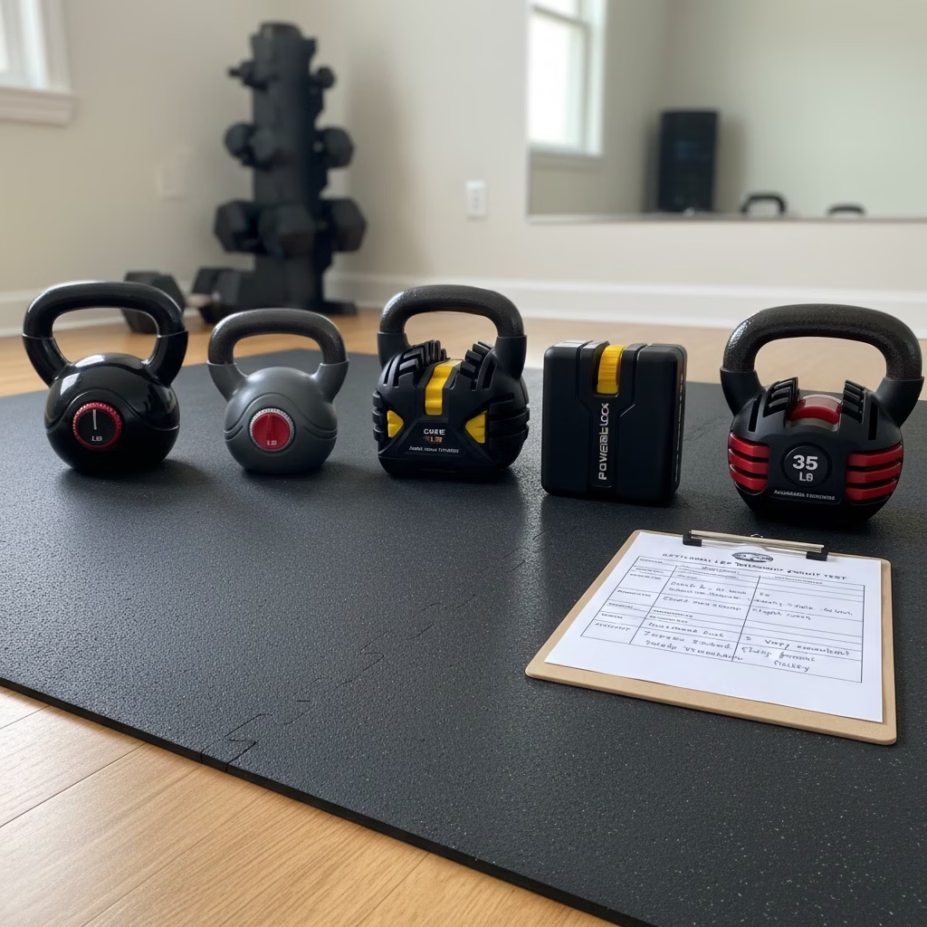
Adjustable Competition Kettlebell Comparison Tool
Latest Update: November 26, 2026
Our Adjustable Competition Kettlebell Comparison Tool gives you a consistent way to compare weight range, handling, adjustment steps and training fit. The right choice depends on how the kettlebell feels during your lifts and how easily its load suits your sessions, not just on its maximum weight.
Key Takeaways
- Compare designs fairly. Competition bells keep a consistent outer shape across weights, while hardstyle bells usually grow as they get heavier. Selectorized models change load through a control such as a dial or pin.
- Look at the full weight range. Record the lightest load, heaviest load and every increment. Your starting load and step sizes need to suit the lifts you plan to do.
- Check handle fit. Diameter, width and hand clearance affect grip, two hand holds and how the bell moves around your wrist.
- Factor in adjustment time. Manual plate changes can suit sessions with fewer weight changes. Circuits that switch loads often put more value on a quick adjustment method.
- Test the loaded feel. A consistent outer shell helps keep body contact familiar, but the bell can still feel different as its internal load changes.
- Use the same checklist for each option. Our adjustable kettlebell brand comparison offers another way to organize your model research.
Check Prices Here—>
What makes an adjustable competition kettlebell different
A fixed competition kettlebell keeps the same outer dimensions across different weights. A regular hardstyle kettlebell generally becomes larger as its weight increases, so prioritize a consistent competition shell when you want similar hand and wrist contact across loads.
An adjustable competition style bell changes its load with internal plates inside a competition shaped shell. A selectorized kettlebell instead selects a load through a dial or pin, while the hardstyle category describes a different bell shape and handling style.
These designs are not interchangeable. Shell shape, handle geometry and loading method all influence how familiar a clean, swing or rack hold feels, so we recommend comparing the details of each design before choosing.
Fixed competition bells offer useful reference points: steel construction, a flat base and a smooth handle around 33 mm in diameter, though individual models can differ. Our competition kettlebell features guide adds context for these design cues.
Our comparison images below show competition and standard forms, while our guide to choosing between competition and other kettlebell types explores how those designs relate to training goals.
The Titan Adjustable Competition Style Kettlebell uses a competition style outer shape with a 12 kg shell and internal plates that bring the total load to 32 kg. At $199.97, it gives shoppers a concrete example of a fixed shell paired with a changeable internal load.
Compare the usable range and load steps
Compare the lightest usable load, the heaviest load and every available increment. A high maximum offers little value if the lightest setting is too heavy for planned movements or the available steps do not support your progression.
The 12/32 kg Titan Adjustable Competition Style Kettlebell separates two useful comparison points: its shell weighs 12 kg, and internal plates bring the total load to 32 kg.
Its listed handle diameter is 35 mm, and its handle width is 190 mm, details that matter alongside its range. The linked Titan review is the reference for these listed specifications; the $199.97 figure is not a guaranteed current price.
Confirm the current price, included plates, available increments and minimum load on the product listing before comparing.
Smaller increments allow more gradual changes between sessions, while fewer or larger steps can make the setup simpler. If your workouts change loads frequently, weigh the usefulness of fine steps against how much time and effort each adjustment takes.
Plan your progression around the movements you actually train. A range that suits presses may not cover heavier swings or squats, so list the lifts and working loads you expect to use before judging the maximum.
Check Prices Here—>
Judge handle geometry, clearance and balance
Compare handle diameter, width and room for hand insertion. A thicker handle can demand more from your grip, while enough clearance makes it easier to insert your hand and hold the bell with both hands.
The Titan example lists a 35 mm handle diameter and 190 mm handle width. Compare those figures with the roughly 33 mm smooth handle often used as a reference for competition kettlebells, then judge the shape by how it fits your hand.
Pay close attention to the shell and handle during cleans, snatches, rack holds and overhead work. Those movements bring the bell around the wrist or require stable control in a held position, so small differences in clearance and balance become noticeable.
Make the check movement-specific: during a clean, note handle roll and forearm contact; on a snatch, notice whether hand turnover catches; in a two-hand swing, check hand clearance and grip security. Repeat the same movements at lighter and heavier settings.
A shell that feels comfortable in a rack position at one load does not establish that its balance or turnover will feel the same at another.
Test the bell at lighter and heavier settings when you can. The outer shell can remain the same while a change in internal weight affects how the load sits and moves, so appearance alone does not establish a familiar feel.
Use familiar movements to judge how your hand enters the handle and where the shell contacts your wrist in the rack. For more context, our guide to competition kettlebell features covers handle feel, balance and other comparison points.
Compare plate changes with dial or pin adjustments
Internal plate systems require opening the bell and changing components. Dial or pin systems select a load through a control, which can make adjustment time especially important in circuits that switch weights between sets.
For an internal plate change, stabilize the bell, follow the prescribed plate arrangement and secure the locking assembly. Before dynamic lifts, check that the components remain in place.
Use only the tools specified for the adjustment system. Allow enough room to open the bell, keep loose plates organized and avoid a setup that leaves components scattered where you need to move.
Plate security and the maker’s movement guidance matter for swings, cleans and snatches, so factor them into your decision alongside the adjustment method.
Match the design to your lifts and training setup
A competition shaped shell keeps hand and wrist contact more consistent across loads. That can be useful when you practice repeated cleans, snatches or rack positions and want a similar outer form as the weight changes.
For general strength sessions with infrequent weight changes, a manual plate system can be practical. For circuits with frequent changes, give adjustment time more weight in your decision because a lengthy change can interrupt the session.
If you also train with fixed competition bells, compare their dimensions and handle feel with the adjustable bell. A similar outer shape does not guarantee the same feel at every load, so use familiar movements to judge how well the adjustable option fits your practice.
One adjustable bell can cover many single bell sessions. A pair is useful when your workout calls for two bells at once or matched loads, but include the extra storage space in your setup decision.
Use a consistent comparison checklist before choosing
Record the same details for every model so one impressive specification does not dominate the decision. Our comparison matrix is another visual reference for organizing adjustable equipment comparisons.
| Comparison point | What to record | Why it matters |
|---|---|---|
| Load range | Starting load, maximum load and every increment | Shows whether the bell covers current lifts and planned progression. |
| Shell | Outer dimensions and shape | Helps you compare body contact and storage fit. |
| Handle | Diameter, width and hand clearance | Clarifies grip fit, hand insertion and room for two hands. |
| Adjustment | Plate, dial or pin method, tools used and observed time for a secure change | Shows how the setup fits your workout pace and available space. |
| Construction and finish | Material, surface finish and visible build details | Lets you judge the bell separately from its comfort and range. |
| Locking security | How the load is secured and how components sit | Helps assess plate stability for the movements you plan to perform. |
| Price and value | Current adjustable-bell price and combined cost of fixed bells for the loads you use | Shows whether the adjustable setup compares well with a realistic fixed-bell alternative. |
Rank each point according to your workout. Range and fine steps support progression, clearance matters for grip and rack work, and a convenient adjustment process matters when you change loads often.
Assess construction, finish and locking security separately. A comfortable handle does not establish that internal plates remain secure during dynamic movement.
When possible, compare an adjustable bell with a fixed competition kettlebell during familiar movements. Note hand insertion, rack contact and balance rather than relying on appearance alone.
Frequently Asked Questions
Can an adjustable competition kettlebell be used in kettlebell sport competition?
An adjustable competition kettlebell can support practice, but competition use depends on the event’s equipment rules and the bell’s compliance with them. Ask the event organizer about permitted equipment before bringing an adjustable model.
How often should I inspect the internal plates and locking parts?
Inspect the assembly before each training session and take a closer look after a hard impact or a change in how the bell closes. Watch for worn threads, damaged contact surfaces or parts that no longer seat evenly.
Will an adjustable competition kettlebell fit a rack made for fixed competition bells?
Fit depends on the rack opening and how the bell rests against its supports. Compare the shell’s width and depth with the rack, then test the unloaded bell to see whether it sits securely without rocking.
Can the same adjustable bell feel different at its lightest and heaviest settings?
Yes. The outer shell can preserve hand contact, while a different loaded mass changes how quickly the bell starts and stops during a lift.
Can I use chalk on a smooth competition style handle?
Chalk can add grip on a smooth handle, and a small amount is usually easier to manage than a heavy coating. Wipe residue from the handle and adjustment area after training so it does not build up around moving parts.
How should I clean an adjustable kettlebell after training?
Wipe the handle and shell with a clean, dry cloth, and pay attention to seams where sweat or chalk can collect. Keep moisture away from the internal plate area and let parts dry before closing the bell.
See also: B0cscH5ij.
Conclusion
Our Adjustable Competition Kettlebell Comparison Tool helps you compare shell shape, usable range, increment size, handle fit and adjustment effort on equal terms.
Choose the design that suits your lifts and workout structure, then judge its handling and loaded balance across the settings you expect to use.