
Tabata Workouts With Weights
Latest Update: November 20, 2026
A 2023 study published in the Journal of Sports Science & Medicine found that high-intensity interval training burns up to 25–30% more calories than moderate-intensity steady-state cardio, and adding weights to the equation pushes those results even further. If you’ve been spending 60 minutes on a treadmill and wondering why your body isn’t changing, Tabata Workouts With Weights might be the most efficient shift you can make in 2027.
This guide breaks down exactly how weighted Tabata training works, why it’s so effective, and how to build a program that fits your goals, whether you’re chasing fat loss, muscle tone, or raw strength.
Key Takeaways 📌
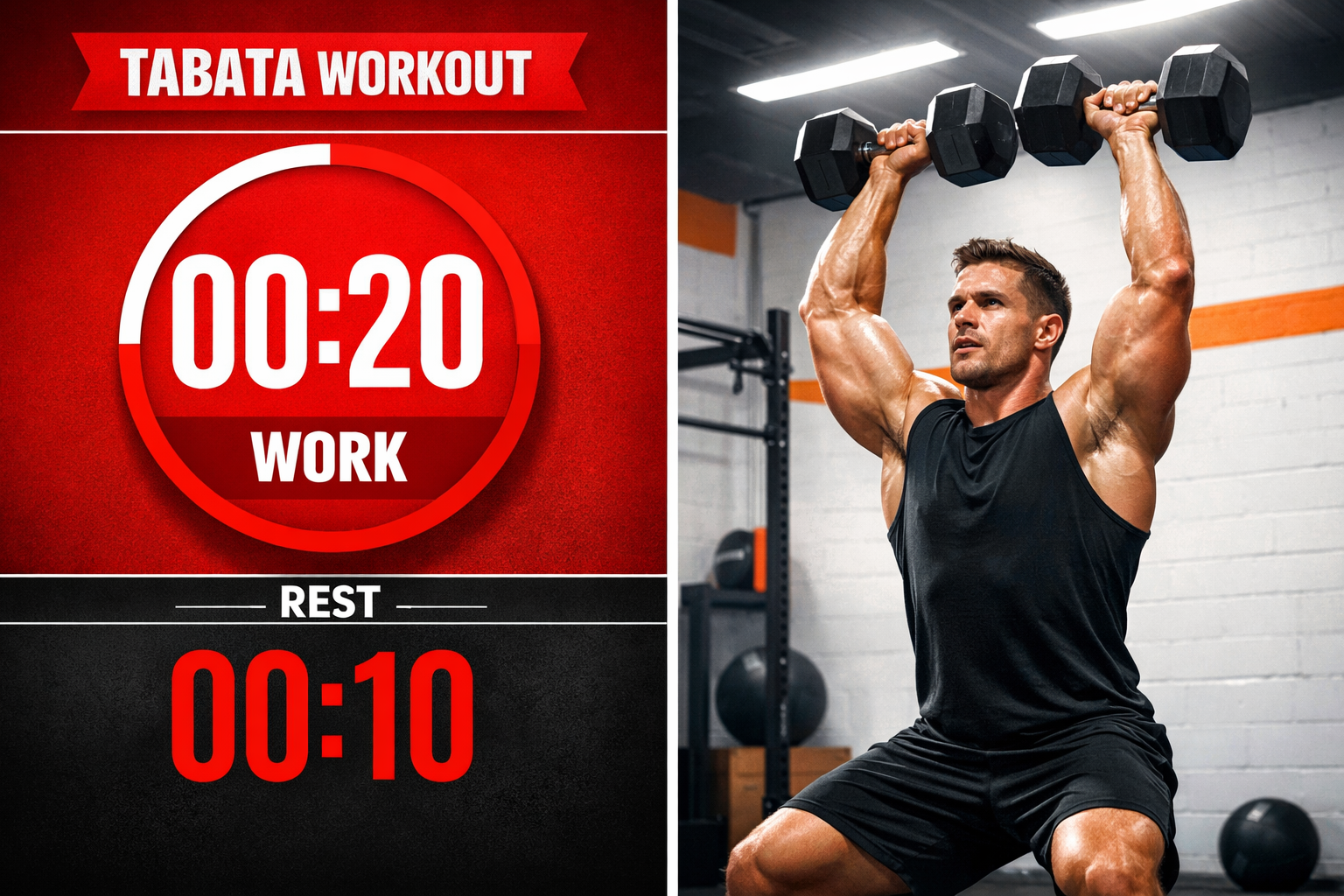
- Tabata protocol = 20 seconds of max effort + 10 seconds of rest, repeated 8 rounds (4 minutes per exercise).
- Adding weights to Tabata dramatically increases muscle recruitment and caloric burn.
- Kettlebells, dumbbells, and barbells each offer unique advantages in a weighted Tabata session.
- You can complete an effective weighted Tabata workout in as little as 20–30 minutes.
- Proper form and appropriate weight selection are critical to avoiding injury.
What Are Tabata Workouts With Weights?
Tabata training was developed by Japanese researcher Dr. Izumi Tabata in 1996. His research showed that short, intense intervals produced superior aerobic and anaerobic fitness gains compared to longer moderate workouts. The classic structure is simple:
“20 seconds of all-out effort. 10 seconds of rest. Repeat 8 times. That’s one round — just 4 minutes.”
When you layer weights into this protocol, you’re combining cardiovascular intensity with resistance training. The result? Your heart rate stays elevated while your muscles are under load, triggering both fat burning and muscle growth simultaneously.
Why Weights Make Tabata More Effective
Bodyweight Tabata is great, but bodyweight Tabata workouts have a ceiling. Once your body adapts to your own weight, progress slows. Adding resistance:
- Increases metabolic demand — more muscle fibers are recruited
- Elevates EPOC (Excess Post-Exercise Oxygen Consumption), meaning you burn calories for hours after the workout
- Builds lean muscle mass, which raises your resting metabolic rate
- Improves functional strength alongside cardiovascular fitness
This dual benefit is why so many fitness coaches, and the best Tabata workout programs — now incorporate free weights as a standard component.
Best Equipment for Weighted Tabata
| Equipment | Best For | Difficulty |
|---|---|---|
| 🏋️ Kettlebells | Full-body, ballistic movements | Beginner–Advanced |
| 🔩 Dumbbells | Upper body, controlled movements | Beginner–Intermediate |
| 🏗️ Barbells | Compound strength, heavier loads | Intermediate–Advanced |
| 🔗 Resistance Bands | Low-impact, travel-friendly | Beginner |
Kettlebells are arguably the most versatile tool for Tabata. Their off-center weight distribution forces your stabilizer muscles to work harder, making every rep more demanding.
If you’re new to kettlebells, our guide on outstanding kettlebell workouts that produce superior results is a great starting point.
How to Structure Tabata Workouts With Weights
Building an effective weighted Tabata session requires more than just picking up heavy things and going fast. Structure matters, especially when you’re working at maximum intensity.
The Basic Framework
A complete tabata workouts with weights session typically looks like this:
- Warm-Up (5–7 minutes) — dynamic stretching, light cardio, mobility work
- Tabata Blocks (3–5 rounds of 4 minutes each, with 1–2 minutes rest between blocks)
- Cool-Down (5 minutes) — static stretching, breathing exercises
Each 4-minute Tabata block focuses on one exercise or alternates between two movements. For example:
Block 1: Kettlebell Swings
- 20 sec: Max-effort swings
- 10 sec: Rest
- Repeat x8
Block 2: Dumbbell Thrusters
- 20 sec: Max-effort thrusters
- 10 sec: Rest
- Repeat x8
Choosing the Right Weight 🎯
This is where most people go wrong. Too heavy = broken form and injury. Too light = wasted effort.
A good rule of thumb:
- You should be able to complete 12–15 reps of the exercise in 20 seconds with good form
- By round 6–8, the effort should feel like a 9 out of 10 on the difficulty scale
- If you’re breezing through all 8 rounds, go heavier
For reference, many beginners start with:
- Kettlebells: 12–16 kg (women), 16–24 kg (men)
- Dumbbells: 10–20 lbs (women), 20–35 lbs (men)
Adjustable weights are a smart investment here. Check out options like the Bowflex SelectTech dumbbells or the Yes4All adjustable kettlebell set to progress without buying multiple pieces of equipment.
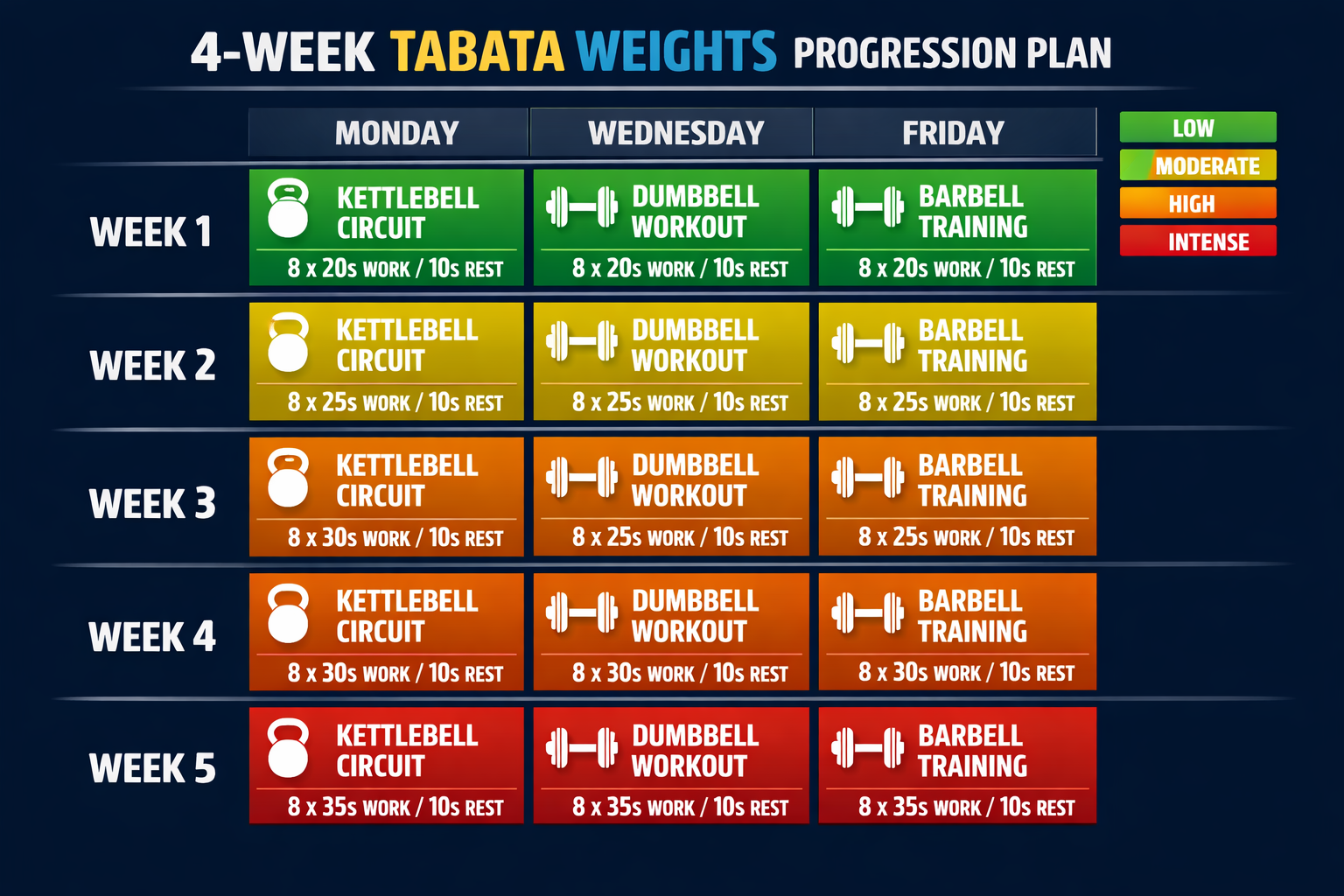
Sample 4-Week Progression Plan
| Week | Sessions/Week | Blocks Per Session | Rest Between Blocks |
|---|---|---|---|
| 1 | 2 | 3 | 2 minutes |
| 2 | 3 | 3–4 | 90 seconds |
| 3 | 3 | 4 | 60 seconds |
| 4 | 4 | 4–5 | 60 seconds |
The Best Exercises for Tabata Workouts With Weights
Not every exercise works well in a Tabata format. The best choices are compound movements — exercises that recruit multiple muscle groups, because they maximize caloric burn and muscle activation in a short window.
🔥 Top Kettlebell Tabata Exercises
- Kettlebell Swings — the king of weighted Tabata. Targets glutes, hamstrings, core, and shoulders. Learn more about kettlebell swings for cardio and weight loss.
- Goblet Squats — great for lower body and core stability
- Kettlebell Clean & Press — full-body power movement
- Russian Twists — core-focused, excellent for rotational strength
💪 Top Dumbbell Tabata Exercises
- Dumbbell Thrusters (squat to press) — total body burner
- Renegade Rows — back, core, and arms in one movement
- Dumbbell Snatches — explosive power, high calorie burn
- Lateral Raises + Squat Combo — shoulders and legs together
🏋️ Top Barbell Tabata Exercises
- Barbell Back Squats — maximum leg and glute activation
- Hang Power Cleans — explosive full-body movement
- Barbell Deadlifts — posterior chain powerhouse
- Push Press — shoulders, triceps, and core
Pro Tip: Alternate between upper and lower body exercises in consecutive Tabata blocks. This lets one muscle group recover while the other works, allowing you to maintain intensity across more rounds.
A Complete 20-Minute Weighted Tabata Workout
Here’s a ready-to-use session you can try today:
| Block | Exercise | Equipment |
|---|---|---|
| 1 | Kettlebell Swings | Kettlebell |
| 2 | Dumbbell Thrusters | Dumbbells |
| 3 | Goblet Squats | Kettlebell |
| 4 | Renegade Rows | Dumbbells |
| 5 | Kettlebell Clean & Press | Kettlebell |
Rest 60–90 seconds between each block. Total workout time: approximately 25–30 minutes including rest.
Safety, Recovery, and Making Progress
Common Mistakes to Avoid ⚠️
- Skipping the warm-up — cold muscles under heavy load = injury risk
- Using too much weight too soon — ego lifting defeats the purpose of Tabata
- Poor form at high speed — always prioritize technique over reps
- Overtraining — Tabata is intense; 3–4 sessions per week is usually the maximum
- Ignoring footwear — proper shoes matter more than people think. See our guide on good workout shoes for recommendations.
Recovery Between Sessions
Because tabata workouts with weights are highly demanding, recovery is non-negotiable:
- 48 hours of rest between sessions targeting the same muscle groups
- Prioritize sleep (7–9 hours) — this is when muscle repair happens
- Nutrition matters: protein intake of 0.7–1g per pound of bodyweight supports muscle recovery. Our resource on building muscle with calories that support growth and repair goes deeper on this topic.
- Active recovery (walking, yoga, light stretching) on rest days
Tracking Progress
Keep a simple training log. Record:
- ✅ Weight used per exercise
- ✅ Reps completed per round
- ✅ How hard the session felt (RPE scale 1–10)
- ✅ Recovery quality
When rounds 6–8 start feeling like a 7 out of 10 instead of a 9, it’s time to increase the weight or reduce rest time.
Conclusion: Start Your Weighted Tabata Journey in 2027
Tabata Workouts With Weights represent one of the most time-efficient, science-backed training methods available.
In as little as 20–30 minutes, you can stimulate fat loss, build lean muscle, and improve cardiovascular fitness, all in a single session.
Your Action Plan 🚀
- Choose your equipment: start with kettlebells or dumbbells if you’re new
- Pick 3–5 compound exercises from the list above
- Set a Tabata timer (free apps are widely available)
- Start with 3 blocks in week one, then progress weekly
- Track everything: progress is built on data, not guesswork
- Recover properly: sleep, nutrition, and rest days are part of the program
The barrier to entry is low. The results, when you’re consistent, are anything but. Pick up the weight, set the timer, and get to work.
References
- Tabata, I., et al. (1996). Effects of moderate-intensity endurance and high-intensity intermittent training on anaerobic capacity and VO2max. Medicine & Science in Sports & Exercise, 28(10), 1327–1330.
- Emberts, T., et al. (2013). Exercise intensity and energy expenditure of a Tabata workout. Journal of Sports Science & Medicine, 12(3), 612–613.
- Boutcher, S. H. (2011). High-intensity intermittent exercise and fat loss. Journal of Obesity, 2011, 868305.
- Schoenfeld, B. J. (2010). The mechanisms of muscle hypertrophy and their application to resistance training. Journal of Strength and Conditioning Research, 24(10), 2857–2872.
