Who makes the best adjustable kettlebell
Latest Update: October 27, 2026
There is no single best maker for every lifter. Bowflex suits people who want dial selection across six settings from 8 to 40 lb. REP Fitness offers a cast-iron option with a flat base and a stated 35–53 lb range.
Titan has two distinct options here: a competition-style model that changes from a 12 kg shell to 32 kg with internal plates, and a 40 lb model with a 10 lb core and six plates. PowerBlock stands out for a pin selector and an expandable 20–40 lb range that reaches 50 lb.
If price is your first filter, the CAP Barbell Adjustable 15 to 35 is listed at $79 and the Yes4All Adjustable 10 to 40 at $89. Choose between these and the other models by matching the usable weights, adjustment process, shape, handle and storage demands to your actual workouts—not by brand name alone.
Use the comparison below as a shortlist, then check the full weight settings and mechanism for the exact model you are considering. Price references can change by retailer. For a broader look at design and adjustment differences, see our adjustable kettlebell brands comparison.
Key takeaways
- Choose by range and progression. Check the starting load, maximum load and every step between them.
- Match the adjustment style to your session. A dial can make changes between settings quick; a twist lock, pin or removable plates requires more hands-on adjustment.
- Test the movement, not just the grip. Handle clearance, forearm contact and how the body hangs affect cleans, snatches and swings.
- Compare similar models, not just makers. One company may offer designs with very different shapes and loading systems.
- Count the storage space for the whole system. A compact bell can save space, but removable components need a secure place too.
Check Price—-> CLICK HERE
Adjustable kettlebell models compared
| Model | Weight range and progression | Adjustment and construction | Price reference | Best fit and trade-off |
|---|---|---|---|---|
| Bowflex SelectTech 840 | 8–40 lb; six settings | Dial selection; powder-coated steel plates and rubberized handle | $199 | Useful when you want several selectable loads in one unit. Check that the six settings offer the steps you need. |
| REP Fitness Adjustable Kettlebell 24kg | 35–53 lb | Cast iron construction; flat, stable base | $210 | A fit for lifters whose work falls within this heavier range and who prefer cast iron. It does not cover lighter loads below 35 lb. |
| Titan Adjustable Competition Style Kettlebell | 12 kg shell; internal plates bring total load to 32 kg | Competition-style outer shape with internal plates | $199.97 | Consider it when a consistent outside shape matters. Its shell begins at 12 kg, so it is not the choice for lighter starting loads. |
| Titan 40 lb Adjustable Kettlebell | 10 lb core plus six internal plates; 40 lb maximum | Internal plate system | $119.99 | A general-fitness, conditioning and mixed-modal option. Confirm the available settings and how the plates secure before choosing. |
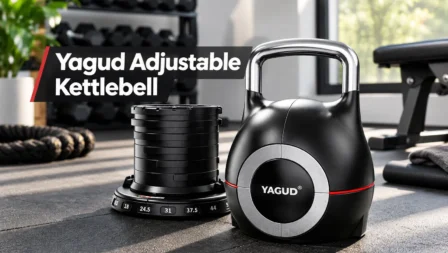
| Yes4All Adjustable 10 to 40 | 10–40 lb | Modular plate system; add or remove components to change load | $89 | A lower-priced choice for a broad stated range. Handling and changing weight involve separate components. |
| CAP Barbell Adjustable 15 to 35 | 15–35 lb | Twist-lock handle; compact footprint | $79 | A low-cost, compact option if the range suits your lifts and you do not need rapid changes between exercises. |
| PowerBlock KettleBlock | 20–40 lb; expands to 50 lb | Pin selector and padded handle | $299 | Consider it if the pin-adjusted format and option to extend the range fit your needs. Its listed price is higher than the other models here. |
For more detail on a particular design, visit our adjustable kettlebell guide, the REP Fitness Adjustable Kettlebell 24kg review or our Titan adjustable kettlebell review.
How the main adjustable designs differ
An all-in-one design keeps the adjustment components within one unit. A plate-loaded or modular kettlebell changes weight by adding or removing parts.
All-in-one systems can make storage tidier; modular systems ask you to handle and store their extra components.
Neither design is automatically better: consider how often you change loads and whether you have a safe place for all the parts.
A competition-style kettlebell aims to keep a consistent outside shape as its internal load changes. That makes the Titan 12/32 kg model relevant if you want the same general body shape across weight settings.
By contrast, designs that change their external configuration as plates are added can feel different from one load to another. A fixed-shape design is not proof that a bell suits your hand or meets a particular competition’s equipment rules.
Cast iron gives the REP model a traditional, solid construction. A modular plate system gives you another way to select a load, but requires parts to be removed and secured.
The photos below show examples of adjustable designs; use the linked model information to identify the details that match your shortlist.
The Yes4All Adjustable 10 to 40 has a stated range of 10–40 lb and a listed price of $89. Its modular plate system suits readers who want to change the load by adding or removing components.
A competition-style alternative is the Titan 12/32 kg model, listed at $199.97, with a 12 kg shell and internal plates that bring the total to 32 kg.
When you compare any plate-based system, ask where its parts sit during use, how each part locks into place, and whether you can make the change without losing small components.
A steady, repeatable setup matters more than a short changeover if you change weight only between exercises.
Check Price—-> CLICK HERE
Choose a range and increments that support progression
Start with the movements you plan to train. A load that feels manageable for a controlled press may be too light for a hinge or squat, while a load that works for swings may be too heavy for a strict upper-body movement.
Your adjustable kettlebell should include the loads you can use with sound control, not just an appealing maximum number.
Next, look at the settings between the minimum and maximum. Two bells with similar endpoint weights can still offer different progression options.
Smaller steps can make gradual increases easier, especially when a larger jump would change the feel of a press, clean or other controlled lift. Larger jumps may be acceptable when you mainly alternate between distinct exercise demands.
Before buying, write down the settings in order and compare them with your planned exercises. The Bowflex SelectTech 840 is specified as having six settings from 8 to 40 lb, but the range alone does not tell you whether the exact steps suit your progression.
For models where a list of increments is not at hand, get the complete setting sequence before treating the endpoints as the whole story.
The REP Fitness Adjustable Kettlebell 24kg has a stated range from 35 to 53 lb, cast iron construction and a flat, stable base.
At $210, it is a potential fit if you want that range for strength work. It is a poor match if you need a light starting weight for single-arm presses or other movements that call for loads below 35 lb.
For a dial-style option, the Bowflex SelectTech 840 offers six settings from 8 to 40 lb. Its powder-coated steel plates and rubberized handle are specified alongside a $199 price. Read our Bowflex SelectTech 840 kettlebell information when reviewing that model.
Adjustment speed and locking: what to check
Check Price—-> CLICK HERE
A dial makes it possible to select among its available settings without assembling a new stack of loose plates. A pin selector also gives you a defined adjustment process, while a twist lock requires manual adjustment.
A modular plate setup involves adding or removing components. The exact time depends on the design and how often you switch loads; no adjustment style removes the need to check that the bell is secured before use.
Think about the rhythm of your workout. If you move between exercises that use different loads, a selector may make transitions more convenient.
If you keep the same load for several sets, slower manual adjustment may matter less. In every case, stop before changing the weight; do not try to adjust a loaded kettlebell while lifting or swinging it.
Before each session, follow the model’s instructions to seat the plates and engage its latch, pin, screw or selector. Check that the parts are in their intended positions and that nothing moves or feels loose.
If a component will not lock securely, do not use the kettlebell until you have corrected the setup. This is particularly important for swings and other ballistic movements, where loose parts can create a hazard.
The Titan 40 lb Adjustable Kettlebell has a 10 lb core weight plus six internal plates. It is listed at $119.99 and is aimed at general fitness, conditioning and mixed-modal training.
Confirm the intended plate arrangement and locking steps for that model before using it dynamically.
The CAP Barbell Adjustable 15 to 35 is listed at $79 and pairs a twist-lock handle with a compact footprint.
Its manual adjustment may suit someone who keeps one load for a block of work rather than changing settings repeatedly. For another look at how a weight adjustment is made, see how to adjust an adjustable kettlebell.
For a broader look at Titan’s adjustable designs, read our Titan adjustable kettlebell review. If you want to compare another adjustable-kettlebell listing, view the adjustable kettlebell option.
Handle comfort, balance and kettlebell shape
Handle shape and clearance can change how a bell feels during a clean, snatch or two-handed grip. Check that your fingers fit around the handle without crowding and that your hand can move through the transition you need. A grip that feels fine when holding the bell still may feel cramped during a repeated clean.
Pay attention to the way the kettlebell rests against your forearm in the rack position. A body that rolls or presses uncomfortably can interrupt a smooth transition.
During a controlled hinge or swing rehearsal, notice whether the bell follows a predictable path or pulls off line. These are practical fit checks, not assumptions you can make from a product name.
A traditional rounded bell, a square-bodied adjustable design and a padded handle can each feel different in the hand and against the forearm.
The PowerBlock KettleBlock 20 to 40 uses a pin selector and padded handle; its range is 20–40 lb and expands to 50 lb.
At $299, it is best considered by someone who values that configuration and will use the extra range. Its higher listed price makes it less compelling if a simpler load range already covers your training.
If you can inspect a kettlebell before choosing, try a load you can control. Hold the handle, rehearse a slow clean into the rack, then make a controlled hinge.
Notice whether your fingers are crowded, whether the bell rolls across the forearm and whether its body tracks smoothly.
Repeat the check at more than one setting: a comfortable grip at the lightest load does not guarantee that a heavier setup feels balanced.
When shopping online, handle-opening and parts photographs can help you screen models, but they cannot establish whether the grip fits your hand.
If single-hand and two-hand exercises are both part of your plan, check that there is room for each grip without crowding.
Which maker fits each training priority?
For dial adjustment and lighter loads: Bowflex
The Bowflex SelectTech 840 covers a stated 8–40 lb range across six settings, with a dial, powder-coated steel plates and a rubberized handle.
It is the clearest match in this comparison for someone who wants a selector-style design and needs loads starting below 10 lb.
Its limitation is that you must choose among its six settings, so inspect the exact progression before deciding that it covers every exercise.
For cast iron and a heavier range: REP Fitness
REP Fitness is a fit if you want a cast-iron adjustable kettlebell with a flat, stable base and the stated 35–53 lb range.
That makes it a different proposition from Bowflex: it starts much heavier and is better matched to someone whose training uses those loads.
See the REP Fitness adjustable kettlebell and the 24kg model review for model-specific details.
For competition-style shape or a plate-based option: Titan
Check Price—-> CLICK HERE
Titan offers two options described here, and they should not be treated as the same product. The competition-style model has a 12 kg shell and internal plates that bring it to 32 kg, with a listed price of $199.97.
The 40 lb model has a 10 lb core and six internal plates, with a listed price of $119.99. Choose between them by checking the load range, shape, settings and adjustment process against your training.
For a pin selector and expansion: PowerBlock
The PowerBlock KettleBlock starts at 20–40 lb and expands to 50 lb. Its pin selector and padded handle suit shoppers who want that specific format and expect to use the added capacity. At $299, consider whether the expansion is useful enough to justify the higher stated price.
For lower listed prices: CAP Barbell or Yes4All
The CAP Barbell Adjustable 15 to 35 is listed at $79, has a twist-lock handle and a compact footprint. The Yes4All Adjustable 10 to 40 is listed at $89 and uses modular plates.
CAP costs less in the stated comparison; Yes4All starts at a lighter load and reaches a higher maximum. The difference that matters is which range and adjustment process suits your sessions.
How to compare Titan and Bells of Steel
Compare a specific Bells of Steel model with the Titan model you are considering rather than choosing by company name.
Put the load range and every increment alongside handle clearance, adjustment and locking steps, footprint and construction. For
Titan, distinguish the 12/32 kg competition-style design from the 40 lb model with a 10 lb core and six plates. Make the same model-level comparison for Bells of Steel before deciding which is the better fit.
For another adjustable-kettlebell listing to compare, view this adjustable kettlebell option.
Price, long-term value and warranty checks
The lowest listed price is not automatically the best value. Compare what the range lets you train, how useful the available steps are, whether the system can expand and how convenient it is to change the load.
In the models above, the stated prices run from $79 for the CAP Barbell Adjustable 15 to 35 and $89 for the Yes4All Adjustable 10 to 40 to $299 for the expandable PowerBlock KettleBlock.
Before paying more for an expandable or selector-based design, ask whether you will use its additional settings or range.
Conversely, a lower-cost model is a poor value if its minimum weight, maximum weight or increments leave out the movements you want to train.
Retailer prices can change, so treat the figures as comparison references rather than a guarantee of the amount you will pay.
Construction details also influence what to inspect over time. The REP model is specified as cast iron; the Bowflex uses powder-coated steel plates and a rubberized handle.
For any model, inspect contact surfaces and moving or locking parts for damage, looseness or wear. Keep the components clean and dry, follow the care instructions and do not modify a locking mechanism. Stop using a bell if a part is damaged or cannot be secured correctly.
Read the written warranty terms before buying. Compare which parts are covered, how long coverage lasts, what exclusions apply and whether replacement parts are available.
Do not assume that the handle, selector, plates and body receive identical coverage. Availability of individual replacement parts can affect whether a system is practical to maintain over time.
Space-saving benefits and storage
An adjustable kettlebell can consolidate several fixed weights into one unit, freeing storage space in a home gym.
Measure the footprint of the complete setup, including any removed plates or accessories, rather than measuring only the bell at its smallest setting. Leave room to lift, move and set it down without hitting a wall, furniture or other equipment.
Consider where loose components will go between sessions. A self-contained selector may be easier to keep together; modular plates need a stable storage place where they will not roll, get lost or create a trip hazard.
The CAP model is described as having a compact footprint, while a plate-loaded system may require additional space for its parts. For further guidance, see our article on how much space you need for a home gym.
For another perspective on space-saving designs, read our Polyfit adjustable kettlebell review.
Choose a kettlebell for your training
- For swings, deadlifts and lower-body strength: Make sure the top of the range is heavy enough for your current work, and that the bell stays secure during dynamic movement. The REP range of 35–53 lb, Titan options and PowerBlock expansion may be relevant depending on the loads you need.
- For presses and upper-body training: Pay particular attention to the lightest setting and the size of the jumps. Bowflex starts at 8 lb; Yes4All starts at 10 lb; CAP starts at 15 lb. A range that begins too heavy can limit controlled single-arm work.
- For frequent changes between exercises: Consider a dial or pin selector if its settings fit your plan. With twist-lock or removable-plate models, decide whether the manual changes will suit your session structure.
- For practice with a consistent competition-style body: Compare the Titan 12/32 kg model’s fixed outer shape and load against your training needs. Check any event rules separately if you intend to compete.
- For a small home gym: Compare the complete storage footprint and how easily you can keep the mechanism and parts together. A single unit saves space only if its components have a safe place.
Check Price—-> CLICK HERE
For a comparison of adjustable and standard kettlebells, read adjustable versus standard kettlebells. If you are choosing weights for specific exercises, our adjustable kettlebell guide for leg exercises and upper-body workout guide offer related guidance.
Frequently asked questions
What is the best adjustable kettlebell on the market?
The best fit depends on the range and adjustment style you need. Bowflex is a strong match for dial selection across six settings from 8 to 40 lb. REP Fitness suits people looking for cast iron and a 35–53 lb range. Titan offers a competition-style 12/32 kg option and a separate 40 lb design. PowerBlock offers a pin selector with an expandable 20–50 lb range. Choose based on the exact loads, progression steps and handling you need rather than assuming one model is best for everyone.
Are adjustable kettlebells worth it?
They can be worthwhile when one unit replaces several fixed weights and its settings cover your training. They may be less useful if you repeatedly need loads outside the available range, need smaller progression steps than the mechanism provides or prefer the feel of a fixed traditional bell. Include adjustment time, storage for parts and long-term maintenance in your decision.
What company makes the best kettlebells?
No single company is best for every training style. REP Fitness, Bowflex, Titan and PowerBlock each offer different ranges and adjustment designs in this comparison; CAP Barbell and Yes4All provide lower-priced listed options. Compare the exact model’s settings, shape, handle, locking system and warranty terms. For more brand-level criteria, see our adjustable kettlebell brands comparison.
Can an adjustable kettlebell be used in kettlebell sport competitions?
An adjustable kettlebell can be useful for practice, but a competition-style shape alone does not establish that a model meets an event’s equipment rules. Event organizers set the rules for equipment used in their competitions; check those rules before competing.
Can one adjustable kettlebell work for one-hand and two-hand exercises?
It can if its handle has enough room for the grip each movement requires and the selected load suits both tasks. Check that both hands can sit securely without crowding, and rehearse the movements with a controlled load.
How much clear floor space should I leave around an adjustable kettlebell?
Leave enough room to set the bell down and complete each movement without furniture, walls or other equipment entering its path. The space needed depends on the exercise and your movement pattern, so plan around the widest position you use and the full route of the bell.
Bottom line
There is no universal winner among adjustable kettlebell makers. Bowflex suits a dial-based setup with a stated 8–40 lb range; REP Fitness suits cast-iron preferences and a 35–53 lb range; Titan offers distinct competition-style and plate-based designs; PowerBlock provides a pin selector and expansion to 50 lb. CAP Barbell and Yes4All are lower-priced options with different ranges and adjustment methods.
First choose the loads and increments you need, then compare adjustment and locking, handle comfort, shape, storage and warranty terms.
The best choice is the model that supports your movements and planned progression while fitting your available space. For more on planning a home-gym layout, see our home gym space guide.