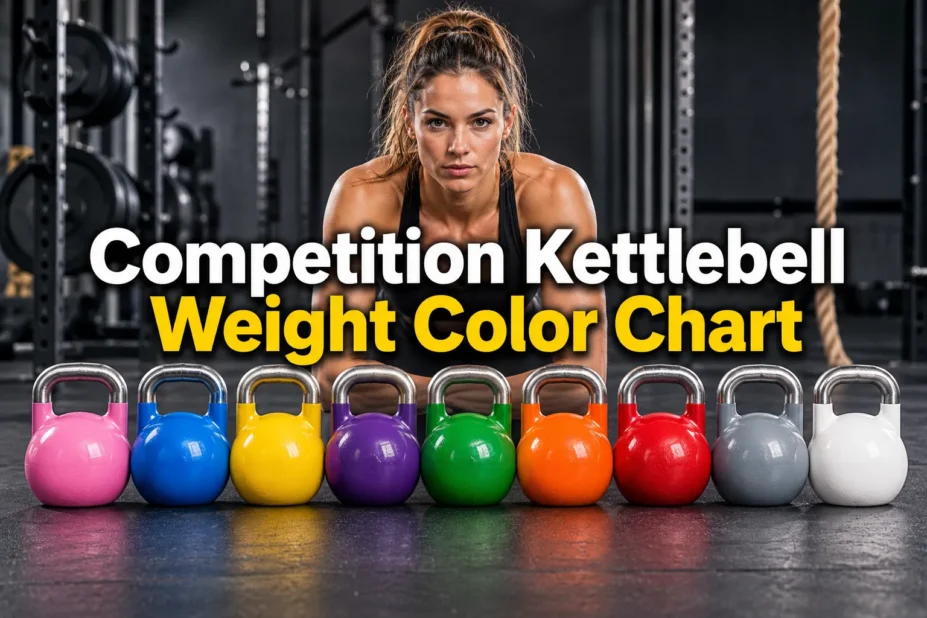
Competition Kettlebell Weight Color Chart
Latest update: November 27, 2026
Quick Answer: Competition Kettlebell Weight Color Charts are a universal visual shorthand that tells you the weight at a glance. The most common consumer palette runs from pink (8 kg) up to gold (48 kg) in 4 kg increments, but official sport federations like the IUKL and WKSF use their own slightly different charts. Understanding this color coding helps you pick the right bell for training, follow competition rules, and avoid mixing up weights during a workout.
Key Takeaways:
- Competition kettlebells use a color-coded system to quickly identify weight, unlike standard cast iron kettlebells that vary in size.
- The most widely recognized chart starts at 8 kg (pink) and goes up to 48 kg (gold) in 4 kg steps.
- Official sport organizations (IUKL, WKSF) have specific color assignments that may differ from the consumer palette.
- Beginners should start with 8 kg (pink) or 12 kg (blue) for technique work, and 16 kg (yellow) is the classic base weight for men.
- Competition kettlebells are more expensive due to uniform size, steel construction, and precision manufacturing, but they offer consistent feel across weights.
- Colors are a training aid, not a strict rule, always verify the actual weight before lifting.
- You can use competition kettlebells for home gym workouts; they are durable and ideal for high-repetition training.
Why Are Competition Kettlebells Different Colors Than Regular Ones?
Competition kettlebells are color-coded so athletes, coaches, and judges can instantly identify the weight during training and events.
Unlike regular cast iron kettlebells that change size and shape as the weight increases, all competition bells share the same external dimensions regardless of weight. That makes a visual label essential.
The color system solves this by assigning a specific hue to each 4 kg increment, from 8 kg to 48 kg and beyond.
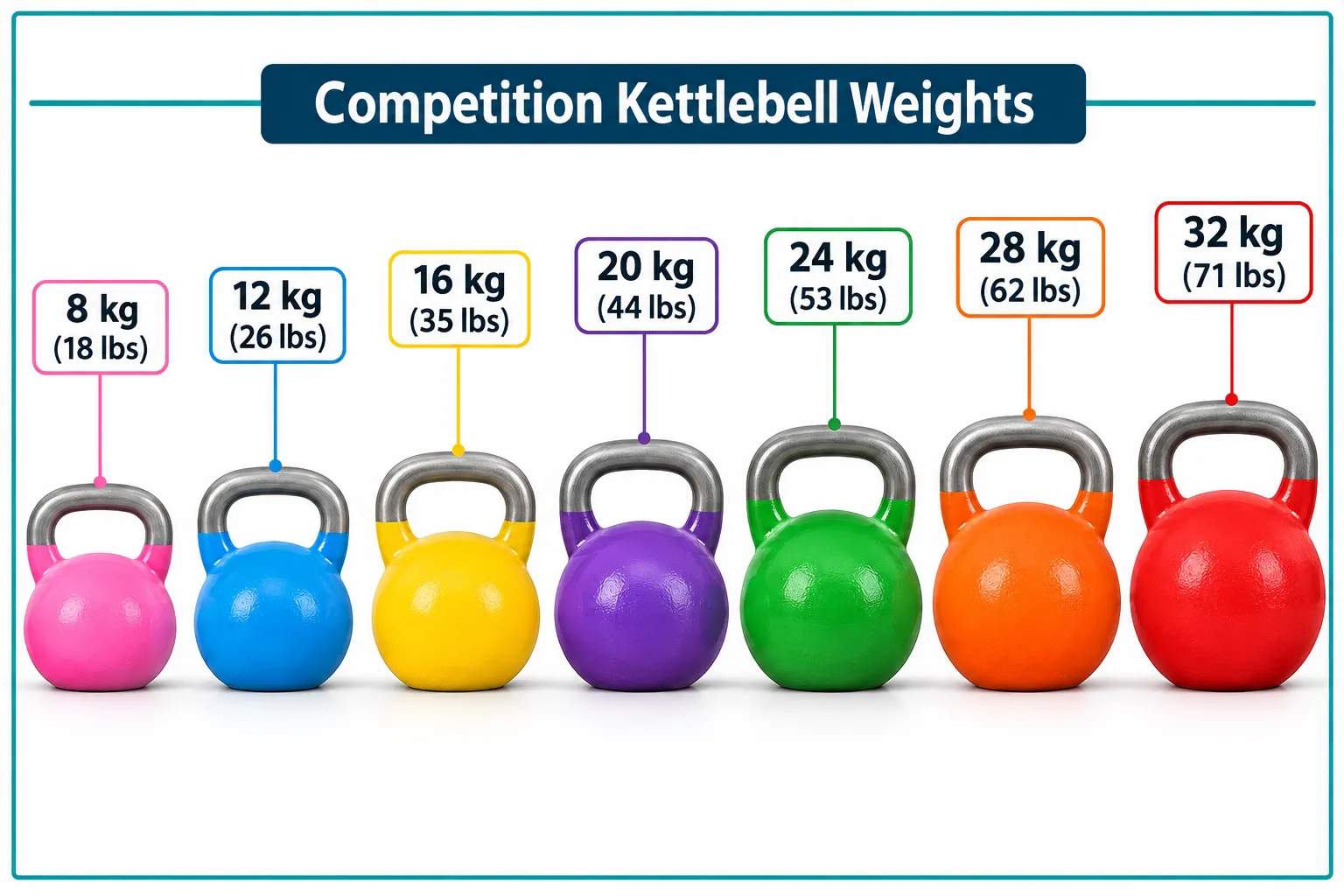
Regular kettlebells, on the other hand, are often just black or grey iron with the weight stamped on them. They get physically larger as the weight goes up, so you can roughly guess the load by size.
But in a fast-paced competition or a crowded gym, that’s not reliable. The color coding on competition bells eliminates guesswork.
You see a pink bell, you know it’s 8 kg. A red one? 32 kg. This consistency is why the sport adopted the system decades ago, and it remains a cornerstone of kettlebell lifting today.
The difference goes deeper than just paint. Competition kettlebells are made of steel and have a hollow core, with the weight adjusted by filling the inside.
This keeps the shell size identical from 8 kg all the way up to 48 kg. Standard kettlebells are typically solid cast iron, so the dimensions grow with each weight.
That uniform feel is a major reason why serious lifters prefer competition bells, you never have to adjust your grip or stance when switching weights.
For a deeper look at how kettlebell training fits into a broader fitness routine, check out our guide on the benefits of kettlebell training.
How Much Does Each Competition Kettlebell Color Weigh?
The conventional color-to-weight mapping used by most manufacturers and training resources is straightforward. Below is the standard consumer chart you will see on brands like Kettlebell Kings, Bells of Steel, and many others.
This palette is what Cavemantraining and other education sites describe as the de facto standard as of 2026. However, it is not universal.
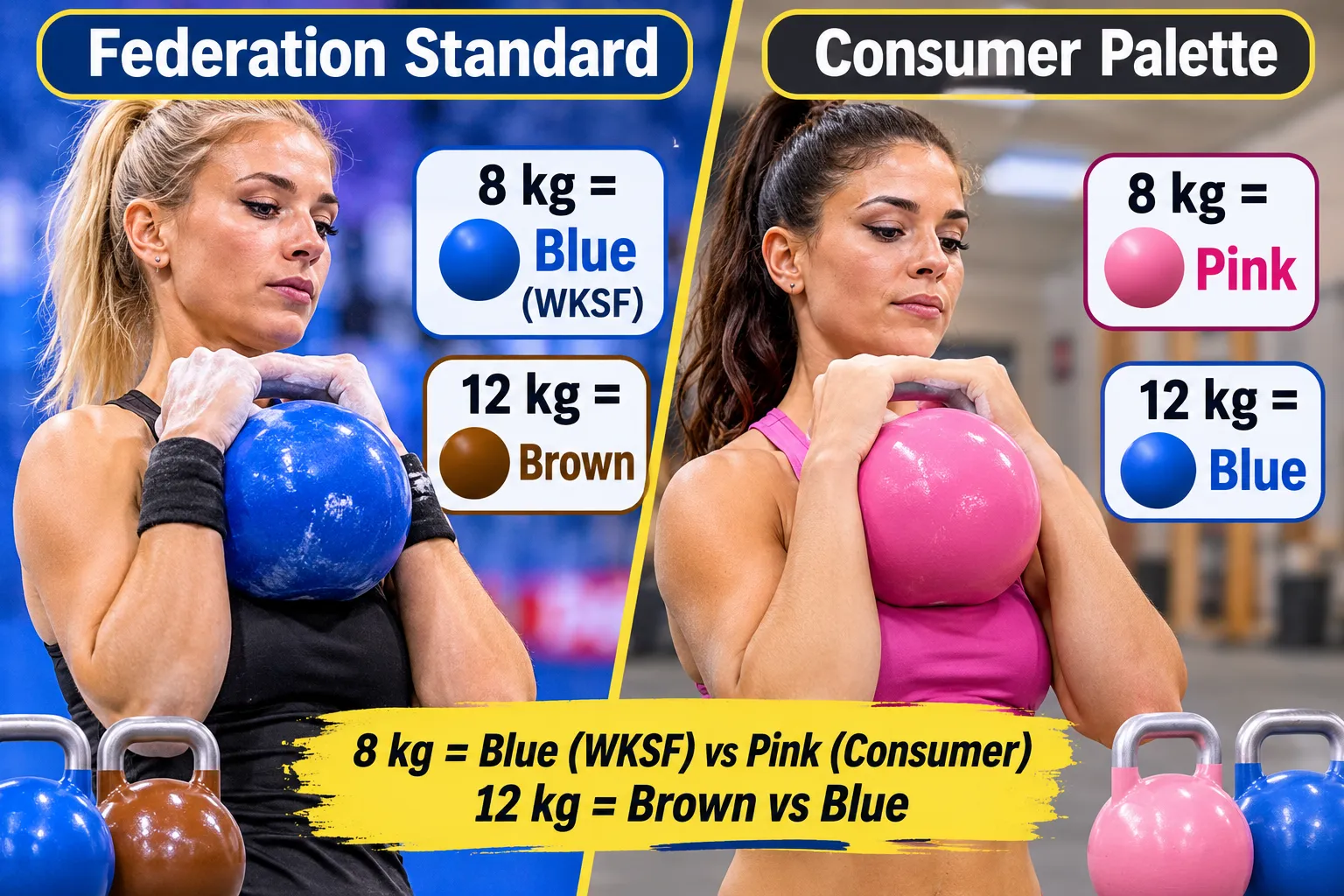
The International Union of Kettlebell Lifting (IUKL) focuses on a core set: 16 kg (yellow), 24 kg (green), 32 kg (red), and 40 kg (bronze). The World Kettlebell Sport Federation (WKSF) uses yet another mapping, for example, 8 kg is blue, 12 kg is brown, and 20 kg is violet.
So while the consumer chart is what you will see in most online stores, always check the specific rules if you plan to compete. For more on how kettlebell weights relate to beginner training, see our article on kettlebell weights for beginners.
Are Competition Kettlebell Colors Standardized Worldwide?
No, competition kettlebell colors are not fully standardized worldwide. There are at least three common systems in use: the conventional consumer palette, the IUKL official chart, and the WKSF competition rules.
While many colors overlap (16 kg is almost always yellow, 24 kg is green, 32 kg is red), there are notable differences, especially at the lighter and heavier ends.
The conventional palette, promoted by major retailers and training sites, assigns pink to 8 kg and blue to 12 kg. But the WKSF rules, updated in 2026, specify blue for 8 kg and brown for 12 kg.
The IUKL does not even include 8 kg in its official competition set; it starts at 16 kg. This lack of uniformity can cause confusion.
A 2026 industry review from Alex Athletics points out that many brands claim to follow IKSF or WKSF standards but actually ship bells with the conventional colors. The result is that a blue kettlebell could be 8 kg, 12 kg, or even 20 kg depending on which chart you are using.
Because of this, experienced lifters and coaches recommend treating color as a helpful guide rather than a guarantee. If you train at a gym that buys from multiple brands, you might see a purple bell that is 20 kg (conventional) or 32 kg (some IKO charts).
Always look for the engraved weight marking or weigh the bell yourself if you are unsure. This is especially important when preparing for a specific competition, check the event’s rulebook for the official color chart they will use.
What’s the Difference Between Competition Kettlebells and Standard Kettlebells?
The core difference is that competition kettlebells are all the same size regardless of weight, while standard kettlebells grow larger as they get heavier. Competition bells are made from steel with a hollow body, and the weight is adjusted internally.
This gives you a consistent grip, rack position, and swing path whether you are using an 8 kg or a 48 kg bell. Standard kettlebells are usually solid cast iron, so a 32 kg bell is physically much bigger than a 16 kg one.
That uniform design is why competition bells need the color coding. Without it, you could not tell a 20 kg from a 24 kg just by looking. Standard bells can be identified by size, but competition bells all look identical except for the color.
This design also makes competition bells more comfortable for high-repetition work because the handle diameter and bell shape never change.
The handle on a competition kettlebell is typically 33 mm or 35 mm in diameter, while standard bells often have thicker, rougher handles that vary between weights.
For home gym users, the choice often comes down to training style. If you plan to do lots of snatches, cleans, and jerks, the classic kettlebell sport lifts, competition bells are worth the investment.
If you are doing general strength work, standard bells or even adjustable kettlebells might serve you just as well. Our best adjustable kettlebell roundup covers options that can replace multiple fixed-weight bells.
Which Kettlebell Color Weight Should I Start With?
For most beginners, the best starting point is the pink 8 kg or blue 12 kg kettlebell. These lighter weights let you practice technique without risking injury. If you are an average-sized woman, 8 kg is a good starting weight for one-arm swings and presses.
For men, 12 kg or 16 kg (yellow) is often recommended. The key is to pick a weight you can control for 10-15 repetitions with perfect form.
The color chart makes it easy to progress. Once you master the 8 kg pink bell, you move to the 12 kg blue, then the 16 kg yellow, and so on. This built-in progression is one reason the system is so popular in gyms and among coaches.
It removes the guesswork from loading. If you are following a specific program, such as a kettlebell workout for weight loss, the color coding helps you quickly switch between weights during circuit training.
A common mistake is starting too heavy because the bell “looks small.” Remember, competition kettlebells are all the same size, so a 32 kg red bell looks identical to an 8 kg pink one. Always check the color and the engraved weight before you lift.
And if you are completely new to kettlebells, consider working with a coach or using a mirror to check your form on basic moves like the swing.
You can also start with just one bell, our guide on can you workout with one kettlebell shows you how to build an effective routine with minimal equipment.
Can I Use Competition Kettlebells for Home Gym Workouts?
Yes, competition kettlebells are excellent for home gym workouts. Their uniform size and smooth steel finish make them comfortable for high-repetition training, and the color coding helps you stay organized when you have multiple weights.
They are also extremely durable, most are made from a single piece of steel with no welds or weak points.
The main downside for home use is the cost. A full set of competition kettlebells from 8 kg to 32 kg can run into the thousands of dollars.
However, many home gym owners start with just two or three bells that cover their most-used weights. For example, a 12 kg (blue) and a 16 kg (yellow) can handle a wide variety of exercises for both men and women.
If space is tight, an adjustable kettlebell might be a better fit, but if you want the authentic sport feel and the convenience of the color system, competition bells are hard to beat.
Because they are designed for thousands of repetitions, competition kettlebells hold up well to daily use. The colored powder coat or vinyl finish resists chipping better than the paint on many standard bells.
Just be sure to store them indoors or in a dry area to prevent rust on the steel surface. For more ideas on how to structure your home workouts, check out our adjustable kettlebell workouts for weight loss article.
How Much Do Competition Kettlebells Cost, and Why Are They So Expensive?
Competition kettlebells typically cost between $1.50 and $3.00 per kilogram, depending on the brand and finish. A single 16 kg (yellow) competition bell might run you $50 to $90, while a 32 kg (red) can be $120 to $180.
A full set from 8 kg to 48 kg can easily exceed $1,500. In contrast, a standard cast iron kettlebell of the same weight often costs half as much.
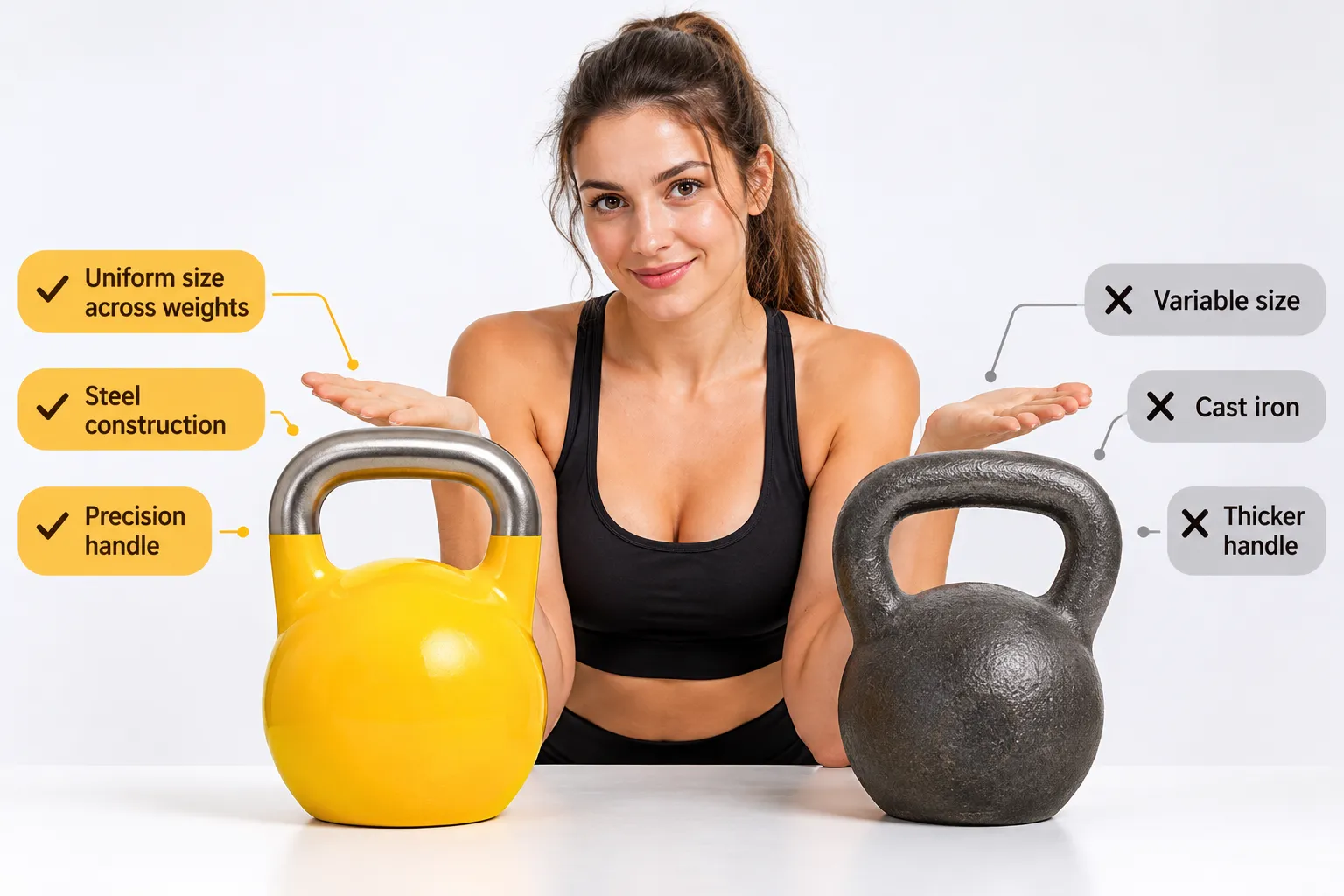
The higher price comes from the manufacturing process. Competition kettlebells are made from steel, which is more expensive than cast iron.
They are hollow and must be precisely filled and balanced so that every bell of a given weight has the exact same dimensions and center of gravity.
The colored finish is also a multi-step process that adds cost. Standard kettlebells are simply cast, ground, and painted, with much looser tolerances.
For a home gym user, the question is whether that precision matters to you. If you compete in kettlebell sport, the answer is yes, you need the consistent feel to perform at your best.
If you are just doing general fitness, a quality standard or adjustable kettlebell may give you 90% of the benefit for 50% of the price.
Our kettlebell swing cardio and weight loss guide shows that you can get an incredible workout with even a single affordable bell.
Do Competition Kettlebell Colors Matter for Training?
The colors themselves do not affect the physical training stimulus, but they matter a lot for organization, safety, and mental focus. In a busy gym or during a timed set, being able to grab the correct weight by color saves time and prevents mistakes.
The psychological aspect is also real, many lifters associate certain colors with specific milestones. Hitting a new personal best with the green 24 kg or the red 32 kg feels like a tangible achievement.
From a coaching perspective, the color system simplifies programming. A coach can say “grab your yellow bell” and everyone knows exactly what to pick up, regardless of brand. This is especially useful in group classes where athletes of different levels might be using different weights.
The colors also make it easier to film and analyze technique, because the weight is immediately identifiable on video.
However, the color system is only as good as its consistency. If you train with bells from multiple manufacturers, you might encounter a situation where a purple bell is 20 kg in one set and 32 kg in another.
That is a real safety risk. Always double-check the engraved weight, and if you are buying bells for a home gym, stick with one brand to keep the colors consistent.
If you ever find a bell whose color does not match the chart you are used to, do not assume, weigh it or check the stamp. The color is a convenience, not a standard you can blindly trust.
Are Competition Kettlebells Worth It Compared to Regular Kettlebells?
For anyone serious about kettlebell sport or high-volume training, competition kettlebells are absolutely worth the extra cost. The uniform size and shape mean your technique stays consistent as you move up in weight, which is critical for efficiency and injury prevention.
The smooth steel handle is also kinder to your hands during hundreds of snatches than the rougher cast iron of most standard bells.
For the general fitness enthusiast, the value proposition is less clear. A good set of standard kettlebells or an adjustable model can provide a fantastic workout for a fraction of the price.
The key deciding factors are your training goals and budget. If you plan to compete or you are a coach running a kettlebell sport program, invest in competition bells.
If you just want to get stronger and fitter at home, you can start with a single 16 kg standard bell and expand as needed.
One often overlooked advantage of competition bells is their resale value. Because they are durable and standardized, used competition kettlebells hold their value well.
You can often sell a set for 60-70% of what you paid, whereas standard bells depreciate more steeply. That makes the initial investment a bit easier to swallow if you ever decide to upgrade or downsize.
Frequently Asked Questions
what do competition kettlebell colors mean
Competition kettlebell colors are a visual code that indicates the weight of the bell. Each color corresponds to a specific kilogram weight, allowing lifters and judges to quickly identify the load without reading a stamped number.
why are competition kettlebells different colors than regular ones
They are different colors because all competition kettlebells share the same external dimensions regardless of weight. Without the color coding, you could not tell a light bell from a heavy one by sight alone. Regular kettlebells change size with weight, so color is not needed for identification.
how much does each competition kettlebell color weigh
The conventional chart assigns 8 kg to pink, 12 kg to blue, 16 kg to yellow, 20 kg to purple, 24 kg to green, 28 kg to orange, 32 kg to red, 36 kg to grey, 40 kg to white, 44 kg to silver, and 48 kg to gold. Official federation charts may differ, especially for lighter weights.
where can i buy competition kettlebells by color
You can buy them from major fitness retailers like Rogue Fitness, Kettlebell Kings, Bells of Steel, and Amazon. Many brands let you filter by weight or color on their websites. Always confirm the weight in kilograms before purchasing, as some brands may use slightly different color assignments.
are competition kettlebell colors standardized worldwide
No, they are not fully standardized. The consumer market follows a common palette, but organizations like the IUKL and WKSF have their own official color charts. This means a blue kettlebell could be 8 kg, 12 kg, or 20 kg depending on the standard being used.
can i use competition kettlebells for home gym workouts
Yes, they work very well for home gyms. Their uniform size and smooth finish make them comfortable for high-rep training, and the color coding helps you stay organized. The main drawback is the higher cost compared to standard kettlebells.
what’s the difference between competition kettlebells and standard kettlebells
Competition kettlebells are all the same size and shape, made from steel with a hollow core, and use color to indicate weight. Standard kettlebells are usually solid cast iron, vary in size with weight, and are typically black or grey with a stamped weight marking.
which kettlebell color weight should i start with
Beginners should start with pink (8 kg) or blue (12 kg) to learn proper technique. Women often start with 8 kg, while men may begin with 12 kg or 16 kg (yellow). Choose a weight you can control for 10-15 reps with good form.
how much do competition kettlebells cost
Prices range from about $1.50 to $3.00 per kilogram. A 16 kg bell might cost $50-$90, while a 32 kg bell can be $120-$180. A full set from 8 kg to 48 kg can exceed $1,500.
do competition kettlebell colors matter for training
The colors themselves do not change the workout, but they are important for safety, organization, and programming. They let you quickly grab the right weight and help coaches manage group sessions. However, you should always verify the actual weight, as colors are not universally consistent.
what if my kettlebell color doesn’t match the chart
If the color does not match the chart you are using, do not assume the weight. Check the engraved weight marking on the bell or weigh it on a scale. Different brands and federations use different color schemes, so mismatches are common.
are competition kettlebells worth it compared to regular kettlebells
For kettlebell sport athletes and high-volume trainers, yes, the uniform feel and durability justify the cost. For casual fitness users, standard or adjustable kettlebells offer better value. Your decision should be based on your training goals and budget.
what kettlebell color is best for beginners
Pink (8 kg) and blue (12 kg) are the best colors for beginners. They allow you to focus on technique without excessive strain. As you build strength and skill, you can progress to yellow (16 kg) and beyond.
why are competition kettlebells so expensive compared to regular ones
They cost more because they are made from steel, require precision manufacturing to maintain uniform size across all weights, and have a multi-step colored finish. Standard kettlebells are simpler to produce from cast iron, which keeps their price lower.