9 Tabata Exercises
Last updated: August 28, 2026
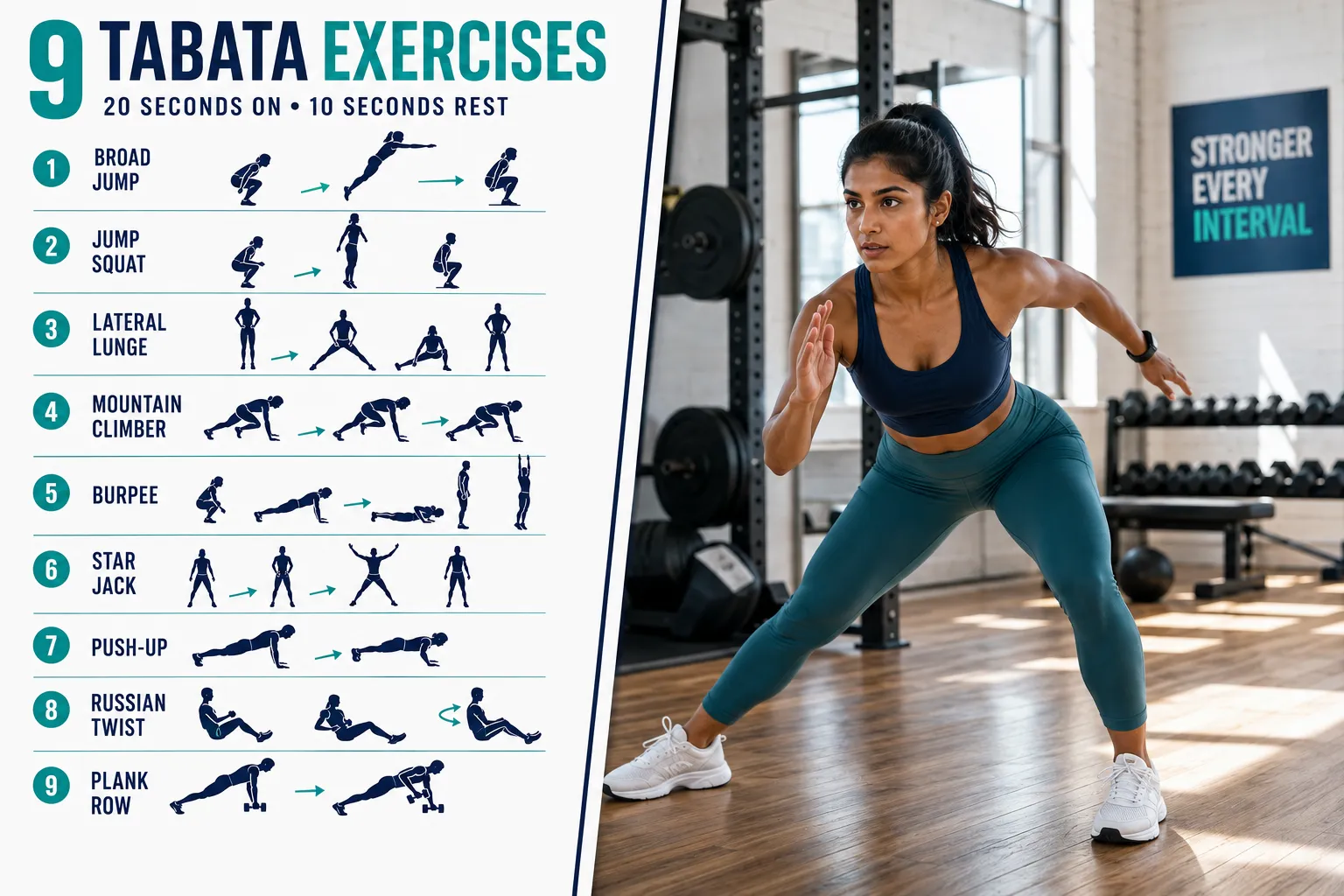
Quick Answer: The 9 Tabata Exercises for a quick workout are broad jump to fast feet, jump squat, lateral lunge to knee drive, lunge chop, mountain climber to single-leg push-up, squat thrust to frog jump, skater to curtsy lunge, Russian twist, and plank with row.
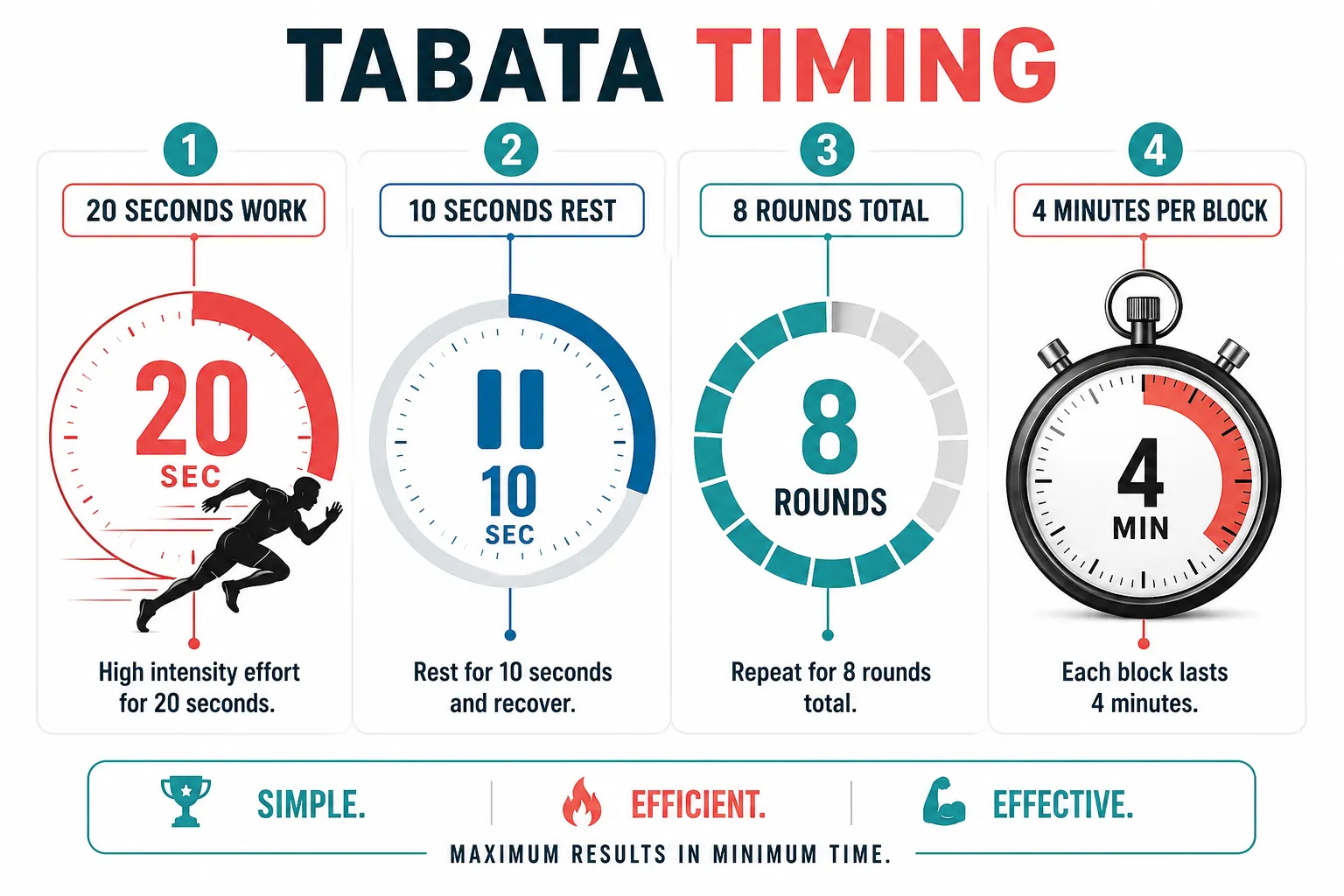
Each exercise follows the classic tabata format of 20 seconds of maximal effort, 10 seconds rest, repeated for 8 rounds, totaling four minutes tabata per block.
This structure makes tabata one of the most time-efficient fitness workout methods available, delivering real cardiovascular and muscular benefits in under 30 minutes.
Key Takeaways
- A classic tabata workout uses 20 seconds of work and 10 seconds rest, repeated 8 times for a total four minutes tabata block.
- The 9 Tabata Exercises in this guide require zero equipment, making them ideal tabata workouts for beginners and experienced athletes alike.
- Bodyweight Tabata workouts are just as effective as weighted versions for cardiovascular conditioning.
- Tabata training was developed by Japanese researcher Dr. Izumi Tabata, whose landmark study showed significant improvements in both aerobic and anaerobic capacity.
- A single four-minute tabata block can burn approximately 13.5 calories per minute, according to research cited by ACE Fitness.
- You can scale tabata-style workouts by adjusting intensity, not timing, making them accessible for most fitness levels.
- Combining multiple tabata blocks into a 20-minute or 30-minute session significantly amplifies fat-burning and conditioning results.
- Proper footwear matters more than most people realize in high-impact tabata training.
Check Current Options Here<—-
What Is Tabata and How Does It Work
Tabata is a specific form of high-intensity interval training (HIIT) that alternates 20 seconds of all-out effort with 10 seconds rest for 8 consecutive rounds, totaling four minutes tabata per exercise block.
The format was developed by Japanese sports scientist Dr. Izumi Tabata and his team at the National Institute of Fitness and Sports in Tokyo.
Their research, published in the journal Medicine and Science in Sports and Exercise, demonstrated that this short, intense structure improved both aerobic and anaerobic fitness more effectively than moderate-intensity steady-state cardio performed for longer durations [1].
The key mechanism behind tabata’s effectiveness is the demand it places on your oxygen-processing systems.
During the 20 seconds of work, you push your muscles into oxygen debt. The 10 seconds rest is just long enough to partially recover, but not enough to fully reset, so each subsequent round compounds the metabolic stress.
This is what makes a tabata workout feel so demanding despite its short duration.
Unlike general HIIT, which can use a wide range of work-to-rest ratios, true tabata training locks in the 20 seconds work and 10 seconds rest repeat structure precisely.
This specificity is what gives tabata its identity as a distinct training protocol rather than just another interval method [7].
Check Current Options Here<—-
Tabata for Beginners: The Basics of Getting Started
Tabata workouts for beginners should start with lower-impact exercise substitutions while keeping the same 20 seconds on, 10 seconds rest timing structure.
The format itself does not need to change; only the intensity and exercise selection need to be scaled to match your current fitness level.
Resources from the University of Wisconsin-Green Bay’s UREC fitness library confirm that beginners can benefit from tabata by simply choosing movements they can sustain safely at a high perceived effort [10].
Before your first tabata workout, keep these points in mind:
- Warm up for at least 5 minutes with light cardio and dynamic stretching before you begin.
- Choose exercises you already know how to perform with correct form. A tabata workout is not the time to learn a new movement pattern.
- Use a tabata timer app or a simple stopwatch. The timing is non-negotiable for the protocol to work.
- Begin with one or two tabata blocks separated by a 1-minute rest, then build up to more blocks over several weeks.
- Wearing supportive shoes matters significantly during jump-heavy sessions. See our guide on the importance of good workout shoes for recommendations.
A common mistake among beginners is going too hard in rounds one and two, then collapsing in effort by round five.
Start at about 80 percent of your maximum effort and aim to maintain that pace across all 8 rounds. Consistency across rounds is the real goal of tabata training.
9 Tabata Exercises: For a Quick Workout You Can Do Anywhere
These 9 tabata exercises for a quick workout require no special equipment and can be performed at home, in a gym, or at a park [1][2].
Each exercise is designed to recruit large muscle groups, which maximizes caloric burn and cardiovascular demand within the short tabata intervals.
After completing one 4-minute block, rest for 60 to 90 seconds, then continue into the next exercise.
Check Current Options Here<—-
1. Broad Jump to Fast Feet
Stand with your feet hip-width apart, bend your knees slightly, then swing your arms and jump forward as far as possible.
Upon landing, immediately begin running in place with quick, short steps (fast feet) for the remainder of the 20 seconds.
This combination trains explosive power and cardiovascular endurance simultaneously. After each 20-second effort, rest 10 seconds, then repeat for 8 rounds total [1].
2. Jump Squat
Begin standing with feet hip-width apart. Lower into a squat until your thighs are parallel to the floor, then drive through your heels and jump as high as possible. Land softly with bent knees and immediately lower back into the next squat. The jump squat is one of the most effective classic tabata exercises for developing lower-body power and spiking heart rate quickly [7].
3. Lateral Lunge to Knee Drive
Start standing, then step your right foot out wide to the side and bend your right knee into a lateral lunge, keeping your left leg straight. Push back to standing and drive your right knee up toward your chest. Alternate sides each rep. This movement trains hip mobility and single-leg stability, which are often neglected in standard tabata workouts [1].
4. Lunge Chop
Stand with feet together, then step forward into a lunge while swinging both arms diagonally across your body as if chopping wood. Push back to standing and repeat on the other side. The rotational component of this movement engages your core more deeply than a standard lunge, making it a special addition to any tabata routine focused on functional fitness.
5. Mountain Climber to Single-Leg Push-Up
Begin in a high plank position. Drive one knee toward your chest, then the other (mountain climbers), for two reps each side. Then perform one push-up, lifting one foot off the ground to increase core demand. This compound tabata exercise targets your chest, shoulders, triceps, and core in a single movement sequence [6].
6. Squat Thrust to Frog Jump
From standing, place your hands on the floor and jump your feet back into a plank position (squat thrust). Then jump your feet forward outside your hands and explode upward into a jump, landing softly. This is a burpee variation that removes the push-up for those who need a modified option. It remains one of the most metabolically demanding tabata exercises available [1][7].
7. Skater to Curtsy Lunge
Jump laterally to your right, landing on your right foot and swinging your left leg behind you in a curtsy lunge. Then jump back to the left and repeat. The lateral movement pattern in this exercise trains the hip abductors and adductors, which standard forward-backward tabata workouts often miss entirely. Greatist highlights this as one of the more special tabata exercises for building lateral stability [1].
8. Russian Twist
Sit on the floor with your knees bent and feet slightly elevated. Lean back slightly to engage your core, then rotate your torso from side to side, touching the floor beside each hip. For added intensity, hold a light weight or water bottle. The Russian twist is a special core-focused tabata exercise that provides a brief but effective break from high-impact movements mid-session [1].
9. Plank with Row
Begin in a high plank position with a light dumbbell in each hand. Row one dumbbell up toward your hip while stabilizing with the opposite arm, then alternate sides. This exercise builds upper-back strength and core anti-rotation stability. If you want to explore more weighted tabata options, our guide on tabata workouts with weights covers programming in detail.
How Long Should a Tabata Workout Be
A single tabata workout can be as short as four minutes if you complete just one block, but most structured sessions run between 20 and 30 minutes when multiple blocks are combined with rest periods.
The ACE Fitness prosource trade june 2014 guide outlines specific 20-minute tabata workout options built from multiple 4-minute intervals separated by one-minute recovery periods [8].
For a practical 20-minute tabata session, you would complete four to five tabata blocks, each featuring a different exercise, with 60 to 90 seconds rest between blocks.
A 30-minute session allows for seven or eight blocks, which is enough to work every major muscle group.
The 9 tabata exercises listed above fit neatly into a 36-minute session when you include rest periods, making them ideal as a complete weekly fitness workout.
Sample 20-minute tabata structure:
- Block 1: Jump squat (4 minutes)
- Rest: 90 seconds
- Block 2: Mountain climber to single-leg push-up (4 minutes)
- Rest: 90 seconds
- Block 3: Skater to curtsy lunge (4 minutes)
- Rest: 90 seconds
- Block 4: Russian twist (4 minutes)
- Rest: 90 seconds
- Block 5: Plank with row (4 minutes)
Tabata vs HIIT: What Is the Difference
Tabata is a specific subset of high-intensity interval training (HIIT), but the two terms are not interchangeable.
HIIT is a broad category that includes any workout alternating high-effort and low-effort periods, with ratios ranging from 1:1 to 1:4 work-to-rest.
Tabata training locks in a precise 20 seconds work, 10 seconds rest, 8 rounds format that was validated through specific research on elite Japanese speed skaters [7][8].
The practical difference matters for programming. A general HIIT session might use 40 seconds of work and 20 seconds of rest, which allows for slightly less maximal intensity.
True tabata demands near-maximal effort because the 10 seconds rest is deliberately insufficient for full recovery. This makes tabata more intense per minute than most HIIT formats, but also shorter in total duration.
For those exploring the broader landscape of interval training, our resource on HIIT kettlebell workouts for burning fat and building muscle offers a complementary approach that pairs well with bodyweight tabata sessions.
Check Current Options Here<—-
Does Tabata Actually Work for Weight Loss
Tabata training is genuinely effective for weight loss when performed consistently and at true high intensity.
A study frequently cited by ACE Fitness found that tabata-style high-intensity interval training can burn approximately 13.5 calories per minute, which is significantly higher than moderate-intensity steady-state cardio [8].
Over a 20-minute session, that translates to roughly 270 calories burned, not including the afterburn effect (excess post-exercise oxygen consumption, or EPOC) that continues for hours after the workout ends.
The weight loss benefit comes from three compounding factors: the high caloric burn during the session, the elevated metabolic rate post-exercise, and the preservation of lean muscle mass that comes from resistance-based tabata exercises like squats and push-ups. T
abata-style workouts that combine strength and cardio movements are particularly effective for body composition changes [7].
That said, tabata is not a replacement for overall caloric management. It is a highly efficient tool within a broader health and fitness strategy, not a standalone solution.
Can You Do Tabata Every Day or Is It Too Intense
Tabata should not be performed at true maximal intensity every single day. Because the protocol demands near-maximal effort, your muscles and central nervous system need 48 hours to recover between full-intensity sessions.
Performing true tabata training daily increases the risk of overtraining, injury, and diminishing returns [7][8].
Most fitness professionals recommend two to four tabata sessions per week for general fitness goals. On recovery days, lower-intensity movement such as walking, yoga, or light stretching supports adaptation without adding excessive stress.
If you want to train daily, you can alternate between high-intensity tabata days and moderate-effort workouts.
For older adults or those newer to exercise, our dedicated guide on tabata workouts for seniors provides modified programming that reduces joint stress while preserving the core benefits of the tabata format.
Do You Need Equipment for Tabata or Just Bodyweight
You do not need any special equipment to perform tabata training. All 9 tabata exercises in this guide are bodyweight movements that require only a flat surface and enough space to jump and lunge freely [1][2][10].
This makes tabata one of the most accessible fitness workout formats available, whether you train at home, while traveling, or at a gym.
That said, adding light dumbbells or kettlebells to certain tabata exercises, such as the plank with row or lunge chop, meaningfully increases the muscular training stimulus without compromising the cardiovascular demand.
If you want to explore equipment-based options, our guide on the best tabata workouts covers both bodyweight and weighted programming in detail.
Equipment options by goal:
- Pure cardio and fat loss: Bodyweight only is sufficient.
- Muscle building and conditioning: Add light dumbbells or a kettlebell to selected exercises.
- Group fitness class setting: Resistance bands or medicine balls work well for tabata-style workouts in a coach group fitness environment.
Tabata Exercises for Bad Knees or Joint Pain
People with knee pain or joint sensitivity can still perform tabata training by substituting high-impact exercises with low-impact alternatives that maintain intensity without compressive force.
Instead of jump squats, use slow-tempo bodyweight squats or wall sits. Instead of broad jumps, use step-out lateral shuffles. The 20 seconds work and 10 seconds rest repeat timing stays exactly the same [10].
The key principle is that tabata intensity comes from effort level, not from impact. A person with knee issues can achieve near-maximal cardiovascular effort through upper-body tabata exercises like push-up variations, plank rows, or battle rope alternatives.
For more guidance on managing lower-body discomfort during exercise, see our resource on the most ideal exercises for lower neck and back pain.
Low-impact tabata exercise substitutions:
- Jump squat becomes: slow squat with isometric hold at the bottom
- Broad jump becomes: lateral step-out with squat
- Skater jump becomes: slow lateral lunge with balance hold
- Mountain climber becomes: slow alternating knee drives from a plank
The Mental Side of 4 Minutes: Why Tabata Works and Why It Lasts
Four minutes sounds trivially short, but anyone who has completed a true tabata block knows it feels considerably longer. This psychological challenge is actually part of why tabata training produces such strong adherence in regular practitioners.
The defined endpoint creates a mental contract: you know exactly when the suffering stops, which makes it easier to push through than an open-ended moderate workout [6][7].
Research on behavior change special to exercise adherence consistently shows that short, intense workouts have higher completion rates than long, moderate ones for time-pressed adults.
The tabata format capitalizes on this by making the commitment feel manageable even when the effort is high. After you begin and find your rhythm across the 8 rounds, the structure itself becomes motivating.
This is also why group fitness settings work so well for tabata. When you join a class where a coach group fitness instructor calls the rounds and keeps the timer, the social accountability amplifies the mental benefits.
Chuze Fitness, for example, has built a popular group fitness program around tabata-style workouts precisely because the format scales well for mixed-ability classes.
Try your next tabata workout at Chuze Fitness if you want a structured, coached environment to push your limits.
Check Current Options Here<—-
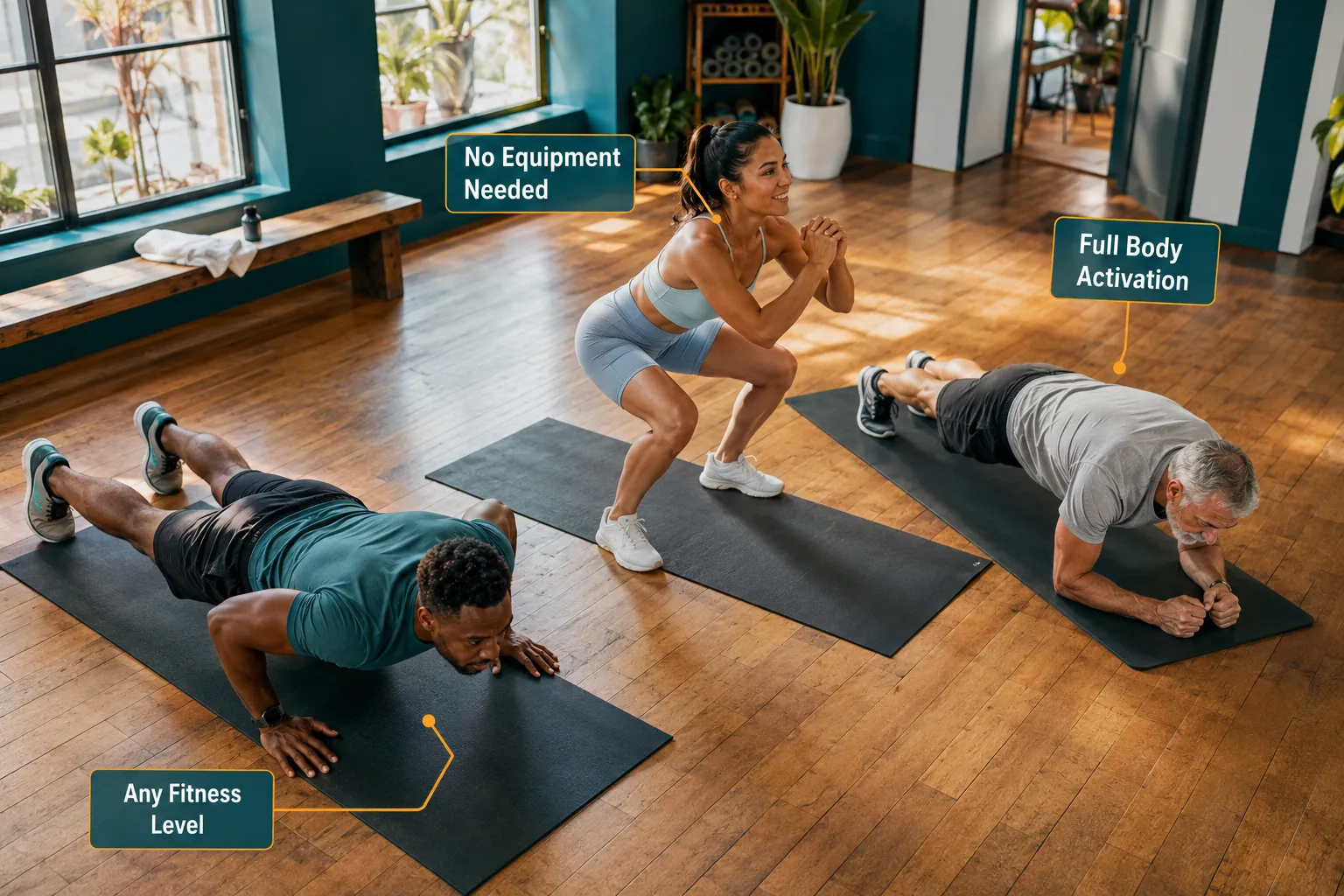
Try Your New Tabata Routine at Chuze Fitness or at Home
Whether you train at a facility like Chuze Fitness or prefer working out at home, the 9 tabata exercises in this guide give you a complete, equipment-free fitness workout that fits into almost any schedule [1][2].
Chuze Fitness locations offer group fitness classes that incorporate tabata-style workouts, making them an excellent option for those who benefit from guided instruction and community motivation.
For home training, all you need is a tabata timer (free apps are widely available), enough floor space to jump and lunge, and a pair of supportive shoes.
If you are new to this style of training, our guide on tabata workouts for beginners walks through the exact progressions to follow in your first four weeks.
Getting started this week:
- Download a free tabata timer app.
- Choose three exercises from the list above.
- Complete each as a separate 4-minute block with 90 seconds rest between blocks.
- Track how many reps you complete in each 20-second interval.
- Aim to match or beat that number in your next session.
Check Current Options Here<—-
FAQ: 9 Tabata Exercises for a Quick Workout
What are 10 examples of exercises to use for Tabata?
Ten effective tabata exercises include jump squats, push-ups, burpees, mountain climbers, broad jumps to fast feet, lateral lunges to knee drives, skaters to curtsy lunges, Russian twists, plank with rows, and star jacks. Each of these recruits large muscle groups, which maximizes cardiovascular demand within the 20-seconds work and 10-seconds rest repeat structure. All can be performed without equipment, making them ideal for home or gym tabata workouts [1][7].
What is an easy Tabata workout for beginners?
An easy tabata workout for beginners starts with three low-impact exercises: slow bodyweight squats, modified push-ups from the knees, and alternating step-back lunges. Perform each as a separate 4-minute tabata block (20 seconds work, 10 seconds rest, 8 rounds), with 90 seconds rest between blocks. This approach keeps the classic tabata timing intact while reducing joint stress. As fitness improves over two to four weeks, swap in higher-impact versions of the same movements [10][8].
What are some good 30-minute Tabata workouts?
A good 30-minute tabata workout includes seven 4-minute tabata blocks, each using a different exercise, separated by 60-second rest periods. A strong sequence would be: jump squat, push-up, mountain climber, lunge chop, skater, Russian twist, and plank with row. This covers lower body, upper body, and core across the full session. The total comes to 28 minutes of structured work and rest, with a brief warm-up and cool-down filling the remaining time [8][1].
Can you show me a 10 minute Tabata workout?
A 10-minute tabata workout uses two 4-minute blocks with a 2-minute rest in between. Block one: jump squats for all 8 rounds (20 seconds on, 10 seconds rest). Block two: mountain climbers for all 8 rounds. This structure is simple, requires no equipment, and delivers a complete cardiovascular stimulus in just 10 minutes. It is an ideal starting point for those new to tabata training or for days when time is genuinely limited [2][10].
Conclusion
The 9 Tabata Exercises for a quick workout covered in this guide give you a complete, science-backed training system that fits into four minutes per block and requires nothing more than your bodyweight and a timer.
From the broad jump to fast feet that opens the sequence to the plank with row that closes it, each exercise was selected to maximize full-body muscular recruitment and cardiovascular demand within the strict 20 seconds work, 10 seconds rest repeat structure.
Start with two or three blocks this week. Track your rep counts in each 20-second interval, then try to maintain or improve those numbers in your next session.
That simple progression is the core of effective tabata training, and it works whether you are a complete beginner or a seasoned athlete looking for a time-efficient fitness workout.
If you want to expand beyond bodyweight, explore our guide on tabata workouts with weights for the next step in your training.
And if you are ready to invest in a quality timer or training tool to support your sessions, Check Current Options Here<—-
References
[1] Best Tabata Moves – https://greatist.com/fitness/best-tabata-moves
[2] 9 Min Tabata Workout – https://evofitness.at/en/blog/move/9-min-tabata-workout/
[3] Watch – https://www.youtube.com/watch?v=89ZZ1UN_xE8
[4] Tabata Workout 9 Chair – https://www.sixpackguineapigs.com/tabata-workout-9-chair
[5] Watch – https://www.youtube.com/watch?v=4HGuifzAJqk
[6] bustle – https://www.bustle.com/wellness/tabata-cardio-workouts/amp
[7] Tabata Exercises – https://www.bodi.com/blog/tabata-exercises
[8] Get It Done 20 Minute Tabata Workout Options – https://www.acefitness.org/continuing-education/prosource/june-2014/4858/get-it-done-20-minute-tabata-workout-options/
[9] 9 Minuten Tabata Workout – https://evofitness.at/de/blog/move/9-minuten-tabata-workout/
[10] Tabata – https://www.uwgb.edu/urec/fitness/library/tabata/